CLASS 11-HUMANITIES . POLITICAL SCIENCE . INDIA CONSTITUTION AT WORK . RIGHTS IN-THE-INDIAN-CONSTITUTION
Chapter 2 : Rights In The Indian Constitution
Ch 2
POLITICAL SCIENCE
CLASS 11-HUMANITIES
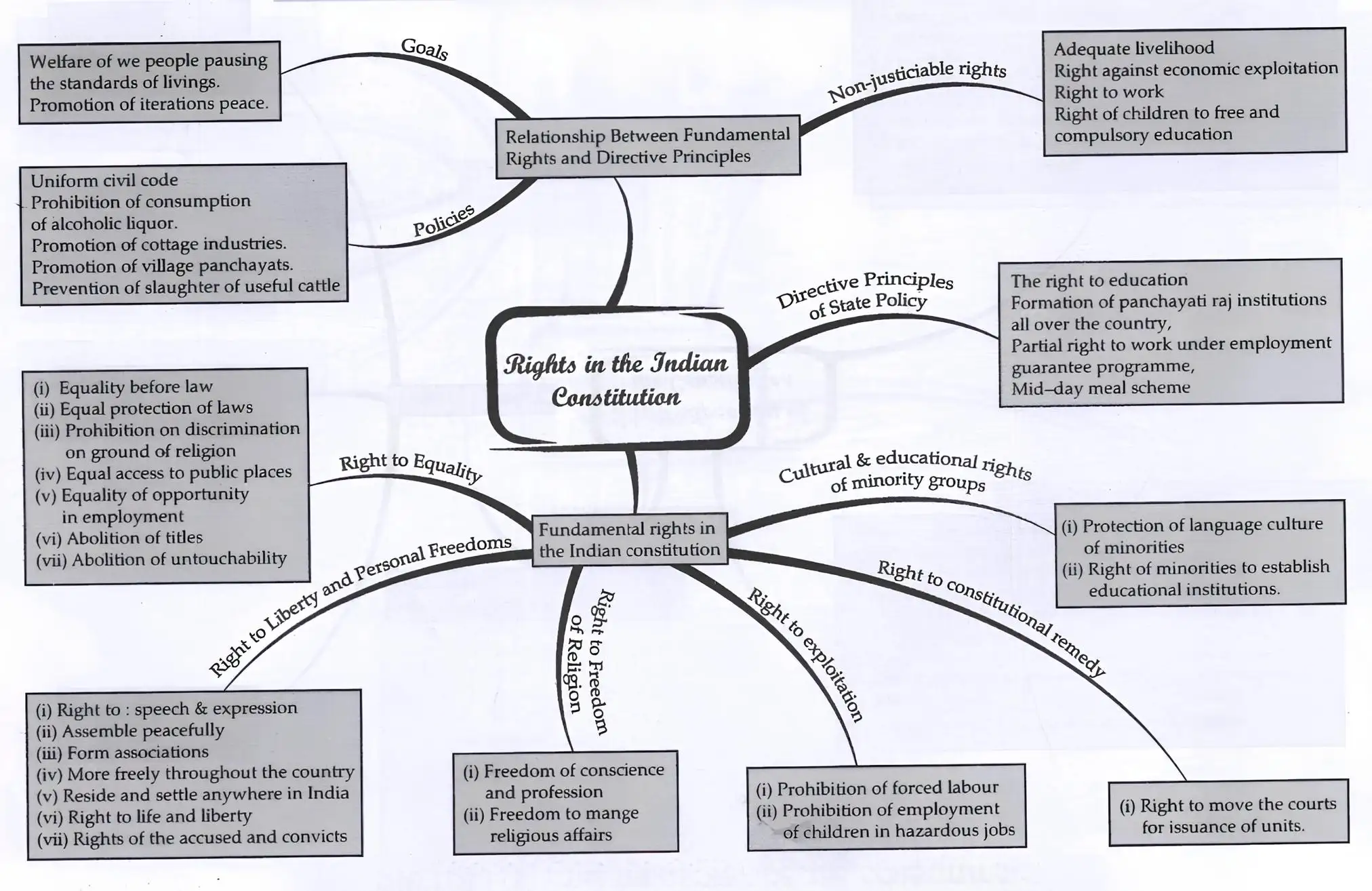
Fundamental Rights
A democracy must ensure that individuals have certain rights that the government recognises and protects. The Constitution of India lists these rights as Fundamental Rights, which are so important that they have special provisions for their protection. Unlike ordinary legal rights, Fundamental Rights can only be changed by amending the Constitution.
Fundamental Rights include:
- Right to Equality: Equality before law, prohibition of discrimination on grounds of religion, race, caste, sex, or place of birth, abolition of untouchability and titles, equal access to public places, and equality of opportunity in public employment.
- Right to Freedom: Freedom of speech and expression, peaceful assembly, forming associations, movement throughout India, practicing any profession, protection in conviction for offences, right to life and personal liberty, right to education, and protection against arbitrary arrest and detention.
- Right against Exploitation: Prohibition of trafficking in human beings, forced labour, and employment of children in hazardous jobs.
- Right to Freedom of Religion: Freedom of conscience, profession, practice and propagation of religion, management of religious affairs, payment of taxes for promotion of religion, and attendance at religious instruction in educational institutions.
- Cultural and Educational Rights: Protection of language and culture of minorities, and right of minorities to establish educational institutions.
- Right to Constitutional Remedies: Right to move courts for enforcement of Fundamental Rights through writs such as habeas corpus, mandamus, prohibition, quo warranto, and certiorari.
Fundamental Rights are not absolute; reasonable restrictions can be imposed by the government. Preventive detention is allowed for up to three months under certain conditions. The Constitution also ensures fair trial rights, such as protection against double jeopardy, no retrospective criminal laws, and protection against self-incrimination.
Exam Questions
Q1: What is the significance of Fundamental Rights in the Indian Constitution?
Answer: Fundamental Rights are essential guarantees provided by the Constitution to protect individual freedoms and ensure equality, liberty, and justice. They are enforceable by courts and can only be amended through constitutional procedures.
Q2: Name any two writs issued by courts to protect Fundamental Rights.
Answer: Habeas Corpus and Mandamus are two writs issued to protect Fundamental Rights.
Directive Principles of State Policy
The Directive Principles of State Policy are guidelines for the government to establish social and economic democracy. These principles are not enforceable by courts but are fundamental in governance to promote welfare and justice.
Goals of Directive Principles include:
- Welfare of the people
- Social, economic, and political justice
- Raising the standard of living
- Equitable distribution of resources
- Promotion of international peace
Policies suggested include:
- Uniform civil code
- Prohibition of alcohol consumption
- Promotion of cottage industries
- Prevention of slaughter of useful cattle
- Promotion of village Panchayats
Non-justiciable rights under Directive Principles include adequate livelihood, equal pay for equal work, right against economic exploitation, right to work, and early childhood care and education.
The 42nd Amendment added Fundamental Duties for citizens, such as respecting the Constitution, National Flag, National Anthem, promoting harmony, protecting the environment, and striving for excellence.
Exam Questions
Q1: What are Directive Principles of State Policy?
Answer: Directive Principles are guidelines in the Constitution that direct the government to create policies aimed at social and economic welfare. They are not enforceable by courts.
Q2: Mention any two Fundamental Duties of Indian citizens.
Answer: To respect the National Flag and National Anthem, and to protect and improve the natural environment.
Solved Examples
Example 1: Explain the difference between Fundamental Rights and Directive Principles.
Solution: Fundamental Rights are justiciable rights guaranteed by the Constitution that individuals can enforce in courts. Directive Principles are non-justiciable guidelines for the government to frame policies for social welfare and justice.
Example 2: What is the significance of the Right to Constitutional Remedies?
Solution: The Right to Constitutional Remedies allows citizens to approach courts to enforce their Fundamental Rights, making it a vital safeguard against violations.
Practice Set
Easy
- What is meant by the Right to Equality?
- Name any two Fundamental Rights related to freedom.
Moderate
- Explain the importance of Directive Principles of State Policy.
- What are the limitations on Fundamental Rights?
Challenging
- Discuss the role of Fundamental Duties in the Indian Constitution.
- Describe the different writs available under the Right to Constitutional Remedies.
Answer Key
- Right to Equality: Equality before law and prohibition of discrimination.
- Two Fundamental Rights related to freedom: Freedom of speech and expression, Freedom to assemble peacefully.
- Importance of Directive Principles: They guide the government to create policies for social welfare and justice.
- Limitations on Fundamental Rights: Reasonable restrictions can be imposed for public order, morality, and security.
- Role of Fundamental Duties: To remind citizens of their responsibilities towards the nation and society.
- Writs under Right to Constitutional Remedies: Habeas Corpus, Mandamus, Prohibition, Quo Warranto, Certiorari.
Quick Reference
- Fundamental Rights: Equality, Freedom, Protection against Exploitation, Freedom of Religion, Cultural and Educational Rights, Constitutional Remedies.
- Directive Principles: Guidelines for welfare, justice, and equitable resource distribution.
- Fundamental Duties: Respect Constitution, National Symbols, promote harmony, protect environment.
- Writs: Legal orders to protect rights and ensure justice.
Glossary
- Begar: Forced labour without payment.
- Constitutional Remedies: Legal protections to enforce Fundamental Rights.
- Duties: Responsibilities of citizens to respect others' rights.
- Exploitation: Injustice or unfair treatment of others.
- Marginalised Communities: Social groups often ignored or disadvantaged.
- Minorities: Groups with fewer members than the majority in society.
- Rights: Guarantees to live a respectful and dignified life.