CLASS 11-HUMANITIES . POLITICAL SCIENCE . POLITICAL THEORY . NATIONALISM
Chapter 7 : NATIONALISM
Ch 7
POLITICAL SCIENCE
CLASS 11-HUMANITIES
Nationalism
The Republic Day parade in Delhi is a striking symbol of Indian nationalism, reflecting the power, strength, and diversity associated with the Indian nation. Nationalism is a complex concept without a single, precise definition. Historically, nationalism has undergone many phases, including the unification of small kingdoms into larger nation-states and the breakup of large empires.
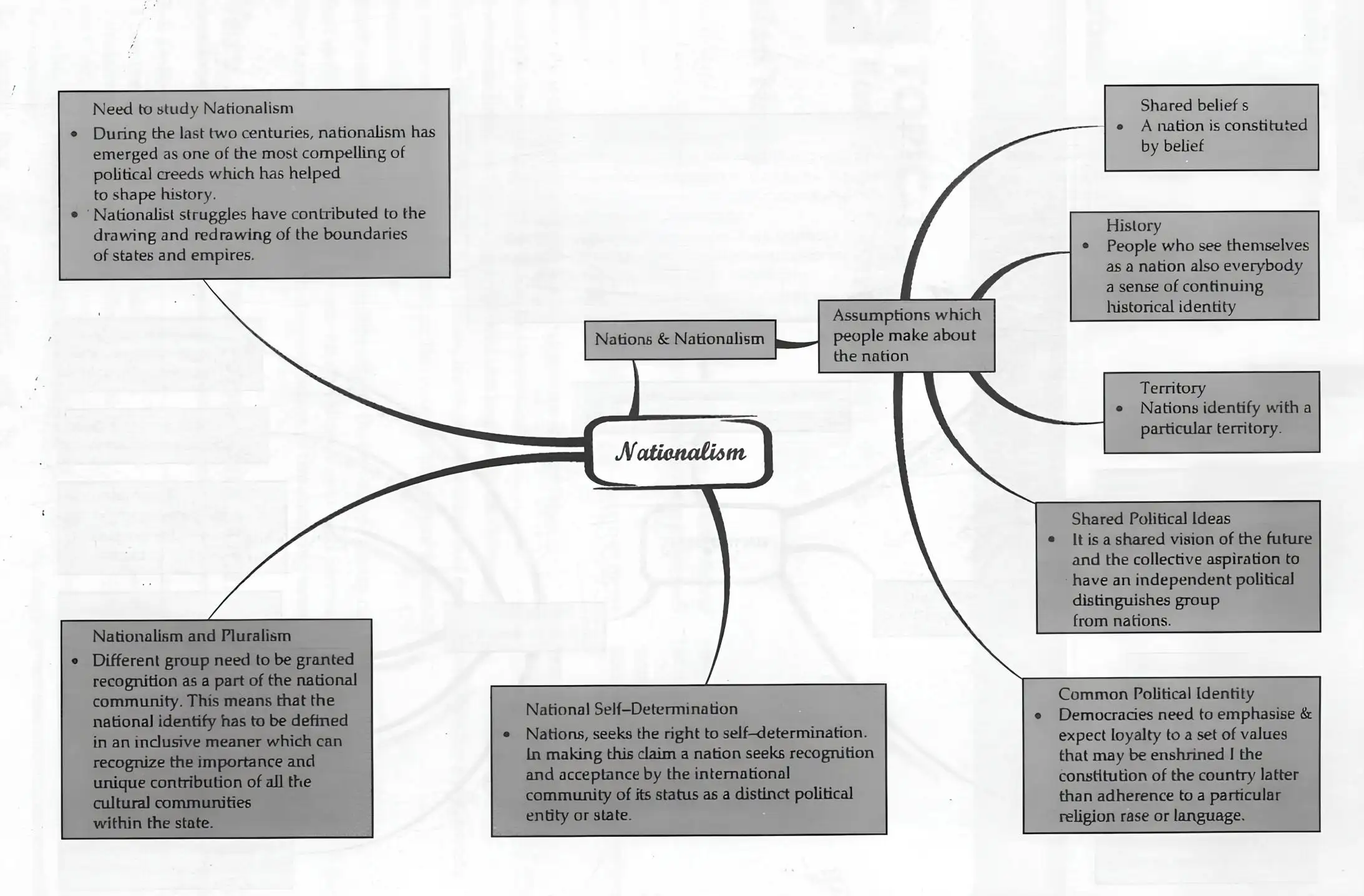
People commonly assume several characteristics about a nation:
- Shared beliefs: A nation exists when its members believe they belong together.
- History: Nations perceive themselves as having a continuous past and future.
- Territory: Nations identify with a specific geographical area.
- Shared political ideals: Members share a vision of the state they want to build.
- Common political identity: A shared political vision binds individuals as a nation.
Nations seek the right to govern themselves and determine their future development. The reorganisation of state boundaries to satisfy the demand for one culture-one state has led to mass migrations across state boundaries. A paradox exists where nation-states that gained independence through struggle sometimes act against minorities within their territories who claim self-determination.
Every state today faces the challenge of addressing movements for self-determination. The solution lies not in creating new states but in making existing states more democratic and equal. A nation-state that does not respect the rights and cultural identities of minorities will struggle to gain loyalty from its members.
The Indian Constitution includes provisions to protect religious, linguistic, and cultural minorities. Some states grant identified communities the right to representation in legislative bodies and other institutions. National identity must be inclusive, recognizing the unique contributions of all cultural communities within the state.
It is neither possible nor desirable to grant independent statehood to every distinct cultural group. Identity claims should not lead to divisions or violence. In a democracy, political identity should encompass the diverse identities of its citizens.
Subtopics
Assumptions about the Nation
People believe that a nation is formed based on shared beliefs, a common history, a defined territory, shared political ideals, and a common political identity.
Exam Question: What are the key assumptions that define a nation?
Answer: A nation is defined by shared beliefs among its members, a sense of common history, identification with a specific territory, shared political ideals, and a common political identity that binds individuals together.
Challenges of Nationalism in Modern States
Modern nation-states face challenges such as managing demands for self-determination from minorities and ensuring democratic equality to maintain loyalty among diverse groups.
Exam Question: What challenges do nation-states face regarding nationalism and self-determination?
Answer: Nation-states face the challenge of addressing minority demands for self-determination while maintaining democratic equality and respecting cultural identities to ensure loyalty and unity.
Role of the Indian Constitution in Protecting Minorities
The Indian Constitution provides protections for religious, linguistic, and cultural minorities, including rights to representation in legislative bodies.
Exam Question: How does the Indian Constitution protect minorities?
Answer: The Constitution includes provisions to safeguard the rights of minorities and grants some communities the right to representation in legislative and state institutions.
Inclusive National Identity
National identity should be inclusive, recognizing the contributions of all cultural communities and preventing divisions or violence based on identity claims.
Exam Question: Why is an inclusive national identity important in a democracy?
Answer: An inclusive national identity ensures that all cultural communities feel recognized and valued, which helps maintain unity and prevents divisions or violence in a democracy.
Mind Map Explanation
The mind map illustrates the importance of nationalism, assumptions about nations, pluralism, and self-determination. It highlights nationalism's role in shaping countries and borders, the beliefs that define nations, the desire for self-governance, recognition of cultural diversity, and the expectation of loyalty to common democratic values.
Exam Question: What key ideas about nationalism are presented in the mind map?
Answer: The mind map presents nationalism as a force shaping nations and borders, based on shared beliefs and identity, emphasizing self-governance, cultural diversity, and loyalty to democratic values.
Solved Examples
Example 1: Explain how nationalism contributed to the unification of small kingdoms into larger nation-states.
Answer: Nationalism fostered a shared sense of identity and political vision among people in small kingdoms, encouraging them to unite under a common nation-state to achieve self-governance and collective strength.
Example 2: Why is it important for a nation-state to respect the rights of minorities?
Answer: Respecting minority rights ensures their loyalty and participation in the nation, preventing conflicts and promoting unity within a diverse society.
Practice Set
Easy
- Define nationalism in your own words.
- List two assumptions people make about nations.
Moderate
- Explain the paradox faced by nation-states regarding self-determination movements.
- Describe how the Indian Constitution protects minorities.
Challenging
- Discuss why creating new states is not always the solution to demands for self-determination.
- Analyze the importance of an inclusive national identity in a diverse democracy.
Answer Key
Easy
- Nationalism is the belief in the right of a nation to govern itself and maintain a shared identity.
- Assumptions include shared beliefs and identification with a territory.
Moderate
- Nation-states that gained independence may suppress minority self-determination claims, creating a paradox.
- The Indian Constitution protects minorities through legal provisions and representation rights.
Challenging
- Creating new states can lead to further divisions and is not always practical; strengthening democracy is preferred.
- An inclusive national identity promotes unity and respects diversity, essential for democratic stability.
Quick Reference
- Nationalism: The right of a nation to self-determination and governance.
- Nation: An imagined community with shared beliefs, history, territory, and political identity.
- State: A sovereign group of people living in a defined territory under organized government.
- Self-determination: The right of a nation to decide its political status and future.
- Inclusive National Identity: Recognition and respect for all cultural communities within a nation.
Glossary
- Nationalism: The ideology advocating for the political independence and unity of a nation.
- Nation: A community of people bound by shared culture, history, and political aspirations.
- State: A political entity with sovereignty over a defined territory and population.
- Self-determination: The principle that nations have the right to govern themselves.
- Minority Rights: Legal protections for groups differing in religion, language, or culture within a state.
| Year | Event | Significance |
|---|---|---|
| 19th Century | Rise of Nationalism in Europe | Led to unification of countries like Germany and Italy. |
| Early 20th Century | Breakup of Empires | Collapse of Austro-Hungarian and Ottoman Empires, formation of new nation-states. |
| 1947 | Indian Independence | Creation of a democratic nation-state with constitutional protections for minorities. |
| Post-1947 | Reorganisation of States in India | States reorganised on linguistic and cultural lines to accommodate diversity. |