CLASS 11-HUMANITIES . POLITICAL SCIENCE . INDIA CONSTITUTION AT WORK . LOCAL GOVERNMENTS
Chapter 8 : Local Governments
Ch 8
POLITICAL SCIENCE
CLASS 11-HUMANITIES
Local Governments in India — Need and Growth
Local government refers to the system of governance at the village and district levels. It plays a crucial role in ensuring active participation of citizens and accountability in administration. When the Indian Constitution was framed, the subject of local government was assigned to the States, allowing them to manage local governance.
In 1952, the Community Development Programme recommended the establishment of a three-tier Panchayati Raj System for rural areas to promote decentralized governance and development.
Exam Questions
Q1: What is the significance of local governments in India?
Answer: Local governments ensure active participation of citizens and accountability in administration at the village and district levels, helping to address local issues effectively.
Q2: What was recommended by the Community Development Programme in 1952?
Answer: It recommended a three-tier Panchayati Raj System of local government for rural areas to promote decentralized governance.
Constitutional Amendments and their Implementation
In 1989, the P K Thungon Committee recommended constitutional recognition for local government bodies. This led to the 73rd and 74th Amendments to the Indian Constitution, which came into force in 1993.
The 73rd Amendment pertains to rural local governments known as Panchayati Raj Institutions, while the 74th Amendment relates to urban local governments.
Key changes brought by the 73rd Amendment include:
- Establishment of a three-tier Panchayati Raj structure: Gram Panchayat at the base, Mandal or Block Panchayat at the intermediate level, and Zila Panchayat at the apex. It also mandated the creation of the Gram Sabha.
- Direct elections for all three levels of Panchayati Raj institutions with a five-year term.
- Reservation of one-third of seats for women and proportional reservations for Scheduled Castes and Scheduled Tribes.
- Transfer of 29 subjects from the State List to Panchayati Raj Institutions.
- Appointment of independent State Election Commissioners to conduct Panchayat elections.
- Formation of State Finance Commissions every five years to review the financial status of local governments.
The Census of India defines an urban area based on population size, occupational pattern, and population density.
India has approximately 500 Zila Panchayats, 6,000 block Panchayats, 2,50,000 Gram Panchayats in rural areas, and over 100 city Corporations, 1,400 town municipalities, and 2,000 Nagar Panchayats in urban areas.
More than 32 lakh members are elected to these local bodies every five years, including at least 10 lakh women, which is significantly higher than the number of elected representatives in State Assemblies and Parliament.
However, local bodies often depend on State and Central governments for financial support, which limits their operational effectiveness.
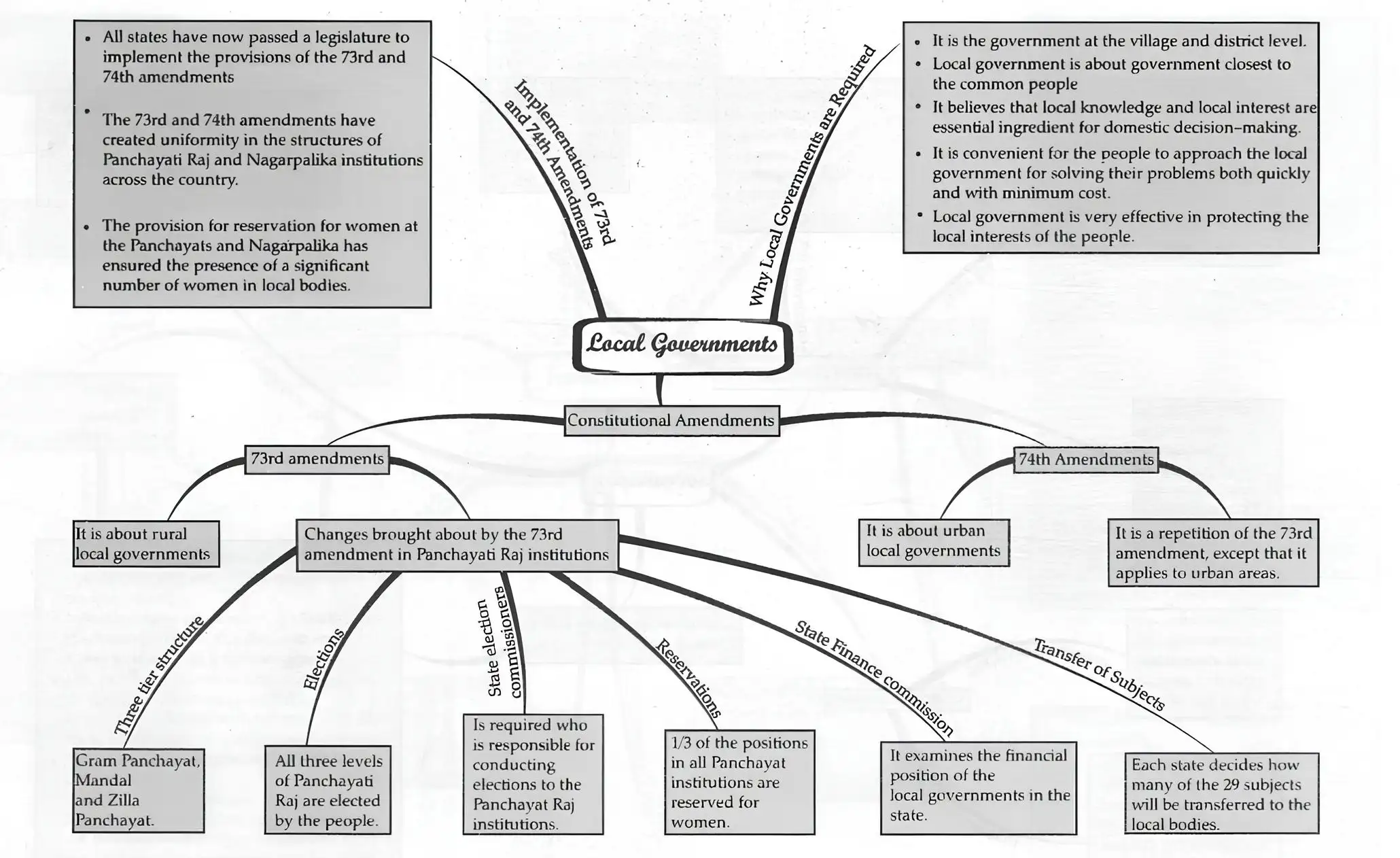
This flowchart illustrates the structure and functions of local governments in India, highlighting the impact of the 73rd and 74th Constitutional Amendments on rural and urban local bodies.
Exam Questions
Q1: What are the main features of the 73rd Constitutional Amendment?
Answer: The 73rd Amendment established a three-tier Panchayati Raj system, direct elections with five-year terms, reservations for women and marginalized groups, transfer of 29 subjects to Panchayats, appointment of independent State Election Commissioners, and formation of State Finance Commissions.
Q2: How does the 74th Amendment relate to urban local governments?
Answer: The 74th Amendment provides constitutional provisions for urban local governments, similar to the 73rd Amendment for rural areas, ensuring democratic governance in cities.
Know the Terms
Local Government: The government at the village and district level that deals with routine problems of the citizens.
Mandal: A group of Gram Panchayats forming an intermediate level in the Panchayati Raj system.
Mayor: The formal head of a Municipal Corporation.
Panchayati Raj: An organ of local government responsible for administration and development of villages.
Zila Panchayat: A group of Mandals forming the apex level in the Panchayati Raj system.
Exam Questions
Q1: Define Panchayati Raj.
Answer: Panchayati Raj is a system of local government responsible for the administration and development of villages through elected bodies.
Q2: What is a Mandal in the context of local government?
Answer: A Mandal is an intermediate level in the Panchayati Raj system, consisting of a group of Gram Panchayats.
Solved Examples
Example 1: Explain the significance of the 73rd Constitutional Amendment.
Solution: The 73rd Amendment provided constitutional status to Panchayati Raj Institutions, ensuring democratic decentralization, regular elections, reservation for marginalized groups, and transfer of powers and responsibilities to local bodies, thereby strengthening rural governance.
Example 2: What are the criteria used by the Census of India to define an urban area?
Solution: An urban area is defined by a minimum population of 5,000, at least 75% of the male working population engaged in non-agricultural activities, and a population density of at least 400 persons per square kilometer.
Practice Set
Easy
- What is the role of local governments?
- Define Gram Panchayat.
Moderate
- List the key features of the 73rd Constitutional Amendment.
- Explain the structure of Panchayati Raj Institutions.
Challenging
- Discuss the impact of financial dependence on the effectiveness of local governments.
- Compare the provisions of the 73rd and 74th Amendments.
Answer Key
Easy:
1. Local governments manage administration and development at village and district levels, ensuring participation and accountability.
2. Gram Panchayat is the lowest tier of Panchayati Raj Institutions at the village level.
Moderate:
1. Features include three-tier structure, direct elections, reservations, transfer of subjects, independent election commissioners, and finance commissions.
2. The structure includes Gram Panchayat (base), Mandal/Block Panchayat (intermediate), and Zila Panchayat (apex).
Challenging:
1. Financial dependence limits local governments' autonomy and ability to function effectively.
2. The 73rd Amendment deals with rural local bodies, while the 74th Amendment addresses urban local bodies; both provide constitutional status and democratic governance.
Quick Reference
- Local governments operate at village and district levels.
- 73rd Amendment: Panchayati Raj Institutions for rural areas.
- 74th Amendment: Urban local bodies.
- Three-tier Panchayati Raj: Gram Panchayat, Mandal Panchayat, Zila Panchayat.
- Reservations for women and marginalized groups.
- State Election Commissioners conduct local elections.
- State Finance Commissions review finances every five years.
Glossary
Local Government: Government at the village and district level responsible for local administration.
Panchayati Raj: System of rural local governance with elected bodies.
Gram Panchayat: The village-level elected body in Panchayati Raj.
Mandal: Intermediate level grouping several Gram Panchayats.
Zila Panchayat: District-level Panchayat overseeing Mandals.
State Election Commissioner: Independent officer conducting local body elections.
State Finance Commission: Body reviewing financial status of local governments.