CLASS 11-HUMANITIES . POLITICAL SCIENCE . INDIA CONSTITUTION AT WORK . LEGISLATURE
Chapter 5 : Legislature
Ch 5
POLITICAL SCIENCE
CLASS 11-HUMANITIES
Legislature
Parliament and its Need
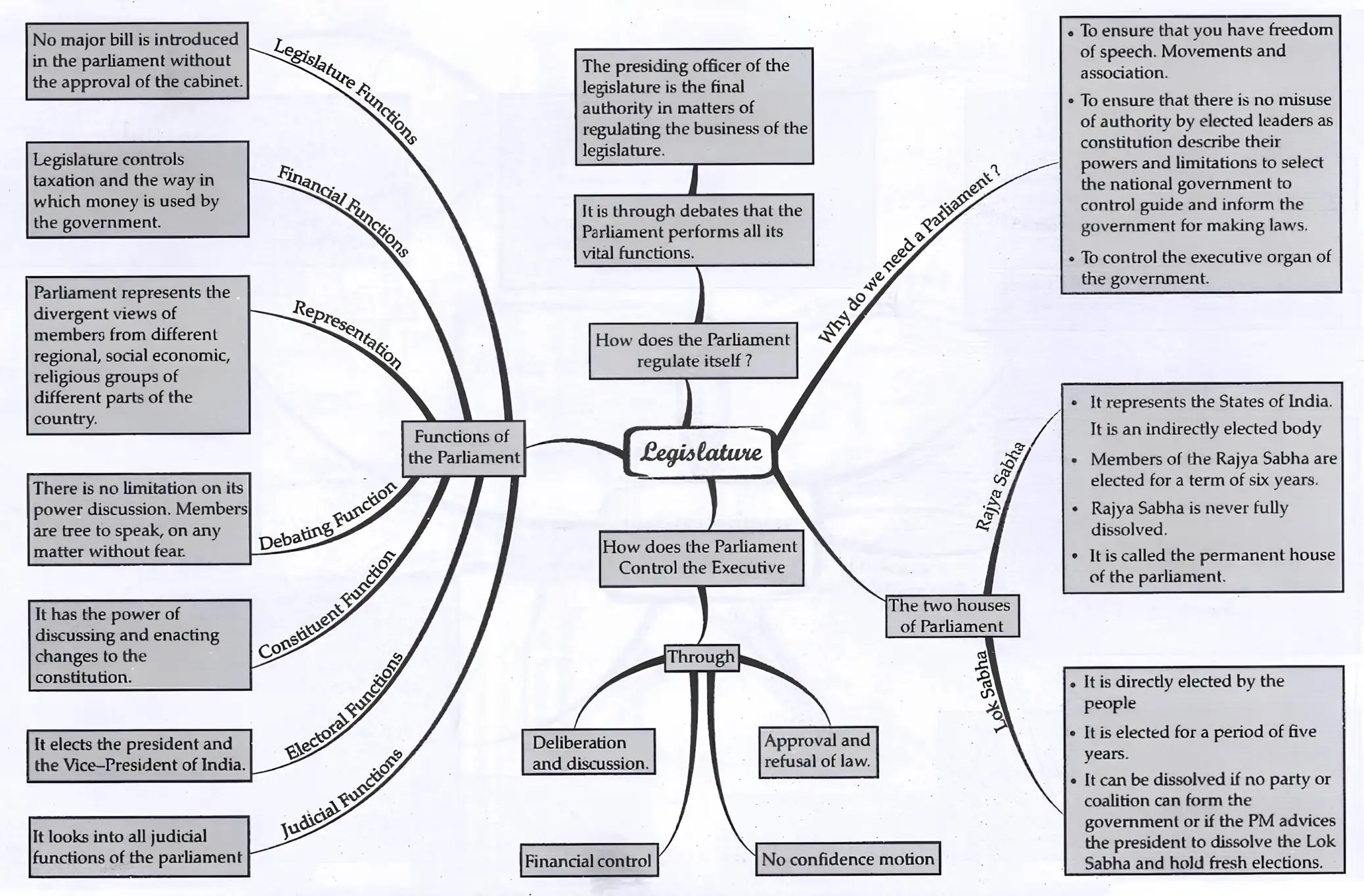
The term ‘Parliament’ refers to the national legislature of India. The legislature of the states is called the State Legislature. When the legislature has two houses, it is known as a bicameral legislature. The Indian Parliament consists of two Houses: the Council of States (Rajya Sabha) and the House of the People (Lok Sabha).
The Constitution allows states to have either a unicameral or bicameral legislature. Currently, seven states—Andhra Pradesh, Bihar, Jammu & Kashmir, Karnataka, Maharashtra, Telangana, and Uttar Pradesh—have bicameral legislatures.
A bicameral legislature ensures that every decision is reconsidered, meaning every bill and policy is discussed twice. The Rajya Sabha represents the States and is indirectly elected by the elected members of the State Legislative Assemblies. Representation in the Rajya Sabha follows two principles: symmetrical representation (equal representation regardless of size or population) and asymmetrical representation (representation based on population).
The number of Rajya Sabha members from each state is fixed by the Fourth Schedule of the Constitution. Members serve six-year terms and can be re-elected. One-third of the members retire every two years, so the Rajya Sabha is never fully dissolved and is called the Permanent House.
The President nominates twelve members to the Rajya Sabha from distinguished fields such as literature, science, art, and social service. The Lok Sabha and State Legislative Assemblies are directly elected by the people. Currently, there are 543 Lok Sabha constituencies. The Lok Sabha is elected for five years but can be dissolved earlier if no party or coalition forms the government.
Exam Questions
Q1: What is a bicameral legislature? Why is it important?
A1: A bicameral legislature has two houses. It is important because it allows every decision to be reconsidered, ensuring thorough discussion of bills and policies.
Q2: How are members of the Rajya Sabha elected?
A2: Members of the Rajya Sabha are indirectly elected by the elected members of the State Legislative Assemblies.
Functions and Powers of Parliament
The Parliament performs several key functions:
- Legislative Function: Enacts laws.
- Control of Executive: Ensures the executive does not exceed its authority and remains accountable.
- Financial Function: Controls taxation and government spending.
- Representation: Represents diverse regional, social, economic, and religious groups.
- Debating Function: Analyzes national issues through discussion.
- Constituent Function: Discusses and enacts constitutional changes.
- Electoral Functions: Elects the President and Vice President of India.
- Judicial Functions: Considers proposals for removal of the President, Vice President, and High Court judges.
Special Power of Rajya Sabha: It can approve the transfer of a subject from the State List to the Union or Concurrent List in the national interest.
Exclusive Powers of Lok Sabha: The Rajya Sabha cannot initiate, reject, or amend money bills and cannot remove the government, though it can criticize it.
Exam Questions
Q1: What are the financial powers of the Parliament?
A1: The Parliament controls taxation and government expenditure, granting resources to implement government programs.
Q2: What special power does the Rajya Sabha have regarding the State List?
A2: The Rajya Sabha can approve the transfer of a subject from the State List to the Union or Concurrent List in the interest of the nation.
Working of the Parliament
A bill is a draft of a proposed law. Bills introduced by non-ministers are called Private Members’ Bills, while those introduced by ministers are Government Bills. The concerned ministry prepares the draft of any bill.
Once a bill is passed by both Houses, it is sent to the President for assent. The President’s assent enacts the bill into law.
Members enjoy parliamentary privilege, meaning no action can be taken against them for statements made in the legislature.
Instruments of Parliamentary Control include:
- Deliberation and discussion
- Question Hour: Held daily during sessions, ministers answer questions from members.
- Zero Hour: Members raise important matters freely.
- Half-an-hour discussion on public importance matters
- Adjournment motion
- Approval and ratification of laws
- Financial control
- No Confidence motion
There has been a decline in the number of sessions and time spent on debates. Issues like absence of quorum and opposition boycotts have weakened parliamentary control over the executive.
India has developed parliamentary standing committees that supervise departments, budgets, expenditures, and bills. Joint Parliamentary Committees (JPCs) are formed to discuss particular bills, with members from both Houses.
The presiding officer regulates the business of the legislature. The anti-defection law prevents legislators from switching parties after election. Defection leads to loss of membership and disqualification from political office.
Exam Questions
Q1: What is the significance of the Question Hour in Parliament?
A1: Question Hour allows members to question ministers and hold the executive accountable.
Q2: What is the anti-defection law?
A2: It is a law that disqualifies members who defect from their party after being elected, preventing political instability.
Glossary
- Bill: A proposed law presented to Parliament for discussion.
- Budget: Annual account of government income and expenditure.
- Deadlock: Equal votes for and against a bill or matter.
- Defection: Political misconduct where a member leaves or votes against their party.
- Ordinance: Law made by the President when Parliament is not in session, later approved by Parliament.
- Question Hour: Time during sessions when members question ministers.
- Zero Hour: Time when members raise important issues freely.
Quick Reference
- Parliament = Rajya Sabha + Lok Sabha
- Rajya Sabha = Permanent House, indirectly elected, 6-year term
- Lok Sabha = Directly elected, 5-year term, can be dissolved
- Functions: Legislative, Financial, Executive Control, Representation, Debating, Constituent, Electoral, Judicial
- Instruments of control: Question Hour, Zero Hour, No Confidence Motion
- Anti-defection law prevents party switching
Solved Examples
Example 1: Explain why the Rajya Sabha is called the Permanent House.
Solution: The Rajya Sabha is called the Permanent House because it is never fully dissolved. One-third of its members retire every two years, ensuring continuity.
Example 2: What happens when a bill is passed by both Houses of Parliament?
Solution: After both Houses pass a bill, it is sent to the President for assent. Once the President gives assent, the bill becomes law.
Practice Set
Easy
- What are the two Houses of the Indian Parliament?
- Who nominates members to the Rajya Sabha?
Moderate
- Describe the financial functions of the Parliament.
- What is the significance of the anti-defection law?
Challenging
- Explain the process of how a bill becomes a law in India.
- Discuss the special powers of the Rajya Sabha and exclusive powers of the Lok Sabha.
Answer Key
- Easy 1: Rajya Sabha and Lok Sabha.
- Easy 2: The President nominates members to the Rajya Sabha.
- Moderate 1: Parliament controls taxation, government spending, and grants resources for government programs.
- Moderate 2: The anti-defection law prevents members from switching parties after election, maintaining political stability.
- Challenging 1: A bill is drafted, introduced in either House, passed by both Houses, and then sent to the President for assent to become law.
- Challenging 2: Rajya Sabha can approve transfer of subjects from State List; Lok Sabha has exclusive powers over money bills and can remove the government.
Chronology of Important Parliamentary Features
| Time Period / Year | Event / Change | Importance |
|---|---|---|
| 1950 | Constitution of India comes into effect | Establishment of Parliament and State Legislatures |
| 1952 | First General Elections held | Formation of first Lok Sabha and Rajya Sabha |
| 1985 | Anti-Defection Law enacted | Prevents political defections and instability |
| Present | Standing Committees and Joint Parliamentary Committees active | Improved legislative scrutiny and control over executive |