CLASS 11-HUMANITIES . POLITICAL SCIENCE . POLITICAL THEORY . FREEDOM OVERVIEW
Chapter 2 : FREEDOM OVERVIEW
Ch 2
POLITICAL SCIENCE
CLASS 11-HUMANITIES
Freedom Overview
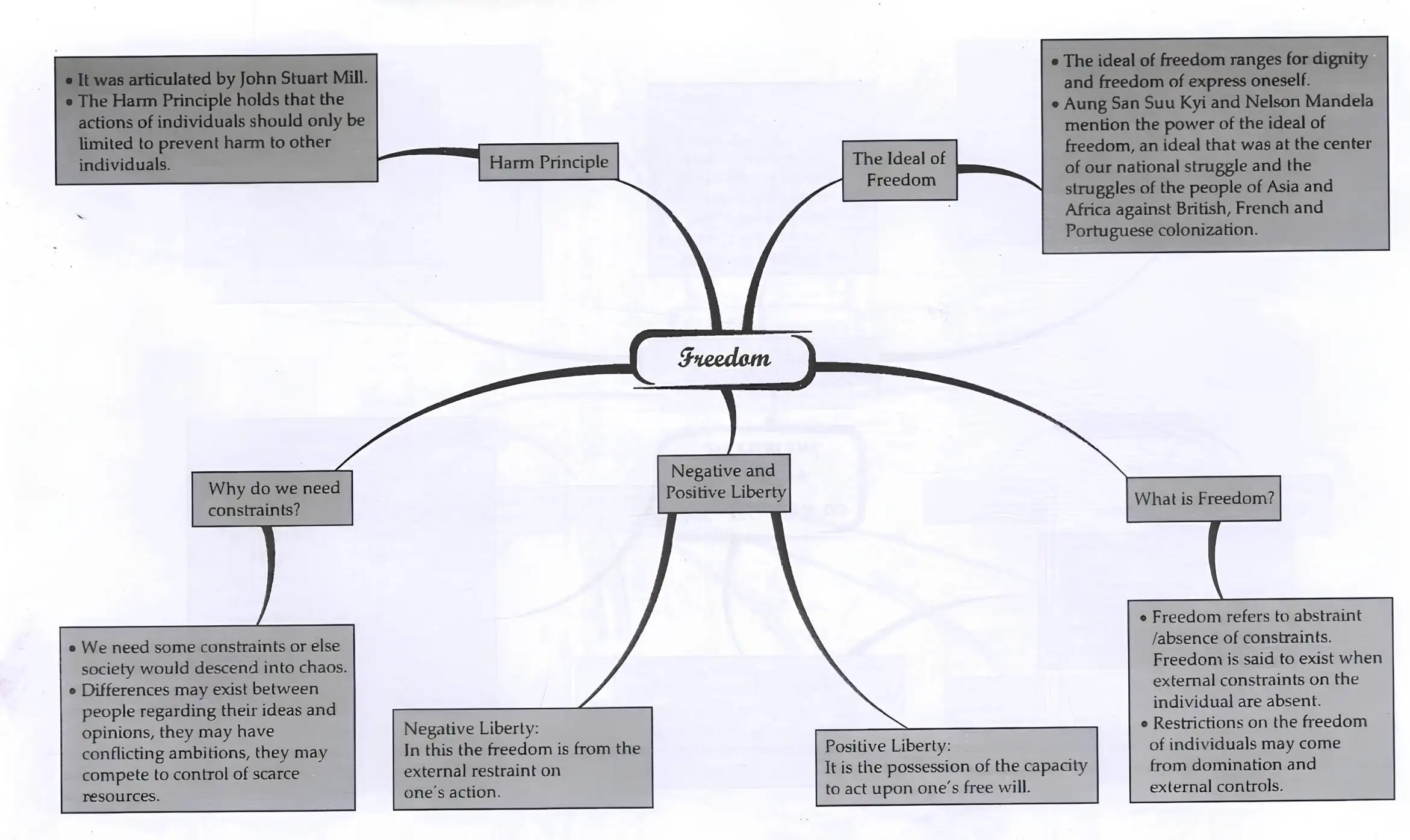
The autobiography of Nelson Mandela, titled Long Walk to Freedom, narrates his personal struggle against the apartheid regime in South Africa. It highlights the resistance of black South Africans to segregationist policies, and the humiliations, hardships, and police brutalities they endured. Similarly, Aung San Suu Kyi, in her book Freedom from Fear, emphasizes that living a dignified human life requires overcoming fear.
The term ‘Swaraj’ combines two words: Swa (self) and Raj (rule), meaning both self-rule and rule over oneself. Freedom can be simply defined as the absence of constraints. It involves expanding individuals' ability to express themselves freely and develop their potential. A free society widens the space where individuals, groups, communities, or nations can chart their own destiny and be what they wish to be.
Freedom allows the full development of an individual's creativity, sensibilities, and capabilities. However, some political and legal restraints are necessary to ensure that differences are discussed and debated without coercion. Liberalism acknowledges the role of the welfare state and supports measures to reduce social and economic inequalities. The state can justifiably constrain actions that cause harm to others, but such constraints should be minimal and not destroy freedom itself.
Hate campaigns cause serious harm to others' freedom and can be legally constrained. However, society must avoid developing a habit of imposing restrictions, as this is detrimental to freedom. Negative liberty defines an inviolable area where individuals can "do, be, or become" whatever they wish without interference. Positive liberty refers to the freedom to govern oneself, answering the question "Who governs me?" with "I govern myself." Freedom of expression is a fundamental value, and society must tolerate some inconvenience to protect it from restrictions. Voltaire famously stated, "I disapprove of what you say but I will defend to death your right to say it." Banning speech may provide short-term relief but harms long-term freedom by fostering a habit of censorship. True freedom is not curtailed if one is not coerced into accepting conditions.
Exam Questions
Q1. What does the term ‘Swaraj’ mean?
Answer: ‘Swaraj’ means self-rule and rule over oneself, combining the words ‘Swa’ (self) and ‘Raj’ (rule).
Q2. Why are some political and legal restraints necessary in a free society?
Answer: Restraints are necessary to ensure that differences can be discussed and debated without coercion, preventing one group from imposing its views on others.
Q3. Explain the difference between negative liberty and positive liberty.
Answer: Negative liberty is freedom from external interference, allowing individuals to act without constraints. Positive liberty is the freedom to govern oneself and act according to one’s own will.
Harm Principle and Constraints on Freedom
The Harm Principle, articulated by John Stuart Mill, states that individual actions should only be limited if they cause harm to others. Freedom means having no restrictions, but limits are justified to protect people from domination or harm. Constraints imposed by law should only occur when other measures fail to prevent serious harm to individuals.
Hate campaigns and actions causing serious harm to others justify legal constraints. However, constraints must not be so severe as to destroy freedom itself. Society must avoid habitual restrictions, as this undermines freedom. Freedom of expression is a core value that society must protect, even if it causes some inconvenience. Banning speech is a short-term solution that harms long-term freedom by encouraging censorship habits.
Exam Questions
Q1. What is the Harm Principle?
Answer: The Harm Principle states that individual actions should only be restricted if they cause harm to others.
Q2. Why should society avoid habitual restrictions on freedom?
Answer: Habitual restrictions are detrimental because they destroy freedom itself and encourage a culture of censorship.
Q3. How does freedom of expression relate to the Harm Principle?
Answer: Freedom of expression is fundamental, but it can be limited only when it causes serious harm to others, in line with the Harm Principle.
Types of Liberty
Negative liberty refers to the absence of external constraints, allowing individuals to act freely without interference. Positive liberty is the capacity to act according to one’s own free will and govern oneself. Both concepts are essential to understanding freedom. Negative liberty protects individuals from coercion, while positive liberty emphasizes self-governance and empowerment.
Freedom of expression is considered part of the minimum area of non-interference. Society must tolerate some inconvenience to protect this freedom. Voltaire’s statement, “I disapprove of what you say but I will defend to death your right to say it,” underscores the importance of protecting free speech even when disagreeing with it.
Exam Questions
Q1. Define negative liberty.
Answer: Negative liberty is freedom from external control or restraint, allowing individuals to act without interference.
Q2. What does positive liberty emphasize?
Answer: Positive liberty emphasizes the ability to govern oneself and act according to one’s own free will.
Q3. Why is freedom of expression important in a free society?
Answer: Freedom of expression allows individuals to share their views and is fundamental to democracy; protecting it ensures diverse opinions can be heard.
Glossary
- Apartheid: Racial discrimination between Whites and Blacks, mainly after World War II.
- Economic liberty: Ensuring earning opportunities and minimum wages for citizens.
- Freedom: A situation limiting constraints on individuals, allowing them to expand their abilities and potential.
- Freedom of expression: The right to express one’s views through speech, writing, etc.
- Legal liberty: The freedom of a country to draft and enforce its own constitution and govern accordingly.
- Natural liberty: The right of a person to be born free.
- Personal liberty: Freedom in individual matters like marriage and food.
- Political liberty: Freedom to choose representatives, contest elections, and participate in government.
- Religious liberty: Freedom to follow and spread any religion without state interference except in special circumstances.
Quick Reference
- Swaraj: Self-rule and rule over oneself.
- Harm Principle: Actions should be limited only if they harm others.
- Negative Liberty: Freedom from external interference.
- Positive Liberty: Freedom to govern oneself.
- Freedom of Expression: Fundamental right to express views.
- Constraints: Necessary legal and political limits to protect freedom.
Solved Examples
Example 1: Explain why some constraints on freedom are necessary in a society.
Solution: Constraints are necessary to prevent harm to others and to ensure that different groups can coexist peacefully without coercion. They help maintain order and protect the rights of all individuals.
Example 2: Differentiate between negative and positive liberty with examples.
Solution: Negative liberty is freedom from interference, such as the right to speak without censorship. Positive liberty is the ability to act on one’s own will, such as participating in democratic governance.
Practice Set
Easy
- What is the meaning of Swaraj?
- Define freedom of expression.
- Who wrote Long Walk to Freedom?
Moderate
- Explain the Harm Principle.
- What is the difference between negative and positive liberty?
- Why is it important to avoid habitual restrictions on freedom?
Challenging
- Discuss the role of the state in balancing freedom and constraints.
- Analyze the significance of freedom of expression in a democratic society.
- Explain how freedom allows the development of individual creativity and potential.
Answer Key
- Easy:
- Swaraj means self-rule and rule over oneself.
- Freedom of expression is the right to express one’s views through speech, writing, etc.
- Nelson Mandela wrote Long Walk to Freedom.
- Moderate:
- The Harm Principle states that actions should only be limited if they harm others.
- Negative liberty is freedom from interference; positive liberty is freedom to govern oneself.
- Habitual restrictions harm freedom by fostering censorship and limiting rights.
- Challenging:
- The state balances freedom and constraints by protecting individuals from harm while ensuring liberty.
- Freedom of expression is vital for democracy as it allows diverse opinions and accountability.
- Freedom enables individuals to develop creativity, sensibilities, and capabilities fully.
| Year | Event | Significance |
|---|---|---|
| 1948 | Nelson Mandela begins struggle against apartheid | Highlighted fight for racial equality and freedom |
| 1960s | John Stuart Mill articulates Harm Principle | Foundation for limiting freedom only to prevent harm |
| 1980s | Aung San Suu Kyi writes Freedom from Fear | Emphasizes overcoming fear for dignified life |