CLASS 11-HUMANITIES . POLITICAL SCIENCE . INDIA CONSTITUTION AT WORK . FEDERALISM
Chapter 7 : Federalism
Ch 7
POLITICAL SCIENCE
CLASS 11-HUMANITIES
Federalism and Its Place in the Indian Constitution
India is a country characterized by unity in diversity, where a federal system of government operates to accommodate this diversity. In this system, there are two levels of government: the Union (Central) Government and the State Governments. Each government is autonomous within its own sphere, and the people have dual identities as members of their region and the nation.
The Indian Constitution clearly defines the powers and responsibilities of the Union and the States through a written constitution, which is supreme. An independent judiciary resolves disputes between the two levels of government. The federal system in India is based on cooperation between the Centre and the States.
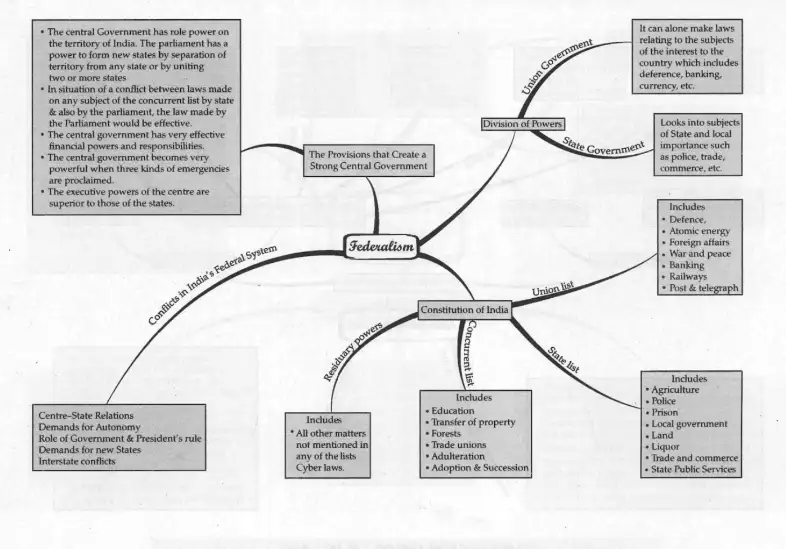
The Constitution divides subjects into three lists:
- Union List: Subjects on which only the Union Parliament can legislate, such as defence, atomic energy, foreign affairs, banking, railways, post and telegraph, airways, ports, foreign trade, currency, and coinage.
- State List: Subjects on which only State Legislatures can legislate, including agriculture, police, prisons, local government, public health, land, liquor, trade and commerce, livestock and animal husbandry, and state public services.
- Concurrent List: Subjects on which both the Union and State Legislatures can legislate, such as education, transfer of property (other than agricultural land), forests, trade unions, adulteration, adoption, and succession.
Additionally, the Residuary List contains subjects of recent origin like cyber laws, on which only the Union Parliament can legislate.
Exam Questions
Q1. What is federalism and how is it reflected in the Indian Constitution?
Answer: Federalism is a system of government where power is divided between a central authority and regional governments. In India, this is reflected by the division of powers between the Union and State Governments as defined in the Constitution through the Union, State, and Concurrent Lists.
Q2. Name the three lists of subjects in the Indian Constitution and give two examples from each.
Answer: The three lists are:
- Union List: Defence, Foreign Affairs
- State List: Police, Agriculture
- Concurrent List: Education, Forests
Federalism and Strong Central Government
The Indian Constitution provides for a strong central government to maintain unity and integrity. Important provisions that strengthen the Centre include:
- The Parliament can create new states, alter boundaries, or change state names.
- During emergencies, powers become centralized.
- The Centre controls major revenue sources; states depend on central grants.
- The NITI Aayog (formerly Planning Commission) coordinates resource management across states.
- The Governor, appointed by the Centre, can recommend dismissal of state governments and dissolution of assemblies.
- The Centre can delay or veto state legislation and legislate on state subjects with Rajya Sabha approval.
- Executive powers of the Centre are superior to those of the States.
- All-India Services serve both Centre and States; states cannot remove officers from these services.
- Parliament protects government servants during martial law to maintain order.
Exam Questions
Q1. How does the Indian Constitution ensure a strong central government?
Answer: The Constitution empowers the Centre to create or alter states, centralizes power during emergencies, controls major revenue sources, appoints Governors, can veto state laws, and has superior executive powers.
Q2. What role does the Governor play in the federal structure?
Answer: The Governor, appointed by the Centre, acts as the Centre's representative in the state and can recommend dismissal of the state government and dissolution of the state assembly.
Conflicts and Special Provisions in Indian Federal System
Despite the federal structure, conflicts arise between the Centre and States, and among States themselves. Many States demand greater autonomy in political, financial, administrative, linguistic, and cultural matters.
The role of Governors is often controversial as they are appointed by the Centre and perceived as instruments of central interference.
The Constitution provides for President’s Rule when a state government cannot function according to constitutional provisions, allowing the Centre to take over the state government.
Common disputes include territorial claims between states (e.g., Belgaum dispute between Maharashtra and Karnataka) and sharing of river waters (e.g., Cauvery dispute between Tamil Nadu and Karnataka, Narmada dispute among Gujarat, Madhya Pradesh, and Maharashtra).
Some states receive special provisions due to their unique circumstances, including the North-Eastern states, Himachal Pradesh, Andhra Pradesh, Goa, Gujarat, Maharashtra, Sikkim, Telangana, and Jammu and Kashmir.
Jammu and Kashmir had special status with its own constitution and flag, requiring state concurrence for laws on Union and Concurrent List subjects, and restrictions on emergency provisions.
Exam Questions
Q1. What are the causes of conflicts in the Indian federal system?
Answer: Conflicts arise due to demands for greater state autonomy, the role of Governors, territorial disputes, and sharing of river waters.
Q2. What special provisions were given to Jammu and Kashmir?
Answer: Jammu and Kashmir had its own constitution and flag, required state concurrence for laws on Union and Concurrent Lists, and emergency due to internal disturbances could not be declared without state consent.
Solved Examples
Example 1: Explain the difference between the Union List and the State List with examples.
Solution: The Union List contains subjects on which only the Union Parliament can legislate, such as defence and foreign affairs. The State List contains subjects on which only State Legislatures can legislate, such as police and agriculture.
Example 2: What happens when President’s Rule is imposed in a state?
Solution: When President’s Rule is imposed, the state government is dismissed, and the Union Government takes over the administration of the state. The Governor administers the state on behalf of the Centre.
Practice Set
Easy
- Define federalism.
- Name the three lists of subjects in the Indian Constitution.
Moderate
- Explain the role of the Governor in the Indian federal system.
- What are the special provisions given to some states in India?
Challenging
- Discuss the reasons for conflicts between the Centre and the States in India.
- How does the Indian Constitution balance the need for a strong Centre with state autonomy?
Answer Key
Easy
- Federalism is a system of government where power is divided between a central authority and regional governments.
- The three lists are Union List, State List, and Concurrent List.
Moderate
- The Governor is appointed by the Centre and acts as its representative in the state, with powers to recommend dismissal of the state government and dissolve the assembly.
- Special provisions are given to states like Jammu and Kashmir, North-Eastern states, and others due to their unique cultural, political, or geographical conditions.
Challenging
- Conflicts arise due to demands for greater autonomy, role of Governors, territorial disputes, and sharing of river waters.
- The Constitution divides powers through lists and provides for a strong Centre with emergency powers, while also allowing states autonomy in their subjects.
Quick Reference
- Federalism: Division of power between Centre and States.
- Union List: Defence, Foreign Affairs, Banking.
- State List: Police, Agriculture, Local Government.
- Concurrent List: Education, Forests, Trade Unions.
- Residuary List: Cyber Laws, only Union Parliament legislates.
- President’s Rule: Central takeover of state government.
- Governor: Centre’s representative in the state.
Glossary
- Federalism
- A system of government where power is divided between a central authority and regional governments.
- Union List
- Subjects on which only the Union Parliament can legislate.
- State List
- Subjects on which only State Legislatures can legislate.
- Concurrent List
- Subjects on which both Union and State Legislatures can legislate.
- Residuary List
- Subjects not mentioned in any list, legislated only by the Union Parliament.
- President’s Rule
- Central government’s direct control over a state when its government cannot function constitutionally.
- Governor
- Appointed by the Centre, acts as its representative in the state government.
| Year | Event | Significance |
|---|---|---|
| 1950 | Adoption of the Indian Constitution | Established federal structure with division of powers |
| 1956 | States Reorganisation Act | Reorganized states on linguistic basis, affecting federal relations |
| 1975-77 | Emergency Period | Centralized power, tested federal balance |
| 2019 | Revocation of Jammu and Kashmir special status | Changed federal relations with Jammu and Kashmir |