CLASS 11-HUMANITIES . POLITICAL SCIENCE . INDIA CONSTITUTION AT WORK . EXECUTIVE
Chapter 4 : Executive
Ch 4
POLITICAL SCIENCE
CLASS 11-HUMANITIES
Executive and its Types
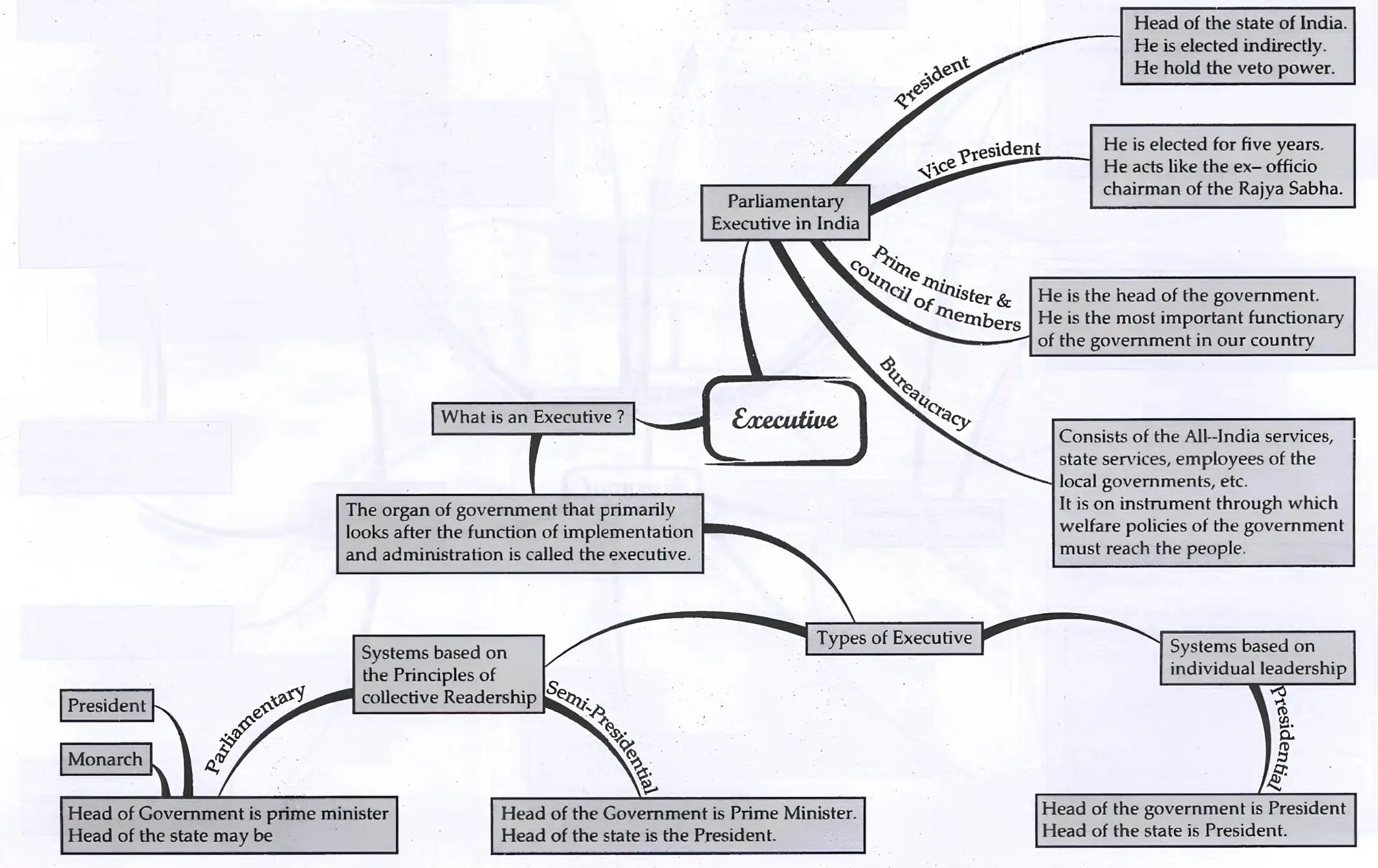
The Executive is the organ of government responsible for implementing laws and administering public policy. It consists of a body of persons who carry out the day-to-day administration and ensure that rules and regulations are put into practice.
The Executive is broadly divided into two categories:
- Political Executive: This includes the heads of government and their ministers who are responsible for overall government policy.
- Permanent Executive: This refers to the permanent administrative officials who handle daily administration.
Different countries have different systems of executive governance:
- Presidential System: The President is both the Head of State and Head of Government, e.g., USA, Brazil.
- Parliamentary System: The Prime Minister is the Head of Government, while a President or Monarch is the nominal Head of State, e.g., UK, Germany, Italy, Japan.
- Semi-Presidential System: Both President and Prime Minister share executive powers, with the President having significant day-to-day powers, e.g., France, Russia, Sri Lanka.
| Country | System | Head of State | Head of Government |
|---|---|---|---|
| USA | Presidential | President | President |
| UK | Parliamentary | Monarch (Queen Elizabeth II) | Prime Minister |
| France | Semi-Presidential | President | Prime Minister |
| Japan | Parliamentary | Emperor | Prime Minister |
| Italy | Parliamentary | President | Prime Minister |
| Russia | Semi-Presidential | President | Prime Minister |
| Germany | Parliamentary | President | Chancellor |
Exam Questions
Q1. What is the difference between a presidential and a parliamentary system of government?
Answer: In a presidential system, the President is both the Head of State and Head of Government and holds executive powers independently. In a parliamentary system, the Prime Minister is the Head of Government, and the Head of State is a separate, usually ceremonial, figure such as a monarch or president.
Q2. Name two countries with a semi-presidential system and explain its key feature.
Answer: France and Russia have semi-presidential systems where both the President and Prime Minister share executive powers, but the President has significant day-to-day powers.
Executive in India: President and Vice-President
In India, the Executive at the national level consists of the President, the Prime Minister, and the Council of Ministers. At the state level, it includes the Governor, the Chief Minister, and the Council of Ministers.
President of India:
- The President is the formal Head of State.
- The President can be removed only by impeachment by Parliament on grounds of violation of the Constitution, requiring a special majority.
- The President must act on the advice of the Council of Ministers, but can ask the Council to reconsider its advice once.
- The President has the right to be informed of all important matters and deliberations of the Council of Ministers.
- The President can exercise discretion in three situations: sending back advice for reconsideration, exercising veto power on bills (except money bills), and deciding who can form the government when no clear majority exists.
- The President can use a 'pocket veto' by keeping a bill pending indefinitely.
Vice-President of India:
- Is elected for five years by an electoral college excluding State Legislatures.
- Can be removed by a resolution of the Rajya Sabha passed by majority and agreed by Lok Sabha.
- Acts as the ex-officio Chairman of the Rajya Sabha.
- Acts as President in case of vacancy until a new President is elected.
Exam Questions
Q1. What are the grounds and procedure for the impeachment of the President of India?
Answer: The President can be impeached for violation of the Constitution. The impeachment requires a special majority in Parliament.
Q2. What are the discretionary powers of the President of India?
Answer: The President can send back advice for reconsideration, withhold assent to bills (veto power), and decide who can form the government when no party has a clear majority.
Executive in India: Prime Minister and Council of Ministers
The Prime Minister is the head of the Council of Ministers and the most important functionary of the government.
Key points about the Prime Minister and Council of Ministers:
- The Prime Minister is chosen as a leader acceptable to the majority or coalition partners.
- The Prime Minister allocates ranks and portfolios to ministers.
- Ministers must be members of Parliament; if not, they must get elected within six months.
- The Council of Ministers cannot exceed 15% of the total members of the Lok Sabha or State Assembly.
- The Executive is under the control and supervision of the legislature.
- A ministry losing the confidence of the Lok Sabha must resign.
- A vote of no confidence against one minister leads to the resignation of the entire Council.
- Ministers must accept Cabinet decisions or resign.
- The Council of Ministers comes into existence only after the Prime Minister takes oath.
- The death or resignation of the Prime Minister dissolves the Council; the resignation of a minister creates a vacancy only.
- The Prime Minister must communicate all Council decisions to the President.
- The Prime Minister's power comes from control over ministers, leadership in Lok Sabha, command over bureaucracy, media access, and international representation.
- Coalition governments have reduced the Prime Minister's authority, requiring more negotiation and consultation.
- At the state level, the Governor (appointed by the President) and Chief Minister function similarly, with the Governor having more discretionary powers.
Exam Questions
Q1. What happens if the Council of Ministers loses the confidence of the Lok Sabha?
Answer: The Council of Ministers must resign if it loses the confidence of the Lok Sabha.
Q2. How has coalition politics affected the authority of the Prime Minister?
Answer: Coalition politics has led to more consultation among partners, reducing the Prime Minister's authority in choosing ministers and deciding policies, making the Prime Minister act more as a negotiator.
Permanent Executive: Bureaucracy
The Permanent Executive or bureaucracy is the administrative machinery of the government, including the Prime Minister, ministers, and civil servants.
Key features of the Indian bureaucracy:
- It is politically neutral but politically accountable.
- Consists of All India Services, State Services, local government employees, and technical and managerial staff in public sector undertakings.
- The Union Public Service Commission (UPSC) conducts recruitment for civil services.
- The Constitution provides reservations in bureaucracy for Dalits, Adivasis, women, and other backward classes.
- Indian Administrative Service (IAS) and Indian Police Service (IPS) officers form the backbone of higher bureaucracy and are under Central Government disciplinary control.
- The bureaucracy implements welfare policies and government programs.
- Excessive political interference can undermine the neutrality and effectiveness of the bureaucracy.
Exam Questions
Q1. What is the role of the bureaucracy in the Indian government?
Answer: The bureaucracy implements government policies and welfare programs and manages day-to-day administration.
Q2. How does political interference affect the bureaucracy?
Answer: Too much political interference can make the bureaucracy an instrument of politicians, reducing its neutrality and effectiveness.
Solved Examples
Example 1: Explain the difference between the political executive and the permanent executive.
Solution: The political executive includes the heads of government and ministers responsible for policy decisions, while the permanent executive consists of civil servants and bureaucrats who implement these policies and manage daily administration.
Example 2: What are the three discretionary powers of the President of India?
Solution: The President can (1) send back advice for reconsideration, (2) withhold assent to bills (veto power), and (3) decide who can form the government when no party has a clear majority.
Practice Set
Easy
- Define the Executive.
- Who is the Head of State in India?
- What is the role of the Vice-President?
Moderate
- Explain the difference between a parliamentary and a presidential system.
- What happens if the Council of Ministers loses the confidence of the Lok Sabha?
- Describe the role of the Prime Minister in the Indian Executive.
Challenging
- Discuss the impact of coalition politics on the authority of the Prime Minister.
- Explain the procedure and grounds for impeachment of the President of India.
- Analyze the role and importance of bureaucracy in the Indian government.
Answer Key
Easy:
- The Executive is the organ of government responsible for implementing laws and administration.
- The President is the Head of State in India.
- The Vice-President acts as the Chairman of the Rajya Sabha and acts as President in case of vacancy.
Moderate:
- In a parliamentary system, the Prime Minister is Head of Government and the Head of State is separate; in a presidential system, the President is both Head of State and Government.
- If the Council of Ministers loses confidence of Lok Sabha, it must resign.
- The Prime Minister leads the Council of Ministers, allocates portfolios, and is the key government functionary.
Challenging:
- Coalition politics requires more negotiation, reduces PM's authority in minister selection and policy decisions.
- The President can be impeached for violation of the Constitution by a special majority in Parliament.
- Bureaucracy implements policies, manages administration, and ensures welfare programs reach people; political neutrality is essential.
Quick Reference
- Executive: Implements laws and policies.
- Political Executive: Prime Minister and Ministers.
- Permanent Executive: Bureaucracy and civil servants.
- President of India: Formal Head of State with limited discretionary powers.
- Vice-President: Chairman of Rajya Sabha, acts as President if needed.
- Prime Minister: Head of Government, leader of Council of Ministers.
- Bureaucracy: Permanent administrative machinery.
Glossary
- Components: Parts or organs of a system.
- Constituency: Geographical area represented by an elected member.
- Electorate: People eligible to vote.
- Harmonious: Balanced and consistent.
- Impeachment: Formal accusation against a public official.
- Insolvent: Unable to pay debts.
- Minimum Wages Act, 1948: Law fixing minimum wages for workers.
- Nominate: To formally propose a person for a position.
- Tenure: Fixed period of holding an office.