CLASS 11-HUMANITIES . POLITICAL SCIENCE . POLITICAL THEORY . EQUALITY
Chapter 3 : EQUALITY
Ch 3
POLITICAL SCIENCE
CLASS 11-HUMANITIES
EQUALITY
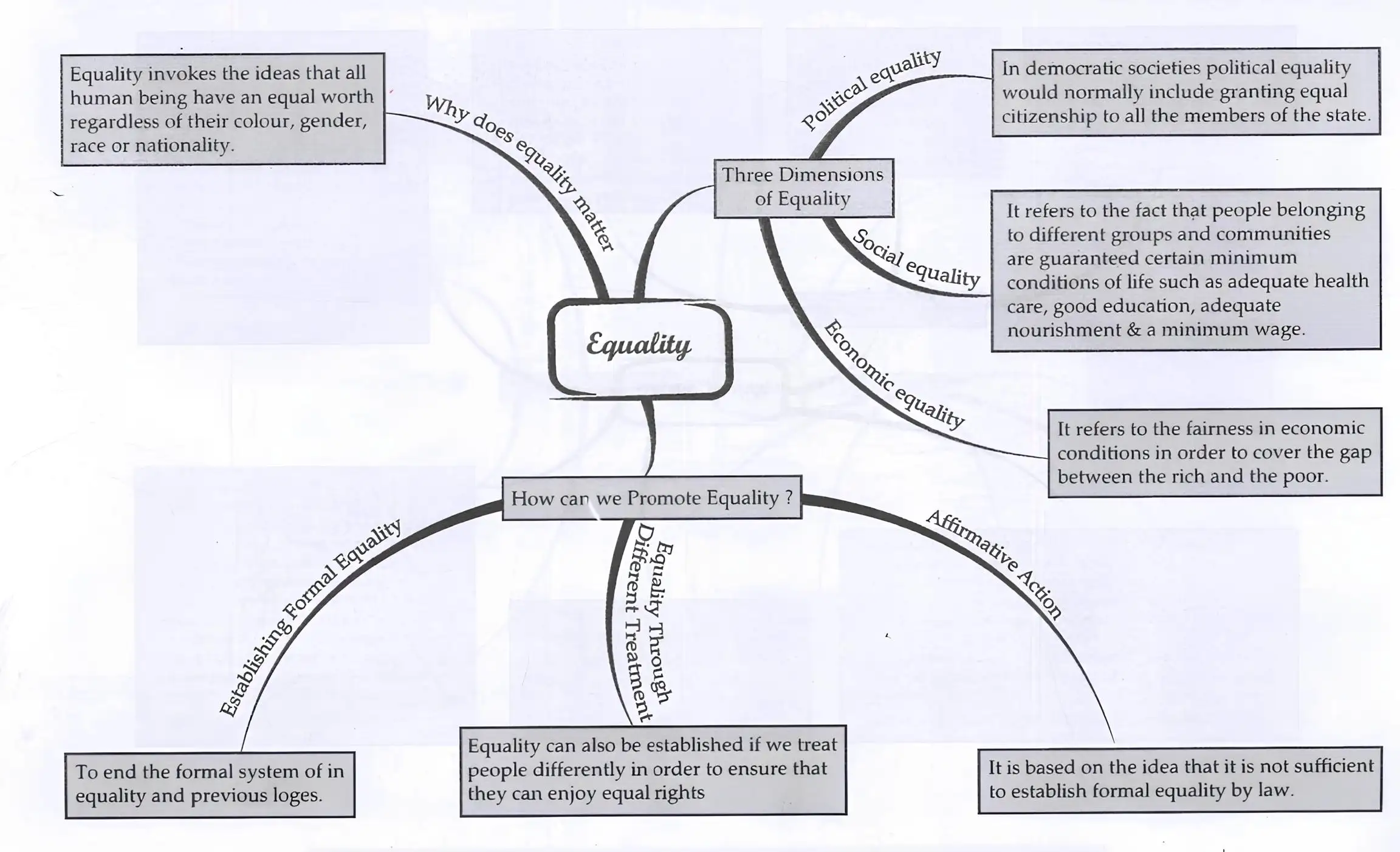
Equality is a powerful moral and political ideal that has inspired and guided human society for many centuries. It is the principle that all human beings have equal worth regardless of their colour, gender, race, or nationality. Despite widespread acceptance of this ideal, inequality remains visible both globally and within societies.
When people are treated differently based on religion, race, caste, or gender, it is considered an unacceptable form of inequality. Equality implies that all individuals are entitled to the same rights and opportunities to develop their skills and talents and pursue their ambitions. The focus is on ensuring equal access to basic goods such as education, healthcare, and safe housing, which are essential for a just society.
The three dimensions of equality are:
Political Equality
Political equality includes granting equal citizenship rights to all members of the state, such as freedom of expression, movement, association, and belief. It encompasses legal rights guaranteed by the Constitution and laws, and often involves demands for equal opportunities.
Exam Question
Q: What does political equality entail?
A: Political equality means all citizens have equal rights and freedoms, including freedom of expression, movement, association, and belief, as guaranteed by the Constitution and laws.
Social Equality
Social equality guarantees minimum living conditions for all members of society, such as adequate healthcare, education, nourishment, and minimum wage. The state should implement policies to prevent discrimination or harassment, especially against women, and promote equal access to education and employment.
Exam Question
Q: How does social equality protect individuals?
A: Social equality ensures that everyone has access to basic necessities like healthcare, education, and fair wages, and protects against discrimination and harassment.
Economic Equality
Economic equality exists when there are no significant differences in wealth, property, or income between individuals or classes. Marx argued that private ownership of economic resources is the root cause of economic inequality and advocated for public control over essential resources to address this.
Exam Question
Q: What is the cause of economic inequality according to Marx?
A: Marx believed economic inequality is caused by private ownership of important economic resources and suggested public control to reduce inequality.
Promoting Equality
Promoting equality involves ending formal systems of inequality and privileges. The Constitution of India prohibits discrimination based on religion, race, caste, sex, or place of birth and abolishes untouchability.
Sometimes, treating people differently is necessary to ensure equal rights, such as providing ramps for disabled individuals. Affirmative action involves positive measures like reservations in education and jobs to minimize entrenched social inequalities.
Critics argue that reservations can be unfair and constitute reverse discrimination. However, a distinction exists between treating everyone identically and treating everyone equally by addressing their specific needs.
For example, women require maternity leave and crèches to exercise their right to work effectively.
Exam Question
Q: What is affirmative action and why is it necessary?
A: Affirmative action involves positive measures such as reservations to reduce social inequalities, ensuring that formal equality by law translates into real equality.
Know the Terms
- Equality: The right of all people to have the same opportunities to develop their skills and pursue their goals.
- Feminism: A political doctrine advocating equal rights for women and men.
- Natural inequalities: Differences arising from individual capabilities and talents.
- Patriarchy: A system valuing men over women, giving men power over women.
- Socially-produced inequalities: Inequalities resulting from unequal opportunities or exploitation within society.
- Socialism: Political ideas focused on minimizing inequality and distributing resources justly.
Solved Examples
Example 1: Explain why political equality is essential in a democracy.
Answer: Political equality ensures that all citizens have equal rights and freedoms, such as voting and freedom of expression, which are fundamental for democratic participation and decision-making.
Example 2: How does affirmative action help in achieving social equality?
Answer: Affirmative action provides special provisions like reservations to disadvantaged groups, helping to overcome historical discrimination and ensuring equal access to education and employment.
Practice Set
Easy
- Define equality in your own words.
- What are the three dimensions of equality?
Moderate
- Explain the difference between natural inequalities and socially-produced inequalities.
- Why is it sometimes necessary to treat people differently to achieve equality?
Challenging
- Discuss the arguments for and against affirmative action.
- How does the Constitution of India promote equality?
Answer Key
- Equality: The principle that all individuals have the same rights and opportunities.
- Three dimensions: Political, social, and economic equality.
- Natural vs Social inequalities: Natural inequalities arise from individual differences; socially-produced inequalities arise from social structures and discrimination.
- Treating differently: To ensure equal rights, some groups may need special provisions to overcome disadvantages.
- Affirmative action arguments: For: helps reduce inequality; Against: may cause reverse discrimination.
- Constitutional promotion: Prohibits discrimination and abolishes untouchability.
Quick Reference
- Equality means equal worth and rights for all.
- Political equality: equal citizenship rights.
- Social equality: access to basic needs and protection from discrimination.
- Economic equality: reducing wealth and income disparities.
- Affirmative action: positive measures to achieve real equality.
Glossary
- Equality: Equal rights and opportunities for all individuals.
- Affirmative Action: Policies to improve opportunities for disadvantaged groups.
- Patriarchy: Social system privileging men over women.
- Socialism: Ideology advocating for equitable distribution of resources.
- Discrimination: Unfair treatment based on group membership.
| Year | Event | Significance |
|---|---|---|
| 1950 | Constitution of India enacted | Prohibited discrimination on grounds of religion, race, caste, sex, or place of birth; abolished untouchability |
| 1970s onwards | Implementation of affirmative action policies | Reserved seats in education and jobs to promote social equality |