CLASS 11-HUMANITIES . POLITICAL SCIENCE . INDIA CONSTITUTION AT WORK . ELECTION AND-REPRESENTATION
Chapter 3 : Election And Representation
Ch 3
POLITICAL SCIENCE
CLASS 11-HUMANITIES
Elections in Indian Democracy
In a democracy like India, it is not feasible for all citizens to participate directly in every decision-making process. Therefore, representatives are elected by the people to govern on their behalf. The Constitution of India lays down fundamental rules governing elections to ensure a fair and democratic process.
Key rules for elections include:
- Eligibility criteria for voters.
- Eligibility criteria for candidates contesting elections.
- Supervision and conduct of elections.
- Methods for choosing representatives.
- Counting of votes.
- Declaration of elected representatives.
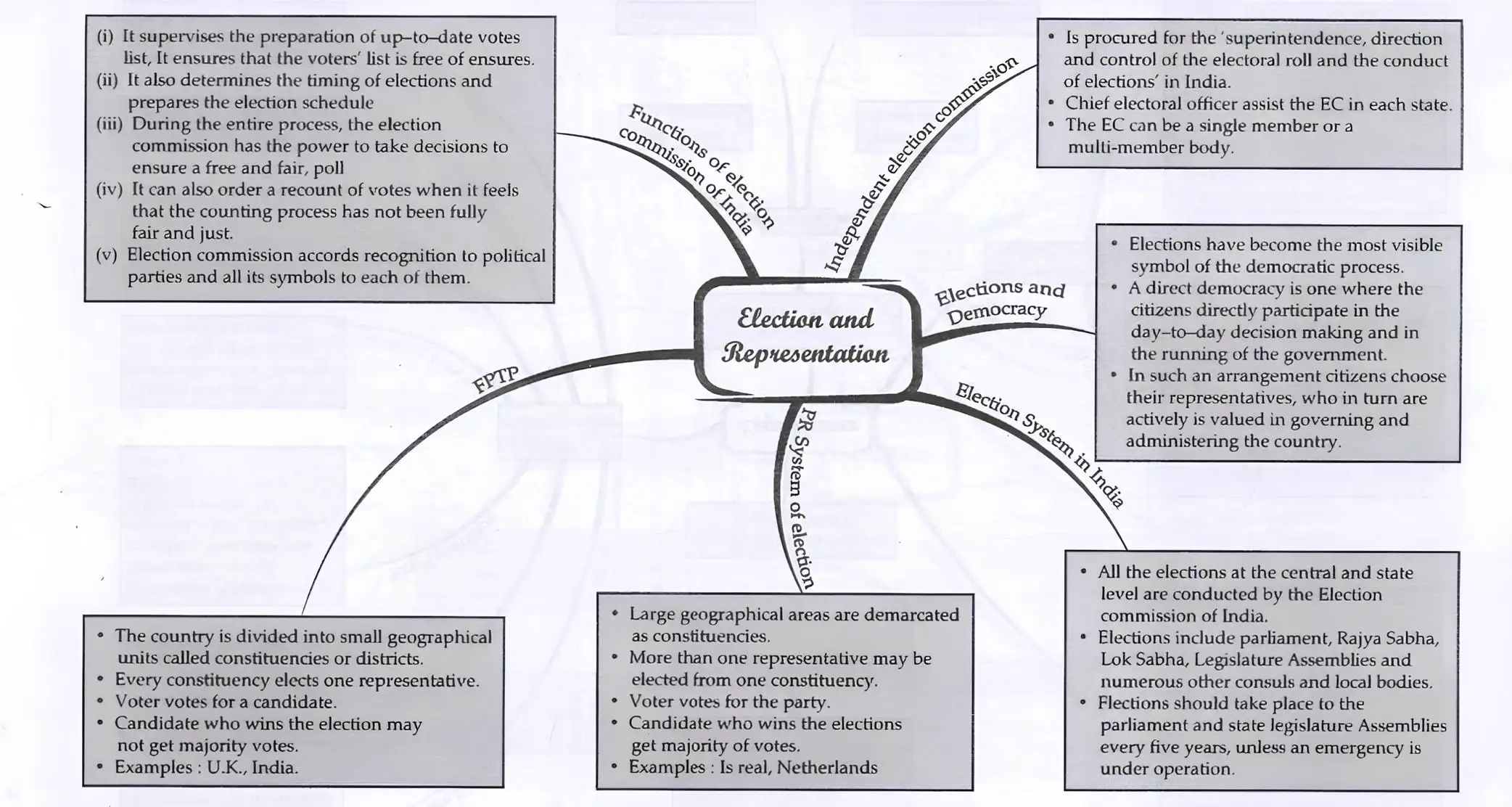
India follows the First Past the Post (FPTP) system, also known as the Plurality System, characterized by:
- The country being divided into 543 constituencies.
- Each constituency electing one representative.
- The candidate with the highest number of votes in a constituency is declared the winner.
In contrast, countries like Israel use the Proportional Representation (PR) system, where seats in the parliament are allocated to parties in proportion to the votes they receive.
For Rajya Sabha elections in India, the Single Transferable Vote system is used. Members are elected by representatives of State Legislative Assemblies, with each state having a specific quota of seats. A candidate must secure a minimum quota of votes, calculated as:
(Total votes polled / Total number of candidates to be elected) + 1
The FPTP system tends to result in a two-party system in India.
Exam Question
Q: What is the First Past the Post system and how does it function in Indian elections?
A: The First Past the Post system is an election method where the country is divided into constituencies, each electing one representative. The candidate who secures the highest number of votes in a constituency wins the election, regardless of whether they have an absolute majority.
Election Characteristics and Electoral Reforms in India
The Delimitation Commission, appointed by the President of India in collaboration with the Election Commission, is responsible for drawing constituency boundaries. It also reserves constituencies for Scheduled Castes (SC) and Scheduled Tribes (ST) based on their population proportion in each state.
Reservation of seats for women is provided in rural and urban local bodies to promote inclusive representation.
Voting age was reduced from 21 to 18 years in 1989, expanding the electorate.
Eligibility criteria for candidates include:
- Minimum age of 25 years to contest Lok Sabha or Assembly elections.
- Disqualification for candidates who have served imprisonment of two or more years for certain offenses.
The Election Commission of India (ECI) supervises elections at the central and state levels but not local body elections. The Chief Election Commissioner (CEC) heads the ECI, with equal powers as other Election Commissioners. They are appointed by the President for a six-year term or until age 65.
The CEC can be removed before term expiry only by a special majority recommendation from both Houses of Parliament. Other Election Commissioners can be removed by the President.
Functions of the Election Commission include:
- Maintaining updated voters’ lists.
- Scheduling elections.
- Ensuring free and fair polls.
- Recognizing political parties and allotting symbols.
The Election Commission has managed elections under challenging conditions such as militancy in Assam, Punjab, Jammu and Kashmir, the assassination of Rajiv Gandhi in 1991, and violence in Gujarat.
Suggested electoral reforms include:
- Changing from FPTP to a variant of the PR system.
- Ensuring at least one-third representation of women in Parliament and Assemblies.
- Stricter control of money in politics.
- Barring candidates with criminal cases from contesting.
- Banning caste and religious appeals in campaigns.
- Regulating political parties through law.
- Encouraging active public vigilance and participation.
- Strengthening political institutions and watchdog organizations.
Exam Question
Q: What are the main functions of the Election Commission of India?
A: The Election Commission of India supervises the preparation of voters’ lists, schedules elections, ensures free and fair polls, recognizes political parties, and allots election symbols.
Glossary
- Democracy: A government of the people, by the people, and for the people.
- Direct Democracy: A system where citizens directly participate in decision-making and governance.
- Election: A process where citizens choose representatives to govern on their behalf.
- First Past the Post System: An election system where the candidate with the most votes in a constituency wins.
- Proportional Representation: An election system where parties receive seats in proportion to their vote share.
- Separate Electorates: An election system where only voters from a particular community elect their representatives.
- Special Majority: A majority requiring two-thirds of those present and voting and a simple majority of the total membership.
- Universal Adult Franchise: The right of all adult citizens to vote regardless of religion, caste, gender, or income.
Solved Examples
Example 1
Question: Explain why the First Past the Post system can lead to a two-party system.
Answer: In the FPTP system, only the candidate with the highest votes in a constituency wins, which discourages smaller parties as votes for them often do not translate into seats. This tends to consolidate votes around two major parties, leading to a two-party system.
Example 2
Question: What is the role of the Delimitation Commission in Indian elections?
Answer: The Delimitation Commission redraws the boundaries of constituencies based on population changes and reserves seats for Scheduled Castes and Scheduled Tribes to ensure fair representation.
Practice Set
Easy
- What is the minimum age to vote in India?
- Define democracy.
Moderate
- Describe the First Past the Post system.
- What are the functions of the Election Commission of India?
Challenging
- Explain the need for electoral reforms in India.
- Discuss the significance of the Single Transferable Vote system in Rajya Sabha elections.
Answer Key
- Easy:
- 18 years.
- A government of the people, by the people, and for the people.
- Moderate:
- FPTP is an election system where the candidate with the highest votes in a constituency wins.
- The Election Commission supervises elections, updates voters’ lists, schedules elections, ensures free and fair polls, recognizes political parties, and allots symbols.
- Challenging:
- Electoral reforms are needed to improve representation, reduce criminalization, control money power, increase women’s participation, and ensure free and fair elections.
- The Single Transferable Vote system ensures proportional representation in Rajya Sabha by requiring candidates to meet a quota of votes, promoting fairness among states.
Quick Reference
- FPTP System: Candidate with most votes in a constituency wins.
- PR System: Seats allocated based on vote share.
- Delimitation Commission: Redraws constituency boundaries and reserves seats.
- Election Commission: Conducts and supervises elections.
- Voting Age: 18 years.
- Candidate Eligibility: Minimum 25 years, no serious criminal record.