CLASS 11-HUMANITIES . POLITICAL SCIENCE . INDIA CONSTITUTION AT WORK . CONSTITUTION WHY-AND-HOW
Chapter 1 : Constitution: Why And How?
Ch 1
POLITICAL SCIENCE
CLASS 11-HUMANITIES
Constitution: Why and How?
Basics of Constitution
Constitution is a set of fundamental principles or established precedents according to which a state or other organisation is governed.
Need for Constitution:
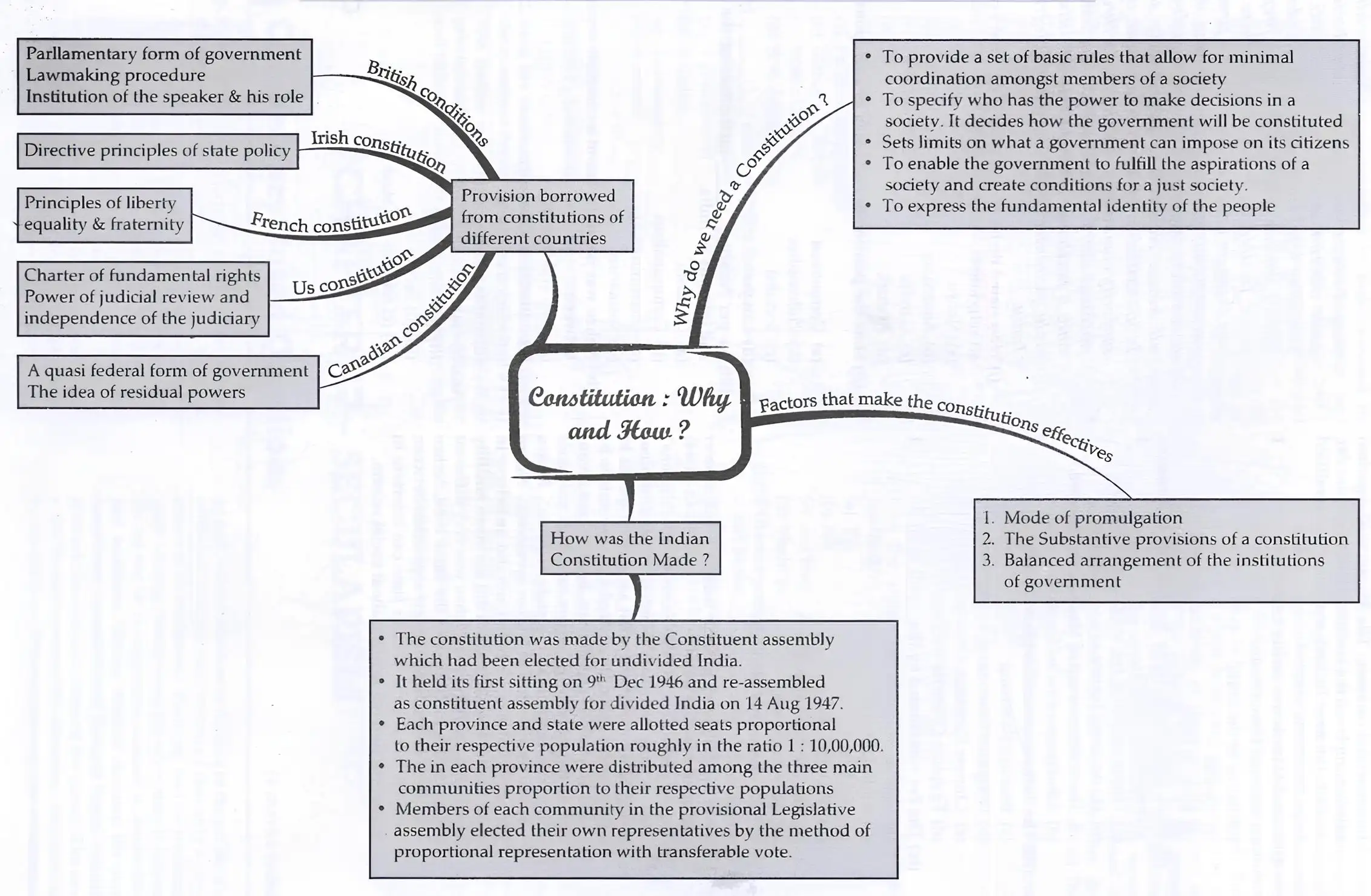
- To provide a set of basic rules that all members of a society can agree upon.
- To specify who has the power to make decisions in a society.
- To decide how the government will be constituted.
- To set some limits on what a government can impose on its citizens.
- To enable the government to fulfil the aspirations of a society and create conditions for a just society.
- To define relationships that constitute the national identity of a country.
Essentials of a Good Constitution:
- Distribution of power in society intelligently so that no single group can subvert the constitution.
- Must strike the right balance between certain values, norms and procedures as authoritative, and at the same time allow enough flexibility in its operations to adapt to the changing needs and circumstances.
Making of the Indian Constitution
India’s Constitution was formally created by a Constituent Assembly between December 1946 and November 1949.
The Constituent Assembly was composed roughly along the guidelines suggested by the plan proposed by the committee of the British cabinet, popularly known as the Cabinet Mission.
The Indian Constitution was drawn up by people who enjoyed immense public credibility, who had the capacity to negotiate and command the respect of a wide cross-section of society, and who were able to convince the people that the constitution was not an instrument for the aggrandisement of their personal power.
Members of all religions were given representation in the Assembly.
The Assembly had 28 members from the Scheduled Castes.
The members of the Constituent Assembly who were elected from territories which fell under Pakistan ceased to be members of the Constituent Assembly from June 3, 1947.
The Constituent Assembly had eight major committees on different subjects.
Only one provision of the Constitution was passed without any debate - the introduction of the Universal Suffrage which means that all citizens attaining a certain age, would be entitled to be voters irrespective of religion, caste, education, gender or income.
The Assembly met for one hundred and sixty six days, spread over two years and eleven months.
The Indian Constitution is described as a ‘living document’.
The Indian Constitution was adopted on November 26, 1949.
The Indian Constitution came into force on January 26, 1950.
The Constitution of India is the first and the foremost law of the country which is to be accepted and respected by all the citizens of the country as well as all government and private institutions in the country.
The Constitution of India is rigidly flexible, that is, it is federal in form and unitary in spirit.
Know the Terms
- Deliberation: Debate and discussion on various matters to be incorporated into the Indian Constitution.
- Disparity: Inequality between two or more groups or sections of society on various grounds.
- Integration: Relationship of harmony and brotherhood amongst people and communities at regional and national level.
- Law: A set of written rules that govern a land and are implemented by proper enforcement machinery of the government setup.
- Promulgation: Formal announcement of the commencement of a law.
- Objective Resolution: Resolution that defines the aims of an Assembly.
- Sects: Different groups that arise within a community.
- Suppressed: Stopping someone from expressing ideas, issues and grievances.
Exam Questions: Basics of Constitution
Q1. What is a constitution?
Answer: A constitution is a set of fundamental principles or established precedents according to which a state or other organisation is governed.
Q2. Why is a constitution needed in a society?
Answer: A constitution is needed to provide basic rules for society, specify decision-making powers, decide government formation, limit government powers, fulfill societal aspirations, and define national identity.
Q3. What are the essentials of a good constitution?
Answer: A good constitution distributes power intelligently to prevent subversion, balances authoritative values and norms, and allows flexibility to adapt to changing needs.
Exam Questions: Making of the Indian Constitution
Q1. When was the Indian Constitution created and by whom?
Answer: The Indian Constitution was created by the Constituent Assembly between December 1946 and November 1949.
Q2. What was unique about the representation in the Constituent Assembly?
Answer: Members of all religions were represented, including 28 members from Scheduled Castes, ensuring wide representation.
Q3. What is Universal Suffrage as introduced in the Indian Constitution?
Answer: Universal Suffrage means all citizens attaining a certain age have the right to vote regardless of religion, caste, education, gender, or income.
Solved Examples
Example 1: Explain why the Indian Constitution is called a 'living document'.
Solution: The Indian Constitution is called a 'living document' because it is flexible and can be amended to meet the changing needs and circumstances of society while maintaining its core principles.
Example 2: Describe the role of the Constituent Assembly in the making of the Indian Constitution.
Solution: The Constituent Assembly was responsible for drafting the Constitution. It included members from diverse backgrounds, debated provisions, and adopted the Constitution on November 26, 1949.
Practice Set
Easy
- Define the term 'Constitution'.
- List two reasons why a constitution is necessary.
Moderate
- Explain the significance of Universal Suffrage in the Indian Constitution.
- What are the key features that make a constitution effective?
Challenging
- Discuss the composition and role of the Constituent Assembly in framing the Indian Constitution.
- Analyze how the Indian Constitution balances rigidity and flexibility.
Answer Key
- Easy 1: Constitution is a set of fundamental principles or established precedents according to which a state or organisation is governed.
- Easy 2: To provide basic rules for society; to specify who has power to make decisions.
- Moderate 1: Universal Suffrage allows all adult citizens to vote regardless of religion, caste, gender, education, or income, ensuring democratic participation.
- Moderate 2: Effective constitutions distribute power wisely, balance authoritative norms with flexibility, and have clear rules and institutions.
- Challenging 1: The Constituent Assembly was a representative body that drafted the Constitution through debates and committees, ensuring inclusivity and legitimacy.
- Challenging 2: The Indian Constitution is rigid in its fundamental principles but flexible through amendments, combining federal and unitary features.
Quick Reference
- Constitution: Fundamental rules governing a state.
- Universal Suffrage: Right to vote for all adult citizens.
- Constituent Assembly: Body that drafted the Indian Constitution.
- Promulgation: Formal announcement of a law.
- Living Document: Constitution that can adapt over time.
Glossary
- Deliberation: Discussion and debate on important matters.
- Disparity: Inequality among groups.
- Integration: Harmony among communities.
- Law: Written rules enforced by government.
- Promulgation: Official announcement of a law.
- Objective Resolution: Statement of aims of an Assembly.
- Sects: Groups within a community.
- Suppressed: Prevented from expressing ideas.
Chronology of Indian Constitution Making
| Year | Event | Significance |
|---|---|---|
| December 1946 | Constituent Assembly first met | Start of drafting the Constitution |
| June 3, 1947 | Members from Pakistan territories ceased membership | Adjustment due to partition |
| November 26, 1949 | Constitution adopted | Formal acceptance of the Constitution |
| January 26, 1950 | Constitution came into force | India became a republic |