CLASS 11-HUMANITIES . HISTORY . THEMES IN WORLD HISTORY . WRITING AND-CITY-LIFE
Chapter 1 : WRITING AND CITY LIFE
Ch 1
HISTORY
CLASS 11-HUMANITIES
City Life Mesopotamia
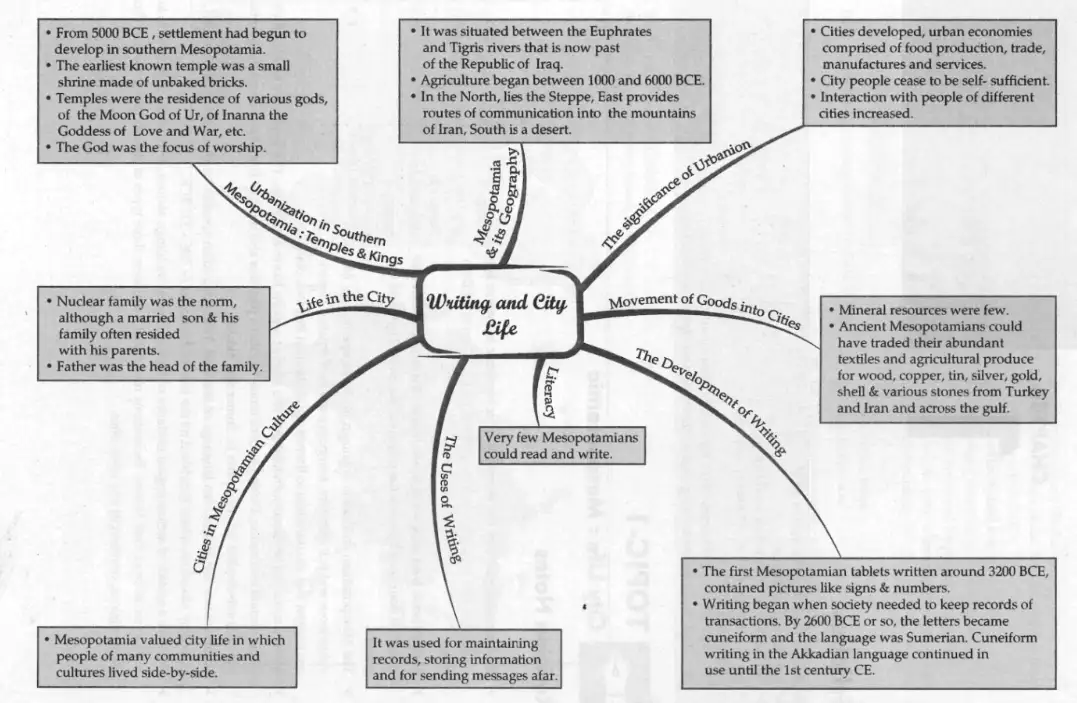
Mesopotamia, located between the Tigris and Euphrates rivers, is known as the cradle of civilization. Around 5000 BCE, early cities developed here with temples and kings, where religion played a central role. Families were mostly nuclear with fathers as heads. The economy was complex, based on food production, trade, and manufacturing. Mesopotamians traded textiles for minerals from neighboring regions. Writing began around 3200 BCE to keep records of transactions, initially using pictographs and numbers, later evolving into cuneiform script. Literacy was limited to a few, but writing was crucial for communication and record-keeping. The Sumerian language and cuneiform writing lasted until about the 1st century CE.
Revision Notes
Mesopotamia, meaning "land between two rivers," flourished between the Tigris and Euphrates rivers. It marked the transition from Neolithic to Bronze Age civilization. The region is divided into North (Assyria) and South (Sumer and Akkad). Sumerian was the first language, later replaced by Akkadian. Archaeological evidence shows three types of cities: religious, commercial, and royal.
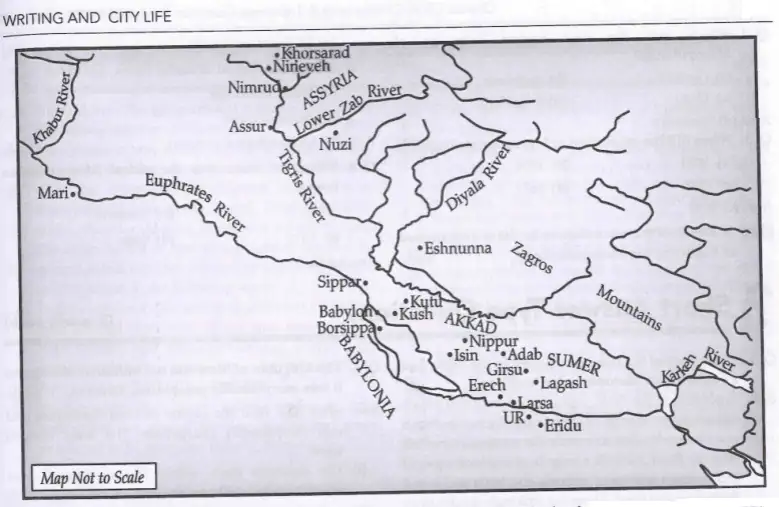
The southern plains, called Sumer, were home to the first city dwellers. Mesopotamia saw the rise of Sumerian, Babylonian, and Assyrian civilizations.
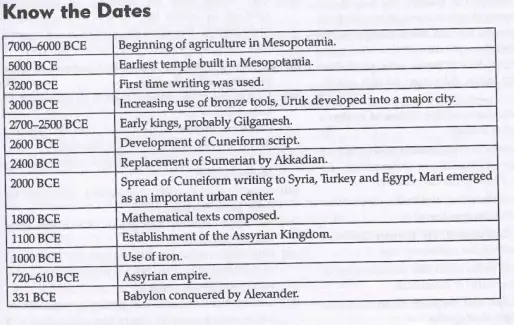
Timeline Highlights:
| Year | Event | Significance |
|---|---|---|
| 7000–6000 BCE | Agriculture begins | Start of settled farming communities |
| 5000 BCE | Earliest temples built | Religious centers established |
| 3200 BCE | Writing begins | Records and communication improve |
| 3000 BCE | Bronze tools common; Uruk grows | Technological advancement and urban growth |
| 2700–2500 BCE | Early kings rule (e.g., Gilgamesh) | Political organization |
| 2600 BCE | Cuneiform script developed | Writing system standardized |
| 2400 BCE | Akkadian replaces Sumerian | Language evolution and spread of cuneiform |
| 1800 BCE | Mathematical texts appear | Advances in science and education |
| 1100 BCE | Assyrian Kingdom established | New political power |
| 1000 BCE | Iron use begins | Technological progress |
| 720–610 BCE | Assyrian empire lasts | Expansion and dominance |
| 331 BCE | Alexander the Great conquers Babylon | End of Mesopotamian independence |
Exam Question
Q: What were the main features of city life in Mesopotamia?
A: City life in Mesopotamia included the presence of temples and kings, a complex economy based on food production, trade, and manufacturing, the use of writing for record-keeping, and a social structure with families headed by fathers.
Urbanisation
Mesopotamia's geography included fertile plains in the northeast with sufficient rainfall and desert in the south where the first cities and writing developed. Agriculture was highly productive, with crops like wheat, barley, peas, and lentils, and animal husbandry providing milk, meat, and wool. Despite natural fertility, agriculture faced challenges from natural causes. Irrigation canals diverted water from the Euphrates to fields.
Urbanisation was driven not only by food production but also by trade, manufacturing, and services. Division of labor was a key feature, with social organization coordinating various activities. Prominent cities included Ur, Mari, Kish, Lagash, and Uruk. Mesopotamia lacked mineral resources, so it traded textiles and agricultural products for metals and wood from neighboring regions.
Transportation was facilitated by canals and rivers like the Euphrates, which served as trade routes. Writing began as a need to keep records of transactions, evolving into cuneiform script by 2600 BCE. Writing was a specialized craft used for administration, legal matters, and communication. Temples were central to city development, owning land and organizing irrigation. Kings gained authority through religious and military power. Administration maintained peace and security, essential for trade and urban growth.
Exam Question
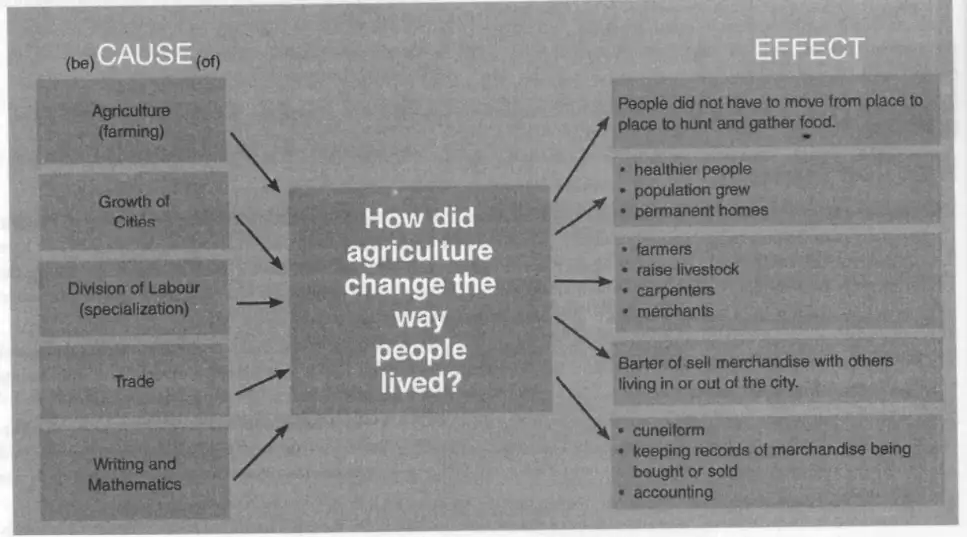
Q: How did agriculture contribute to urbanisation in Mesopotamia?
A: Agriculture allowed people to settle permanently, leading to population growth and specialization of labor. This specialization supported trade, manufacturing, and services, which in turn encouraged the growth of cities and the development of writing for record-keeping.
Legacy of Writing Historians Debate
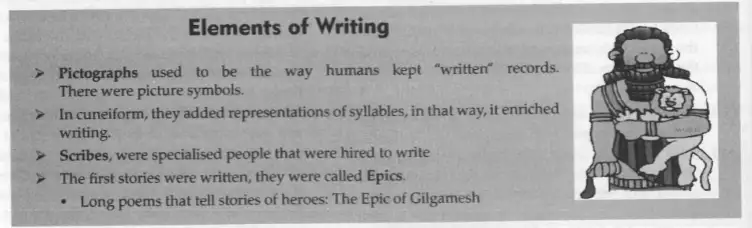
The most significant legacy of Mesopotamian civilization is the development of writing. Writing was done on small clay tablets using a stylus to create cuneiform script. Some tablets from around 1800 BCE contain advanced mathematical tables, indicating significant growth in mathematics.
Mesopotamian literature includes the epic of Gilgamesh, a long poem about a hero. They developed a number system based on 60, the Pythagorean theorem, and a calendar dividing the year into 12 months, weeks, and days. These innovations influenced later civilizations including the Romans and medieval Europe.
Schools trained scribes who learned hundreds of signs. Scribes maintained records and served as intellectuals. The Assyrian king Assurbanipal collected thousands of tablets in a library, preserving history, literature, and science. Even after Sumerian ceased to be spoken, it was taught in schools alongside Akkadian.
Writing enabled communication over distances and became the language of diplomacy between Egypt and West Asia. The achievements of Mesopotamians made their civilization the most advanced of their time.
Exam Question
Q: What was the importance of writing in Mesopotamian civilization?
A: Writing was crucial for record-keeping, administration, legal matters, literature, and communication. It allowed the preservation of knowledge, facilitated trade and diplomacy, and contributed to the intellectual achievements of Mesopotamia.
Solved Examples
Example 1
Question: Why did Mesopotamians develop writing?
Answer: Mesopotamians developed writing primarily to keep records of transactions, trade, and administrative activities, which became necessary due to the complexity of urban economies and social organization.
Example 2
Question: Name three major civilizations that developed in Mesopotamia.
Answer: The three major civilizations were the Sumerian, Babylonian, and Assyrian civilizations.
Practice Set
Easy
- What does the word Mesopotamia mean?
- Name two important rivers in Mesopotamia.
Moderate
- Explain the role of temples in Mesopotamian cities.
- Describe the importance of the Euphrates river for Mesopotamian civilization.
Challenging
- Discuss how the development of writing influenced the social and political structure of Mesopotamia.
- Analyze the impact of trade on the urbanization of Mesopotamian cities.
Answer Key
Easy
- Mesopotamia means "land between two rivers."
- The two important rivers are the Tigris and Euphrates.
Moderate
- Temples were the center of city life, owned land, organized irrigation, and were religious and economic hubs.
- The Euphrates river provided water for irrigation, transportation, and trade routes essential for agriculture and urban growth.
Challenging
- Writing allowed record-keeping, legal documentation, and communication, which supported administration and social hierarchy.
- Trade brought resources not locally available, encouraged specialization, and connected cities, fostering urbanization.
Quick Reference
- Mesopotamia: Land between Tigris and Euphrates rivers.
- Cuneiform: Early writing system using wedge-shaped marks on clay tablets.
- Sumerians: First city dwellers and creators of cuneiform.
- Urbanization: Growth of cities due to agriculture, trade, and social organization.
- Gilgamesh: Epic poem from Mesopotamia about a legendary king.
Glossary
- Cuneiform: A system of writing developed by the Sumerians using wedge-shaped marks.
- Epic: A long poem narrating heroic deeds.
- Irrigation: The supply of water to land or crops to help growth.
- Mesopotamia: Ancient region between the Tigris and Euphrates rivers.
- Scribe: A person trained to write and keep records.
- Urbanization: The process of cities growing and societies becoming more complex.