CLASS 11-HUMANITIES . HISTORY . THEMES IN WORLD HISTORY . THE THREE-ORDERS
Chapter 4 : THE THREE ORDERS
Ch 4
HISTORY
CLASS 11-HUMANITIES
Feudalism
The period from 1300 to 1700 in Europe witnessed significant developments including changes in agriculture, the lives of peasants, and cultural transformations. The growth of trade increased contacts between continents, facilitating the exchange of ideas, inventions, and goods. However, constant warfare between kingdoms for control of land, resources, and trade routes caused displacement and drastically transformed the lives of enslaved men and women.
Christianity survived the collapse of the Roman Empire and spread to central and northern Europe. The Church became a major landholder and political power. Historical documents such as land ownership records, prices, and legal cases provide insights into family structures and population. Inscriptions in churches reveal information about traders’ associations. Historians use these sources to understand economic and social life and changes over time.
Marc Bloch (1886-1944) emphasized that history is more than political events, highlighting the importance of geography in shaping human history. He detailed social relations, hierarchies in French society, land management, and popular culture during the medieval period.
The term 'Feudalism' describes the economic, political, legal, and social relationships in medieval Europe. Derived from the German word 'feud' meaning a piece of land, feudalism developed in medieval France and later in England and southern Italy. Peasants performed labor services for lords in exchange for military protection, with lords exercising judicial control over peasants. Thus, feudalism extended beyond economic control to social and political aspects of life.
The Franks, a Germanic tribe, gave their name to Gaul, which became France. Their strong links with the Church were reinforced when Pope crowned King Charlemagne as the Holy Roman Emperor. England and Scotland were conquered by a duke from Normandy in the 11th century.
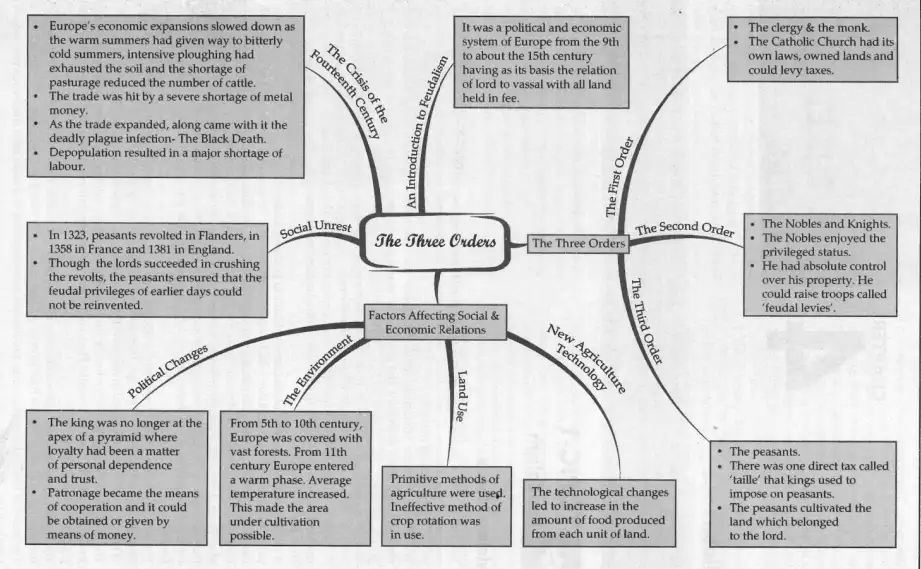
This mind map explains the social, political, and economic system in medieval Europe, highlighting the three orders: Clergy, Nobles, and Peasants, and factors affecting social and economic relations such as environment, land use, agricultural technology, political changes, social unrest, and the 14th-century crisis.
Exam Question
Q: What was feudalism and how did it affect the lives of peasants in medieval Europe?
A: Feudalism was a system of economic, political, legal, and social relationships based on land ownership and service. Peasants worked the land for lords in exchange for protection but were under the lord’s judicial control and had limited freedom.
The Three Orders
Medieval western society (5th to 15th centuries) was divided into three orders: The Clergy, The Nobility, and The Peasantry.
The Clergy were regarded as God's representatives on earth, enjoyed special privileges including tax exemption, and were the most powerful institution independent of the king. The Pope was the head of the Western Church. Each village had a church and priest. Not everyone could become a priest; serfs, women, and the physically challenged were excluded. Bishops formed the religious nobility. The Church collected a tithe (one-tenth of peasants' produce) and received donations from the rich.
Religious customs and symbols such as kneeling in prayer were shared with the feudal knights, who took vows of loyalty to their lords. Monasteries, governed by abbots or abbesses, were religious communities where monks lived in isolation, dedicating time to prayer, study, and manual labor.
Despite Christianity, old folk traditions and beliefs in magic persisted. Important festivals like Christmas and Easter were celebrated as holidays by peasants, who often feasted and enjoyed festivities. Pilgrimages to shrines and churches were common.
The Nobility controlled land and social processes through the practice of vassalage. Kings were linked to nobles as their lords, and nobles to peasants. Nobles promised protection to their vassals in exchange for loyalty. They had privileged status, controlled their property, raised troops called feudal levies, held courts, and could mint money. Their estates, called manors, were self-sufficient with peasants cultivating the land and providing military service when required.
Knights, a new class, were granted fiefs by lords in exchange for military service. They could serve multiple lords and paid fees to their lords. Peasants were either free tenants or serfs bound to the land, giving much of their produce to lords without wages and could not leave without permission.
Feudalism developed in England from the 11th century, with lords as chief tenants of the king, providing military help by supplying knights. Changes in environment, agriculture, and land use affected social and economic ties between lords and vassals. From the 11th century, warmer climate and technological advances like iron ploughs and water mills increased food production. Economic transactions became more money-based, influencing prices and weakening personal bonds of feudalism.
Exam Question
Q: Describe the roles and privileges of the three orders in medieval European society.
A: The Clergy were religious leaders with special privileges and tax exemptions. The Nobility controlled land, raised armies, and held courts. The Peasantry worked the land, paid taxes, and provided military service but had limited freedom.
A Fourth Order: New Towns and Townspeople
Expansion in agriculture led to population growth, trade, and the rise of towns. Towns offered paid work and freedom from lord’s control, attracting peasants and serfs as unskilled labor. Skilled individuals like bankers and lawyers formed a Fourth Order.
Guilds, associations of crafts or industries, controlled product quality, prices, and sales. By the 11th century, new trade routes with West Asia developed. In France, commerce and crafts grew in the 12th century, with craftsmen settling in towns for production and trade. Town merchants became rich and rivalled nobility.
Rich merchants donated to the Church, leading to the construction of large cathedrals from the 12th century. Areas around cathedrals became populated centers of pilgrimage, with small towns developing around them.
Exam Question
Q: What factors contributed to the growth of towns and the emergence of the Fourth Order in medieval Europe?
A: Agricultural expansion increased population and trade, leading to town growth. Towns offered paid work and freedom, attracting peasants and skilled workers. Guilds organized crafts, and merchants gained wealth and influence.
The 14th Century Crisis
Economic expansion slowed in the 14th century due to three main factors: (i) Climate change with cold summers shortened cropping seasons and caused floods; (ii) Intensive land use exhausted soil and reduced pastures; (iii) Population growth outpaced resources, causing famines (1315-1317) and cattle deaths (1320).
Trade suffered from a shortage of metal money due to reduced silver mining. The arrival of ships brought the bubonic plague (Black Death) between 1347-1350, killing about 20% of Europe’s population, with some areas losing up to 40%.
This caused social dislocation, labor shortages, and imbalance between agriculture and manufacturing. Agricultural prices dropped while wages rose. Lords’ incomes fell, leading them to try to revive labor services, which peasants violently opposed. Peasant revolts occurred in Flanders (1323), France (1358), and England (1381), though crushed, they prevented the return of feudal privileges.
European kings strengthened military and financial power, establishing standing armies, permanent bureaucracies, and national taxation. Monarchs like Louis XI (France), Maximilian (Austria), Henry VII (England), and Isabella and Ferdinand (Spain) ruled absolutist states. Spain and Portugal began overseas expansion.
The dissolution of feudalism and slow economic growth allowed kings to increase control over nobles, replacing feudal levies with professional infantry and artillery. Taxes increased to support armies, overcoming aristocratic resistance. Rebellions in England and religious wars in France reflected struggles between royal authority and privileges.
Money became a key means for non-aristocratic families like merchants and bankers to access royal courts by lending money to kings. This shaped the future political structures of France and England.
Exam Question
Q: What were the causes and consequences of the 14th-century crisis in Europe?
A: Causes included climate change, soil exhaustion, population growth, famine, and plague. Consequences were labor shortages, social unrest, peasant revolts, decline of feudalism, and strengthening of royal power.
Solved Examples
Example 1
Q: Explain the role of the Church in medieval European society.
A: The Church was a powerful institution owning land and political influence. It provided spiritual guidance, collected tithes, and was exempt from taxes. The Pope led the Church, and clergy held special privileges. The Church influenced social customs and education.
Example 2
Q: Describe the feudal relationship between lords and vassals.
A: Lords granted land (fiefs) to vassals in exchange for military service and loyalty. Vassals managed the land and provided troops when required. This created mutual obligations and structured medieval society.
Practice Set
Easy
- What were the three orders in medieval society?
- Who was the head of the Western Church?
Moderate
- Explain the significance of the guilds in medieval towns.
- What were the effects of the Black Death on European society?
Challenging
- Analyze how the 14th-century crisis contributed to the decline of feudalism.
- Discuss the role of money in changing feudal relationships during the medieval period.
Answer Key
- Three orders: Clergy, Nobility, Peasantry.
- The Pope was the head of the Western Church.
- Guilds controlled quality, prices, and sales of crafts, supporting economic organization in towns.
- The Black Death caused massive population loss, labor shortages, social unrest, and economic disruption.
- The crisis weakened feudal bonds, increased labor value, and led to peasant revolts, hastening feudalism's decline.
- Money replaced personal bonds, enabling economic transactions and access to royal courts, changing feudal ties.
Quick Reference
- Feudalism: System of land-based economic, social, and political relations.
- Three Orders: Clergy, Nobility, Peasantry.
- Guild: Association controlling crafts and trade.
- Black Death: Plague causing massive mortality in 14th century.
- Vassalage: Mutual obligations between lords and vassals.
- Manor: Estate controlled by a noble.
Glossary
- Abbey: Religious community governed by an abbot or abbess.
- Tithe: One-tenth tax paid to the Church by peasants.
- Monastery: Place where monks live in religious isolation.
- Friars: Monks who preached and lived on charity.
- Minstrels: Traveling storytellers and musicians.
- Taille: Direct tax imposed by kings on peasants.
- Feudal Levies: Troops raised by nobles for military service.
- Cathedral: Large church, often a center of pilgrimage.
Chronology of Early France
| Year | Event | Significance |
|---|---|---|
| 481 | Clovis becomes King of France | Beginning of Frankish rule |
| 486 | Clovis and Franks conquer northern Gaul | Expansion of Frankish kingdom |
| 496 | Clovis converts to Christianity | Christianity spreads in France |
| 714 | Charles Martel becomes mayor of the palace | Political leadership established |
| 751 | Pepin becomes king | End of last Frankish ruler |
| 768 | Charlemagne becomes king | Expansion and consolidation of empire |
| 800 | Charlemagne crowned Holy Roman Emperor | Church and state alliance |
| 840 onwards | Viking raids begin | Threat to stability |
Chronology of Medieval Europe (1066-1381)
| Year | Event | Importance |
|---|---|---|
| 1066 | Normans defeat Anglo-Saxons | Norman control of England |
| 1100 onwards | Cathedrals built in France | Religious and cultural growth |
| 1315-1317 | Great famine | Widespread starvation |
| 1347-1350 | Black Death | Massive population loss |
| 1338-1461 | Hundred Years’ War | Conflict between England and France |
| 1381 | Peasants’ revolt in England | Social unrest |
Chronology of New Monarchs
| Year | Country | Event |
|---|---|---|
| 1461 | France | New monarch begins rule |
| 1474-1556 | Spain | New monarchs rule |
| 1485-1547 | England | New monarchs rule |