CLASS 11-HUMANITIES . HISTORY . THEMES IN WORLD HISTORY . NOMADIC EMPIRES
Chapter 3 : NOMADIC EMPIRES
Ch 3
HISTORY
CLASS 11-HUMANITIES
13th - 14th Century
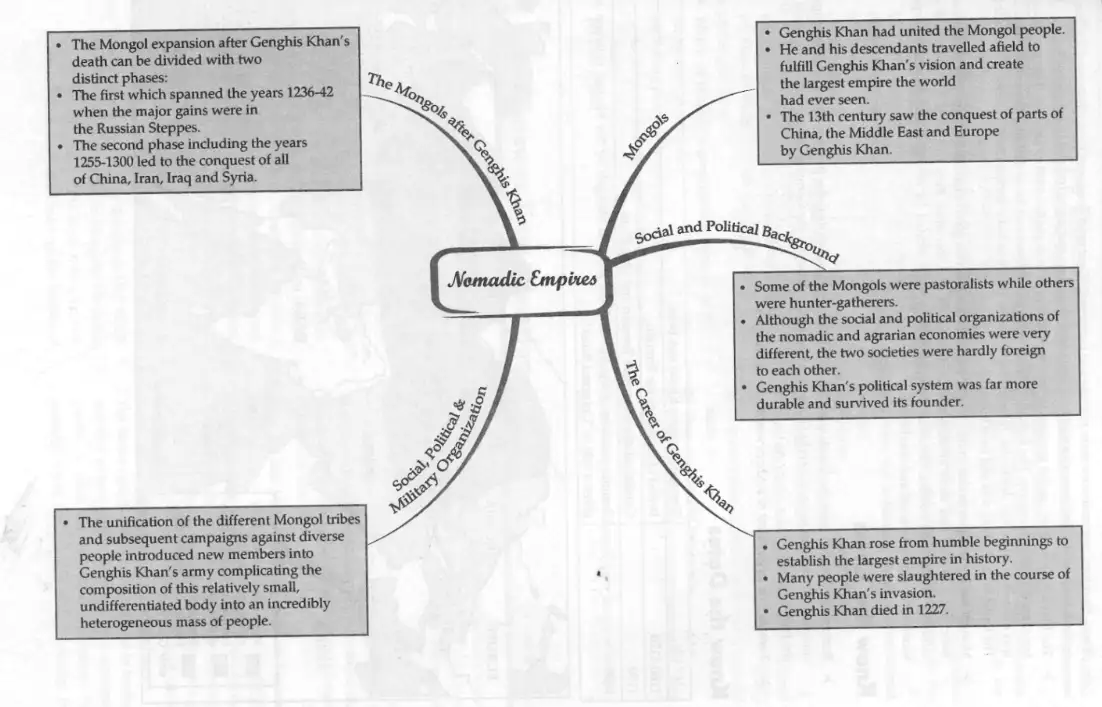
The 13th and 14th centuries mark a significant period in Central Asian history when the Mongols, under the leadership of Genghis Khan, established a vast transcontinental empire stretching from Europe to Asia. The Mongols were a nomadic group from the steppes of Central Asia, primarily modern-day Mongolia, living as pastoralists and hunter-gatherers. Their society was patriarchal, and they lived in tents, moving seasonally with their herds.
The Mongols had no tradition of producing their own literature, so historical sources about this period come mainly from chronicles, travelogues, and documents by city-based literati, which are often biased. Russian scholars in the 18th and 19th centuries contributed significantly to the study of Mongol history, using sources in multiple languages.
The Mongol tribes were ethnically and linguistically linked to groups such as the Tatars, Khitan, Manchus, and Turkic tribes. Their economy was based on barter trade with neighboring settled societies like China, exchanging agricultural produce and iron utensils for horses, furs, and game. This barter system sometimes led to military conflicts, prompting Chinese rulers to build fortifications such as the Great Wall of China.
Exam Questions
Q1: What were the main economic activities of the Mongols in the 13th and 14th centuries?
A1: The Mongols were primarily pastoralists and hunter-gatherers who engaged in barter trade with neighboring settled societies, exchanging agricultural produce and iron utensils for horses, furs, and game.
Q2: Why did the Chinese rulers build the Great Wall of China during this period?
A2: The Great Wall was built to defend against military pressures and raids from the nomadic Mongols, who often engaged in conflicts due to tensions in the barter trade system.
Formation of Empires
Genghis Khan, born in 1167 CE, was the son of Yesugei, chieftain of the Kiyat tribe. After his father's death, he faced many hardships but showed remarkable valor and leadership. Supported by allies like Jamuqa and Tughril Khan, he defeated powerful tribes and was declared the Great Khan in 1206 by the tribal assembly called Quriltai.
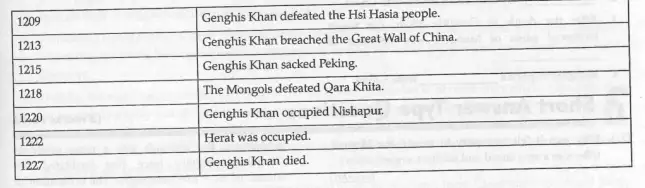
Genghis Khan initiated military campaigns to conquer China, defeating the Hsi Hsia people by 1209 CE, breaching the Great Wall in 1213, and sacking Peking in 1215. He also expanded westward, conquering regions such as Qara Khita, Transoxiana, and Khwarazm, capturing cities like Bukhara and Samarkand. His forces reached Crimea and the Caspian Sea, and although they planned to enter India, harsh weather prevented this.
Genghis Khan died in 1227 after a life of military conquest. His military success was due to innovative strategies, including superior horse-riding skills, rapid cavalry movements, and the use of siege engines and naphtha bombardment. After his death, Mongol expansion continued in two phases: 1236-1242, conquering parts of Europe, and 1255-1300, conquering China, Iran, Iraq, and Syria. However, internal family conflicts eventually weakened their campaigns.
Exam Questions
Q1: What title was bestowed upon Genghis Khan in 1206, and by whom?
A1: Genghis Khan was given the title of Great Khan by the Quriltai, the tribal assembly of Mongol chiefs, in 1206.
Q2: Describe two military innovations introduced by Genghis Khan.
A2: Genghis Khan's army used superior horse-riding skills for speed and mobility, and employed siege engines and naphtha bombardment to capture fortified cities.
Social, Political and Military Organisation
The Mongols were originally a nomadic society of pastoralists and hunters, with all adult males bearing arms. Genghis Khan reorganized the Mongol army into decimal units, dividing soldiers into groups of 10, 100, 1,000, and 10,000 called Tumans. This system integrated members from different tribes and clans, weakening old tribal loyalties and creating a new military identity.
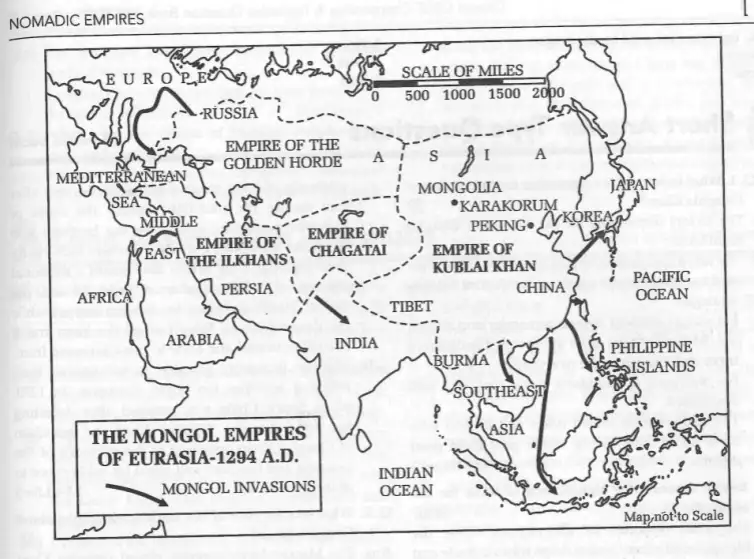
Military units called noyans were led by trusted commanders, including Genghis Khan's four sons: Jochi, Chaghatai, Ogodei, and Toluy. The empire was divided into Ulus or states, though these did not have fixed territories during Genghis Khan's lifetime. The capital was established at Karakorum.
The Quriltai, an assembly of chieftains, made collective decisions on important matters such as campaigns, plunder distribution, and succession. Genghis Khan also introduced the Yam, a courier system with relay stations for fast communication across the empire, funded by a special tax called Qubcur.
Administrators from conquered peoples were employed in the Mongol administration and often transferred between provinces to prevent local loyalties. Trade flourished along the Silk Route under Mongol rule, with traders paying a tax called Baj for safe passage.
Despite political control, the Mongols were a minority ruling over diverse populations. The Yasa, a legal code attributed to Genghis Khan, helped maintain order and Mongol identity. Over time, the empire's unity weakened due to succession struggles and the rise of individual dynasties.
Exam Questions
Q1: What was the purpose of dividing the Mongol army into Tumans?
A1: Dividing the army into Tumans integrated soldiers from different tribes, reducing tribal loyalties and creating a unified military force.
Q2: Explain the function of the Yam system.
A2: The Yam was a courier system with relay stations that enabled fast and reliable communication across the vast Mongol Empire.
Genghis Khan and the Mongols in World History
Genghis Khan is remembered differently across societies. While many civil societies view him as a conqueror responsible for widespread destruction and death, the Mongols regard him as their greatest ruler who united the tribes, ended internal wars, and established a prosperous empire.
The Mongol rulers practiced religious tolerance, recruiting people from various faiths such as Shamanism, Buddhism, Christianity, and Islam into their administration and military. This created a multi-ethnic, multi-lingual, and multi-religious empire, setting a precedent for later secular regimes like that of Mughal Emperor Akbar.
The Mongols maintained diplomatic relations with other countries, exemplified by the French emperor Louis IX sending a Franciscan monk to the court of Great Khan Mongke. The empire's capital was a cultural hub with artisans from various regions, reflecting its prosperity.
Today, Genghis Khan is honored as a national hero in independent Mongolia.
Exam Questions
Q1: How did the Mongol rulers approach religion within their empire?
A1: The Mongol rulers followed a policy of religious tolerance, allowing people of different faiths to serve in administration and military roles.
Q2: What is the significance of Genghis Khan in modern Mongolia?
A2: Genghis Khan is regarded as a venerable national hero who united the Mongol people and established a great empire.
Solved Examples
Example 1: Explain the significance of the decimal system in the Mongol military organization.
Solution: The decimal system divided the army into units of 10, 100, 1,000, and 10,000 soldiers called Tumans. This system integrated soldiers from different tribes, reducing tribal rivalries and creating a disciplined and unified military force, which was crucial for the Mongols' successful conquests.
Practice Set
Easy
- Who was Genghis Khan?
- What was the Yam system?
Moderate
- Describe the social and political organization of the Mongol Empire under Genghis Khan.
- What role did the Quriltai play in Mongol governance?
Challenging
- Analyze the impact of Mongol military strategies on their rapid expansion.
- Discuss the significance of religious tolerance in the Mongol Empire.
Answer Key
Easy:
1. Genghis Khan was the founder and Great Khan of the Mongol Empire who united the Mongol tribes and led them to conquer vast territories.
2. The Yam was a courier system established by Genghis Khan to enable fast communication across the empire.
Moderate:
1. The Mongol Empire was organized into military units called Tumans, integrating different tribes. The capital was Karakorum, and governance involved assemblies called Quriltai.
2. The Quriltai was an assembly of chieftains that made collective decisions on important state and family matters.
Challenging:
1. Mongol military strategies included superior horse-riding skills, rapid cavalry movements, and use of siege technology, enabling swift and effective conquests.
2. Religious tolerance allowed the Mongol Empire to govern a diverse population peacefully and recruit talented individuals regardless of faith.
Quick Reference
- Genghis Khan: Founder of the Mongol Empire, ruled 1206-1227 CE.
- Tuman: Military unit of 10,000 soldiers.
- Quriltai: Assembly of Mongol chieftains.
- Yam: Mongol courier system for communication.
- Yasa: Legal code attributed to Genghis Khan.
- Barter Trade: Exchange of goods between Mongols and settled societies.
Glossary
- Barbarians
- Term used by Greeks to describe non-Greeks whose language sounded like random noise.
- Tuman
- The largest military unit in the Mongol army, consisting of approximately 10,000 soldiers.
- Anda
- Blood-brothers, a close bond between Mongol warriors.
- Naukar
- Bondsmen or servants in Mongol society.
- Ulus
- Territorial divisions or states within the Mongol Empire.
- Quriltai
- Assembly of Mongol chieftains to decide on important matters.
- Yam
- The courier system established by Genghis Khan for fast communication.
- Qubcur
- Tax paid by nomads to maintain the Yam courier system.
- Qanats
- Underground canals used for irrigation.
- Baj
- Tax paid by traders for safe passage within Mongol territories.
Chronology of Mongol Empire
| Year | Event | Significance |
|---|---|---|
| 1167 | Birth of Temujin (Genghis Khan) | Beginning of the life of the future Mongol ruler |
| 1206 | Temujin declared Genghis Khan at Quriltai | Unification of Mongol tribes under one ruler |
| 1209 | Defeat of Hsi Hsia people | Start of Mongol expansion into China |
| 1213 | Breached Great Wall of China | Opened path for Mongol invasion of northern China |
| 1215 | Sack of Peking | Major conquest in China |
| 1218 | Defeat of Qara Khita | Expansion into Central Asia |
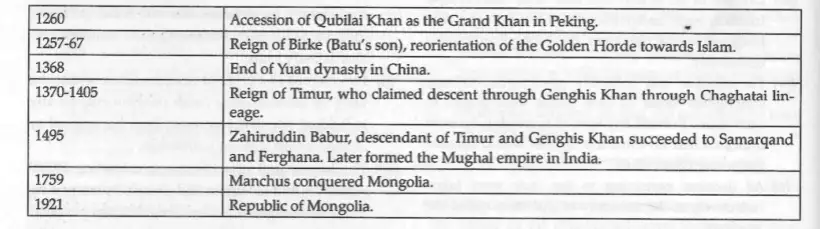
| 1227 | Death of Genghis Khan | End of founder's reign, empire continues to expand |
| 1236-1242 | Conquests in Europe (Russia, Poland, Hungary) | Expansion into Eastern Europe |
| 1255-1300 | Conquest of China, Iran, Iraq, Syria | Completion of vast Mongol Empire |
| 1294 | Height of Mongol Empire under Kublai Khan | Largest territorial extent of the empire |