CLASS 11-HUMANITIES . GEOGRAPHY . FUNDAMENTAL OF PHYSICAL GEOGRAPHY . WORLD CLIMATE-AND-CLIMATE-CHANGE
Chapter 11 : World Climate And Climate Change
Ch 11
GEOGRAPHY
CLASS 11-HUMANITIES
World Climate and Climate Change
Climate refers to the average weather conditions of a place over a long period. The Earth's climate varies widely due to natural and human factors. Climate change involves significant changes in global or regional climate patterns, especially from the mid to late 20th century onwards.
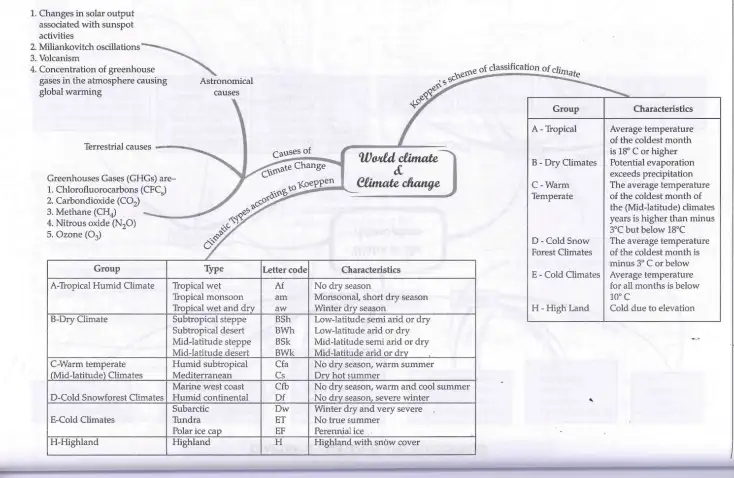
This diagram illustrates the causes of climate change, including astronomical and terrestrial factors, and presents the classification of various climate types based on Köppen's system.
Köppen's Scheme of Classification of Climate
Köppen's classification is an empirical system that relates climate to vegetation distribution using temperature and precipitation data. It divides climates into five major groups, designated by capital letters A, B, C, D, and E, with an additional group H for highland climates. Each group is further subdivided using small letters indicating seasonality of precipitation and temperature severity.
Exam Question
Q: What is the basis of Köppen's climate classification?
A: Köppen's classification is based on observed temperature and precipitation patterns and their relationship with vegetation distribution.
Tropical Humid Climates (Group A)
Located between the Tropic of Cancer and Tropic of Capricorn, these climates are hot and humid due to the sun's overhead position and the Inter Tropical Convergence Zone (ITCZ). They include:
- Af - Tropical Wet Climate: Found near the equator, e.g., Amazon Basin, western equatorial Africa. Temperatures range from 20°C to 30°C with high rainfall year-round.
- Am - Tropical Monsoon Climate: Found in the Indian subcontinent, northeastern South America, and northern Australia, characterized by seasonal monsoon rains.
- Aw - Tropical Wet and Dry Climate: Located north and south of Af regions, with distinct wet and dry seasons and deciduous forests.
Exam Question
Q: Name the three types of tropical humid climates in Köppen's classification.
A: Tropical wet (Af), tropical monsoon (Am), and tropical wet and dry (Aw) climates.
Dry Climates (Group B)
Characterized by low rainfall insufficient for most vegetation, these climates occur between 15° and 60° latitudes. They are subdivided into:
- BS - Steppe or Semi-arid Climate: Receives slightly more rainfall than deserts, supports sparse grasslands.
- BW - Desert Climate: Very low rainfall, extreme temperatures, and sparse vegetation.
Subtypes include subtropical steppe (BSh) and subtropical desert (BWh), with high summer temperatures and large temperature ranges.
Exam Question
Q: What distinguishes steppe climates from desert climates?
A: Steppe climates receive more rainfall than deserts, enough to support grasslands, while deserts have very low rainfall and sparse vegetation.
Warm Temperate Climates (Group C)
Found between 30° and 50° latitudes on continental margins, these climates have moderate temperatures and precipitation. Types include:
- Cwa - Humid Subtropical Climate: Warm winters, summer rainfall, found in North Indian plains and South China.
- Cs - Mediterranean Climate: Dry summers, wet winters, found around the Mediterranean Sea and similar latitudes.
- Cfa - Humid Subtropical Climate: Rainfall throughout the year, thunderstorms in summer, found in eastern USA, southern China.
- Cfb - Marine West Coast Climate: Mild temperatures, precipitation year-round, found in Northwestern Europe and parts of North America.
Exam Question
Q: Describe the Mediterranean climate characteristics.
A: Mediterranean climate has dry summers, wet winters, moderate temperatures, and annual precipitation between 35-90 cm.
Cold Snow Forest Climates (Group D)
Located between 40° and 70° north latitudes in Europe, Asia, and North America, these climates have severe winters and short summers. Types include:
- Df - Cold Climate with Humid Winters: Short frost-free season, large temperature ranges.
- Dw - Cold Climate with Dry Winters: Found in Northeastern Asia, low precipitation, monsoon-like wind reversals.
Exam Question
Q: What are the main features of cold snow forest climates?
A: They have severe winters, short summers, large temperature ranges, and varying precipitation patterns.
Polar Climates (Group E)
Found beyond 70° latitude, polar climates include:
- ET - Tundra Climate: Vegetation includes mosses and lichens; permafrost present; long daylight in summer.
- EF - Ice Cap Climate: Found in Greenland and Antarctica; temperatures below freezing year-round; very low precipitation.
Exam Question
Q: What distinguishes tundra climate from ice cap climate?
A: Tundra climate supports some vegetation and has permafrost, while ice cap climate is permanently frozen with no vegetation.
Highland Climates (Group H)
These climates are influenced by altitude and topography. Temperature and precipitation vary greatly over short distances, with vertical zonation of climate types on mountains.
Exam Question
Q: How does altitude affect highland climates?
A: Altitude causes temperature to decrease and precipitation patterns to change, creating distinct climate zones vertically.
Climate Change, Climate in the Past, Causes of Climate Change, Global Warming
Earth's climate has changed naturally over millions of years, with evidence from geological records, glacial deposits, tree rings, and historical data showing alternating warm and cold periods.
Examples include the wet and cool climate in Rajasthan around 8,000 B.C., the Harappan Civilization period with higher rainfall, and the Pleistocene Epoch with glacial and inter-glacial cycles.
Recent decades have seen increased climate variability, including extreme weather events and temperature rises.
Causes of Climate Change
Causes are grouped into astronomical and terrestrial factors:
- Astronomical Causes: Changes in solar output linked to sunspot cycles, Earth's orbital variations (Milankovitch cycles), and axial tilt affect insolation.
- Terrestrial Causes: Volcanic eruptions release aerosols that reduce solar radiation reaching Earth.
- Anthropogenic Causes: Increased greenhouse gas emissions from fossil fuel combustion, deforestation, and industrial activities enhance the greenhouse effect, leading to global warming.
Exam Question
Q: What are the main natural and human causes of climate change?
A: Natural causes include solar activity, Earth's orbital changes, and volcanic eruptions. Human causes mainly involve increased greenhouse gas emissions.
Greenhouse Effect and Global Warming
Greenhouse gases (GHGs) like carbon dioxide, methane, nitrous oxide, chlorofluorocarbons, and ozone trap heat in the atmosphere, warming the Earth. The greenhouse effect is essential for life but enhanced GHG concentrations cause global warming.
Global warming leads to rising temperatures, melting glaciers, sea-level rise, and climate disruptions.
International efforts like the Kyoto Protocol aim to reduce GHG emissions to mitigate climate change.
Exam Question
Q: What is the greenhouse effect and how does it relate to global warming?
A: The greenhouse effect is the trapping of heat by greenhouse gases in the atmosphere. Increased GHGs intensify this effect, causing global warming.
Solved Examples
- Example: Identify the climate type of a region with high temperatures year-round, heavy rainfall, and dense tropical forests.
Solution: This describes a Tropical Wet Climate (Af) under Köppen's classification.
- Example: Explain why deserts are found around 30° latitude.
Solution: These areas lie under subtropical high-pressure belts where descending air inhibits rainfall, creating dry desert climates.
Practice Set
Easy
- What does Köppen's climate classification primarily use to classify climates?
- Name two greenhouse gases responsible for global warming.
Moderate
- Describe the characteristics of the Mediterranean climate.
- What are Milankovitch cycles and how do they affect climate?
Challenging
- Explain the impact of volcanic eruptions on climate change.
- Discuss the significance of the Kyoto Protocol in addressing climate change.
Answer Key
- Köppen's classification uses temperature and precipitation data.
- Carbon dioxide (CO₂) and methane (CH₄).
- Dry summers, wet winters, moderate temperatures, and annual precipitation between 35-90 cm.
- Milankovitch cycles are variations in Earth's orbit and tilt that affect solar radiation and climate patterns.
- Volcanic eruptions release aerosols that reduce solar radiation, causing temporary cooling.
- The Kyoto Protocol is an international agreement to reduce greenhouse gas emissions to combat global warming.
Quick Reference
- Köppen Classification: A (Tropical), B (Dry), C (Warm Temperate), D (Cold Snow Forest), E (Polar), H (Highland)
- Greenhouse Gases: CO₂, CH₄, N₂O, CFCs, O₃
- Major Climate Change Causes: Solar activity, volcanic eruptions, greenhouse gas emissions
- Global Warming Effects: Temperature rise, glacier melting, sea-level rise
Glossary
- Köppen's Scheme
- Climate classification system based on temperature and precipitation related to vegetation.
- Greenhouse Effect
- Warming of Earth's atmosphere due to trapped heat by greenhouse gases.
- Global Warming
- Increase in Earth's average surface temperature due to enhanced greenhouse effect.
- Milankovitch Cycles
- Periodic changes in Earth's orbit and tilt affecting climate.
- Ozone Hole
- Depletion of ozone layer in the stratosphere allowing harmful UV rays to reach Earth.
- Kyoto Protocol
- International treaty to reduce greenhouse gas emissions.
| Time Period / Year | Event / Change | Importance |
|---|---|---|
| 8,000 B.C. | Wet and cool climate in Rajasthan desert | Indicates past climate variability affecting human settlements |
| 3,000-1,700 B.C. | Harappan Civilization flourished during higher rainfall period | Shows climate influence on ancient civilizations |
| 18,000 years ago | Last major glacial period in Pleistocene Epoch | Marks significant climate cooling phase |
| 1550-1850 | Little Ice Age in Europe | Period of cooler temperatures affecting agriculture and society |
| 1997 | Kyoto Protocol signed | Global effort to reduce greenhouse gas emissions |