CLASS 11-HUMANITIES . GEOGRAPHY . FUNDAMENTAL OF PHYSICAL GEOGRAPHY . WATER IN-THE-ATMOSPHERE
Chapter 10 : Water In The Atmosphere
Ch 10
GEOGRAPHY
CLASS 11-HUMANITIES
Water in the Atmosphere
Water in the atmosphere exists in various forms including precipitation, condensation, and clouds. These forms are essential components of the Earth's weather and climate system.
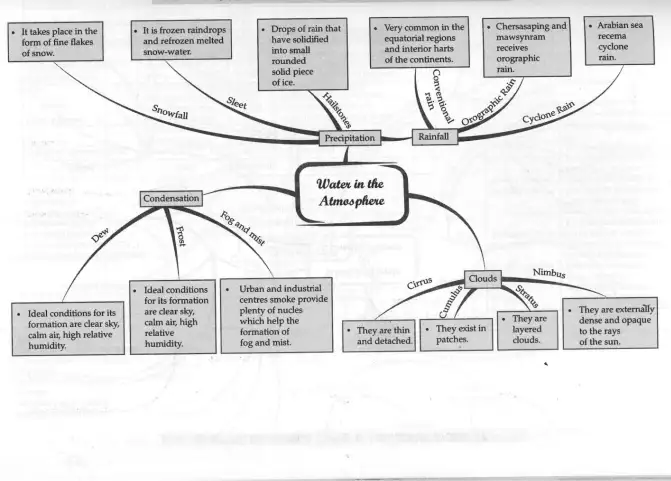
Forms of Water in the Atmosphere
Water in the atmosphere appears as precipitation (rainfall, snowfall, sleet, hailstones, cyclone rain), condensation (dew, frost, fog, mist), and clouds (cirrus, cumulus, stratus, nimbus).
Exam Question
Q: What are the main forms of water present in the atmosphere?
A: The main forms of water in the atmosphere are precipitation, condensation, and clouds.
Evaporation, Condensation, and Clouds
The atmosphere contains water vapour, which varies from zero to four percent by volume. Water exists in gaseous, liquid, and solid forms in the atmosphere. Water vapour is known as humidity and is measured as absolute humidity (actual amount of water vapour) and relative humidity (percentage of moisture compared to full capacity at a given temperature).
Evaporation is the process of water changing from liquid to gas, driven by heat. Condensation is the reverse process where water vapour turns into liquid or solid forms due to cooling. The temperature at which air becomes saturated and condensation begins is called the dew point.
Condensation forms dew, frost, fog, mist, and clouds. Dew forms on cool surfaces, frost forms when condensation occurs below freezing point, fog is a cloud near the ground formed by condensation on dust particles, and mist is similar but with thicker moisture layers. Smog is a mixture of fog and smoke.
Clouds are masses of tiny water droplets or ice crystals formed by condensation at high altitudes. They are classified into four types based on height and appearance:
- Cirrus: High altitude, thin, white, feathery clouds.
- Cumulus: Puffy, cotton-like clouds with flat bases at mid-altitudes.
- Stratus: Layered clouds covering large sky areas.
- Nimbus: Thick, dark clouds that bring precipitation.
Exam Question
Q: What causes condensation and what are the different forms it takes in the atmosphere?
A: Condensation occurs when water vapour cools and changes into liquid or solid forms. It results in dew, frost, fog, mist, and clouds.
Precipitation, Types of Rainfall, and World Distribution of Rainfall
Precipitation is the release of moisture from the atmosphere after condensation. It includes rainfall, snowfall, sleet, and hailstones. Rainfall is liquid water, snowfall is frozen flakes, sleet is frozen raindrops or refrozen snow, and hailstones are solid ice pieces.
Rainfall is classified into three types based on origin:
- Convectional Rain: Caused by heated air rising, cooling, and condensing, common in equatorial and interior continental regions.
- Orographic Rain: Occurs when moist air is forced to rise over mountains, causing condensation and rainfall on windward slopes; leeward slopes receive less rain (rain-shadow area).
- Cyclonic Rain: Results from the meeting of two air masses with different temperatures and humidity, often associated with cyclones.
Rainfall distribution varies globally, with coastal and equatorial regions receiving heavy rainfall, interior continental areas receiving moderate rainfall, and rain-shadow and high latitude areas receiving low rainfall.
Exam Question
Q: What are the three main types of rainfall and how do they occur?
A: The three main types of rainfall are convectional (heated air rises and cools), orographic (air forced over mountains), and cyclonic (air masses meet causing precipitation).
Solved Examples
Example 1: Explain why dew forms on grass blades during early morning.
Answer: Dew forms when the temperature of the air drops to the dew point, causing water vapour to condense on cool surfaces like grass blades.
Example 2: Describe the characteristics of nimbus clouds.
Answer: Nimbus clouds are thick, dark grey or black clouds that are dense and opaque, often bringing heavy rainfall and sometimes appearing to touch the ground.
Practice Set
Easy
- Define humidity.
- What is the dew point?
Moderate
- Explain the difference between absolute and relative humidity.
- List and describe the four main types of clouds.
Challenging
- Describe the process and conditions leading to orographic rainfall.
- Explain how fog and smog differ.
Answer Key
- Humidity: Water vapour present in the air.
- Dew point: Temperature at which air becomes saturated and condensation begins.
- Absolute vs Relative Humidity: Absolute humidity is the actual amount of water vapour; relative humidity is the percentage of moisture relative to full capacity at a given temperature.
- Four main cloud types: Cirrus (high, thin), Cumulus (puffy), Stratus (layered), Nimbus (dark, rain-bearing).
- Orographic rainfall: Occurs when moist air is forced to rise over mountains, cools, and condenses, causing rain on windward slopes.
- Fog vs Smog: Fog is a cloud near the ground formed by condensation; smog is fog mixed with smoke and pollution.
Quick Reference
- Humidity: Water vapour in air.
- Evaporation: Liquid water to vapour.
- Condensation: Vapour to liquid or solid.
- Dew Point: Temperature for saturation.
- Precipitation: Moisture falling as rain, snow, etc.
- Cloud Types: Cirrus, Cumulus, Stratus, Nimbus.
- Rainfall Types: Convectional, Orographic, Cyclonic.
Glossary
- Absolute Humidity
- Actual amount of water vapour in the air.
- Condensation
- Process of water vapour turning into liquid or solid.
- Dew
- Water droplets formed on cool surfaces.
- Dew Point
- Temperature at which air becomes saturated.
- Evaporation
- Change of water from liquid to gas.
- Humidity
- Water vapour present in the air.
- Orographic Rain
- Rain caused by air rising over mountains.
- Precipitation
- Release of moisture from the atmosphere.
- Relative Humidity
- Percentage of moisture relative to full capacity.
- Smog
- Combination of smoke and fog.
Chronology of Water in the Atmosphere
| Time Period / Year | Event / Change | Importance |
|---|---|---|
| Continuous | Evaporation and condensation cycles | Maintains atmospheric moisture and weather patterns |
| Formation of Clouds | Condensation of water vapour at various altitudes | Leads to different cloud types affecting weather |
| Precipitation Events | Release of moisture as rain, snow, sleet, hail | Essential for replenishing water on Earth's surface |
| Seasonal Variations | Changes in rainfall distribution globally | Influences climate zones and ecosystems |