CLASS 11-HUMANITIES . GEOGRAPHY . FUNDAMENTAL OF PHYSICAL GEOGRAPHY . THE ORIGIN-AND-EVOLUTION-OF-THE-EARTH
Chapter 2 : THE ORIGIN AND EVOLUTION OF THE EARTH
Ch 2
GEOGRAPHY
CLASS 11-HUMANITIES
The Origin and Evolution of the Earth
The origin and evolution of the Earth is a fundamental topic in physical geography that explains how our planet formed and developed over billions of years. Scientists have proposed various theories to explain the Earth's beginnings, ranging from early philosophical ideas to modern scientific explanations.
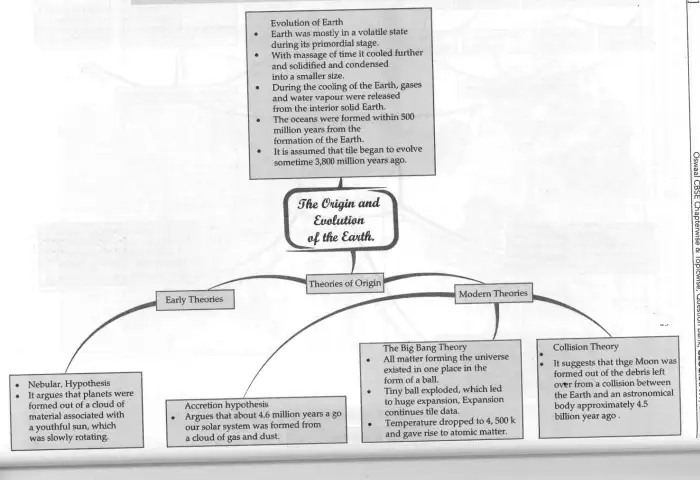
The Earth started as a hot, volatile mass that gradually cooled and solidified. Gases and water vapor released during this process led to the formation of oceans within 500 million years. Life likely began around 3.8 billion years ago. Understanding these stages helps us appreciate the complex processes that shaped our planet.
Early Theories and Modern Theories of Earth's Origin
Early theories about the Earth's origin include the Nebular Hypothesis proposed by Immanuel Kant and revised by Laplace in 1796. This hypothesis suggests that planets formed from a slowly rotating cloud of gas and dust around a young sun. The Binary Theories, supported by scientists like Chamberlain, Moulton, Jeans, and Jeffrey, proposed that a wandering star's close approach caused material to separate from the sun, forming planets.
Modern scientific theories focus on the origin of the universe itself. The Big Bang Theory, also known as the Expanding Universe Hypothesis, is widely accepted. It states that the universe began as a tiny, dense ball that exploded and expanded about 13.7 billion years ago. This expansion continues today, leading to the formation of atoms, stars, galaxies, and eventually planets.
| Time Period / Year | Event / Change | Importance |
|---|---|---|
| ~13.7 billion years ago | Big Bang event | Origin of the universe and beginning of expansion |
| ~5.6 billion years ago | Formation of stars from nebulae | Stars formed from hydrogen gas clouds, leading to solar system formation |
| ~4.6 billion years ago | Formation of the solar system and planets | Planets formed from planetesimals around the sun |
| ~4.5 billion years ago | Formation of the Moon (Big Splat) | Moon formed from debris after a giant collision with Earth |
| ~3.8 billion years ago | Origin of life on Earth | First life forms appeared in oceans |
Exam Question
Q: What is the Nebular Hypothesis and who proposed it?
A: The Nebular Hypothesis, proposed by Immanuel Kant and revised by Laplace, suggests that planets formed from a slowly rotating cloud of gas and dust around a young sun.
Our Solar System and the Moon
Our solar system consists of the sun, eight planets, 63 moons, millions of smaller bodies like asteroids and comets, and vast amounts of dust and gases. The planets are divided into inner and outer groups. The inner planets—Mercury, Venus, Earth, and Mars—are terrestrial, meaning they are rocky and dense. The outer planets—Jupiter, Saturn, Uranus, and Neptune—are Jovian or gas giants, mostly composed of hydrogen and helium.
The Moon is Earth's only natural satellite. Earlier theories suggested it formed from a rapidly rotating Earth or from material pulled away by tidal forces. The currently accepted theory is the Giant Impact or Big Splat theory, which states that a Mars-sized body collided with Earth, and the debris formed the Moon about 4.44 billion years ago.
Exam Question
Q: What is the Big Splat theory regarding the Moon's origin?
A: The Big Splat theory states that the Moon formed from debris after a giant collision between Earth and a Mars-sized body shortly after Earth's formation.
Evolution of the Earth, Lithosphere, Atmosphere, Hydrosphere, and Origin of Life
The Earth has a layered structure with different materials arranged by density. Heavier materials like iron sank to the center forming the core, while lighter materials formed the crust. The Earth cooled and solidified over time, developing the lithosphere.
The atmosphere evolved in three stages: loss of the primordial atmosphere, contribution from Earth's interior, and modification by living organisms through photosynthesis. The hydrosphere formed as water vapor condensed into oceans.
Life began around 3.8 billion years ago, initially confined to oceans. Photosynthesis evolved between 2.5 and 3 billion years ago, producing oxygen that eventually accumulated in the atmosphere, enabling diverse life forms.
Exam Question
Q: What is differentiation in the context of Earth's evolution?
A: Differentiation is the process by which Earth's materials separated into layers of different densities, forming the core, mantle, and crust.
Solved Examples
Example 1: Explain the stages of the Big Bang Theory.
Solution: The Big Bang Theory states that the universe began as a tiny, dense ball that exploded and expanded about 13.7 billion years ago. Within minutes, the first atoms formed. Over time, the universe cooled, allowing stars and galaxies to form.
Example 2: Describe the difference between terrestrial and Jovian planets.
Solution: Terrestrial planets are rocky and dense, located closer to the sun (Mercury, Venus, Earth, Mars). Jovian planets are gas giants with thick atmospheres, located farther from the sun (Jupiter, Saturn, Uranus, Neptune).
Practice Set
Easy
- What is a nebula?
- Name the four inner planets of the solar system.
Moderate
- Explain the Big Bang Theory in brief.
- What is the significance of photosynthesis in Earth's atmospheric evolution?
Challenging
- Describe the process of planet formation from planetesimals.
- Discuss the Giant Impact theory for the Moon's formation.
Answer Key
- Easy 1: A nebula is a large cloud of hydrogen gas and dust in space.
- Easy 2: Mercury, Venus, Earth, Mars.
- Moderate 1: The Big Bang Theory states that the universe began as a tiny dense ball that exploded and expanded about 13.7 billion years ago.
- Moderate 2: Photosynthesis produced oxygen, which changed the atmosphere and allowed diverse life forms to evolve.
- Challenging 1: Small rounded objects called planetesimals formed from gas and dust, collided, and stuck together due to gravity to form planets.
- Challenging 2: The Giant Impact theory suggests a Mars-sized body collided with Earth, and the debris formed the Moon.
Quick Reference
- Nebular Hypothesis: Planets formed from a rotating cloud of gas and dust.
- Big Bang Theory: Universe began with a massive explosion and expansion.
- Planetesimals: Small bodies formed from gas and dust that combined to form planets.
- Big Splat: Giant collision that formed the Moon.
- Differentiation: Separation of Earth's materials into layers.
- Photosynthesis: Process by which plants produce oxygen.
Glossary
- Nebula
- A large cloud of gas and dust in space where stars and planets form.
- Planetesimals
- Small solid objects formed from dust and gas that combine to form planets.
- Big Bang Theory
- The scientific explanation for the origin of the universe involving a massive explosion and expansion.
- Giant Impact (Big Splat)
- The collision between Earth and a Mars-sized body that led to the formation of the Moon.
- Differentiation
- The process of separation of Earth's materials into layers based on density.
- Photosynthesis
- The process by which green plants use sunlight to produce oxygen and nutrients.