CLASS 11-HUMANITIES . GEOGRAPHY . FUNDAMENTAL OF PHYSICAL GEOGRAPHY . SOLAR RADIATION-HEAT-BALANCE-AND-TEMPERATURE
Chapter 8 : Solar Radiation, Heat Balance And Temperature
Ch 8
GEOGRAPHY
CLASS 11-HUMANITIES
Solar Radiation, Heat Balance and Temperature
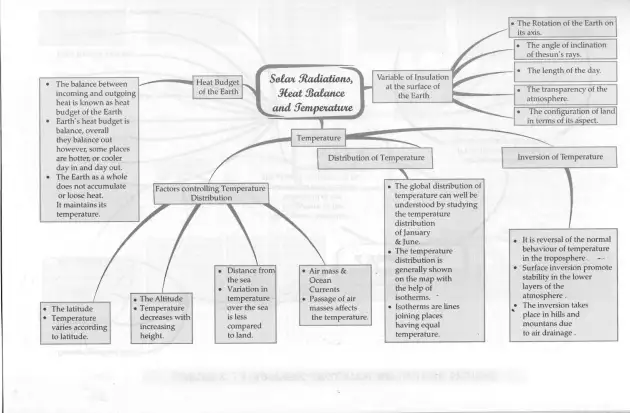
Solar radiation is the energy emitted by the sun that reaches the Earth. The balance between the incoming solar radiation and the outgoing terrestrial radiation is known as the Earth's heat budget. This balance maintains the Earth's temperature and climate. Temperature distribution on Earth is influenced by various factors such as latitude, altitude, distance from the sea, air masses, and ocean currents. The Earth's rotation, tilt, and atmospheric conditions also affect how solar radiation is received and distributed.
Exam Questions
Q1: What is the Earth's heat budget?
A1: The Earth's heat budget is the balance between the incoming solar radiation and the outgoing terrestrial radiation, which maintains the Earth's temperature.
Q2: Name two factors that affect temperature distribution on Earth.
A2: Latitude and altitude are two factors that affect temperature distribution.
Solar Radiation, Variability of Insolation at the Surface of the Earth, Heating and Cooling of Atmosphere, Terrestrial Radiation
The Earth receives almost all its energy from the sun in the form of solar radiation, also called insolation. The amount of insolation varies due to Earth's spherical shape, its rotation, and its revolution around the sun. The Earth is farthest from the sun at aphelion (4th July) and nearest at perihelion (3rd January). These variations cause differences in temperature and pressure, leading to wind and heat transfer.
Insolation is mostly shortwave radiation that passes through the atmosphere and heats the Earth's surface. The Earth then emits longwave radiation, heating the atmosphere from below, a process called terrestrial radiation. Heat transfer in the atmosphere occurs through conduction (direct contact), convection (vertical movement), and advection (horizontal movement). For example, the hot dry winds called 'loo' in northern India during summer are caused by advection.
Exam Questions
Q1: What is insolation?
A1: Insolation is the incoming solar radiation received by the Earth's surface.
Q2: Explain terrestrial radiation.
A2: Terrestrial radiation is the longwave radiation emitted by the Earth after being heated by the sun, which heats the atmosphere from below.
Heat Budget of the Planet Earth, Temperature, Factors Controlling Temperature Distribution, Inversion of Temperature
The Earth maintains its temperature by balancing the heat received from the sun and the heat lost through terrestrial radiation. About 35% of solar radiation is reflected back to space, known as the Earth's albedo. The surplus heat in the tropics is redistributed towards the poles, preventing extreme temperature differences.
Temperature is influenced by several factors:
- Latitude: Temperature varies with distance from the equator due to varying insolation.
- Altitude: Temperature decreases with height at a normal lapse rate of 6.5°C per 1000 meters.
- Distance from the Sea: Land heats and cools faster than the sea, causing temperature variations.
- Air Masses and Ocean Currents: Warm air masses and currents increase temperature, while cold ones decrease it.
Temperature distribution is shown on maps using isotherms, lines joining points of equal temperature. Sometimes, temperature inversion occurs when the normal decrease of temperature with height is reversed, often during clear, calm nights or in polar regions. Cold air drains down slopes and collects in valleys, protecting plants from frost.
Exam Questions
Q1: What is the normal lapse rate?
A1: The normal lapse rate is the rate at which temperature decreases with altitude, approximately 6.5°C per 1000 meters.
Q2: Define temperature inversion.
A2: Temperature inversion is a reversal of the normal temperature pattern where temperature increases with height instead of decreasing.
Solved Examples
Example 1: Explain why the equator receives less insolation than the tropics despite being closer to the sun.
Solution: The equator receives less insolation than the subtropical deserts because of higher cloud cover and atmospheric moisture, which reflect and absorb solar radiation, reducing the amount reaching the surface.
Example 2: Describe the process of heat transfer by convection in the atmosphere.
Solution: Convection is the vertical transfer of heat where warm air near the Earth's surface rises, carrying heat upwards and warming the upper layers of the atmosphere.
Practice Set
Easy
- What is insolation?
- Define albedo.
Moderate
- Explain the factors affecting temperature distribution on Earth.
- What causes the 'loo' winds in northern India?
Challenging
- Discuss the significance of Earth's heat budget in maintaining climate stability.
- Explain the phenomenon of temperature inversion and its effects on weather.
Answer Key
Easy:
- Insolation is the incoming solar radiation received by the Earth's surface.
- Albedo is the fraction of solar radiation reflected back to space by the Earth's surface and atmosphere.
Moderate:
- Temperature distribution is affected by latitude, altitude, distance from the sea, air masses, and ocean currents.
- 'Loo' winds are hot, dry winds caused by horizontal heat transfer (advection) during summer in northern India.
Challenging:
- The Earth's heat budget balances incoming and outgoing radiation, preventing extreme temperature changes and maintaining climate stability.
- Temperature inversion occurs when a layer of warm air lies above cooler air near the surface, affecting weather by trapping pollutants and causing fog.
Quick Reference
- Insolation: Incoming solar radiation.
- Albedo: Reflectivity of Earth's surface.
- Heat Budget: Balance of incoming and outgoing heat.
- Conduction: Heat transfer by direct contact.
- Convection: Vertical heat transfer by rising air.
- Advection: Horizontal heat transfer by wind.
- Terrestrial Radiation: Longwave radiation emitted by Earth.
- Normal Lapse Rate: Temperature decrease with altitude.
- Temperature Inversion: Reversal of normal temperature decrease with height.
Glossary
- Aphelion
- The point in Earth's orbit when it is farthest from the sun.
- Perihelion
- The point in Earth's orbit when it is closest to the sun.
- Isotherms
- Lines on a map connecting points of equal temperature.
- Albedo
- The proportion of solar radiation reflected by a surface.
- Conduction
- Transfer of heat through direct contact between substances.
- Convection
- Transfer of heat by the movement of fluids or gases.
- Advection
- Horizontal transfer of heat by wind or water currents.
- Terrestrial Radiation
- Longwave radiation emitted by the Earth after absorbing solar energy.
- Temperature Inversion
- A meteorological condition where temperature increases with altitude instead of decreasing.
Chronology of Key Events
| Time Period / Year | Event / Change | Importance |
|---|---|---|
| 3rd January | Perihelion - Earth closest to the sun | Maximum solar radiation received, minor effect on weather |
| 4th July | Aphelion - Earth farthest from the sun | Minimum solar radiation received, minor effect on weather |
| Daily | Variation in insolation due to Earth's rotation | Causes day and night temperature changes |
| Seasonal | Variation in insolation due to Earth's tilt and revolution | Causes seasons and temperature variation |
| Nighttime | Temperature inversion occurrence | Leads to cold air pooling and frost in valleys |