CLASS 11-HUMANITIES . GEOGRAPHY . INDIA PHYSICAL ENVIRONMENT . NATURAL VEGETATION
Chapter 5 : Natural Vegetation
Ch 5
GEOGRAPHY
CLASS 11-HUMANITIES
Natural Vegetation
Natural vegetation refers to plant communities that have developed naturally without human interference, adapting to the climate and soil conditions of a region over a long period. India, with its diverse climate and soil types, exhibits a wide variety of natural vegetation types across different regions.
What is natural vegetation and why does it vary across India?
Answer: Natural vegetation is the plant life that grows naturally in an area without human intervention. It varies across India due to differences in climate, soil, and topography.
Types of Forests and Forest Cover in India
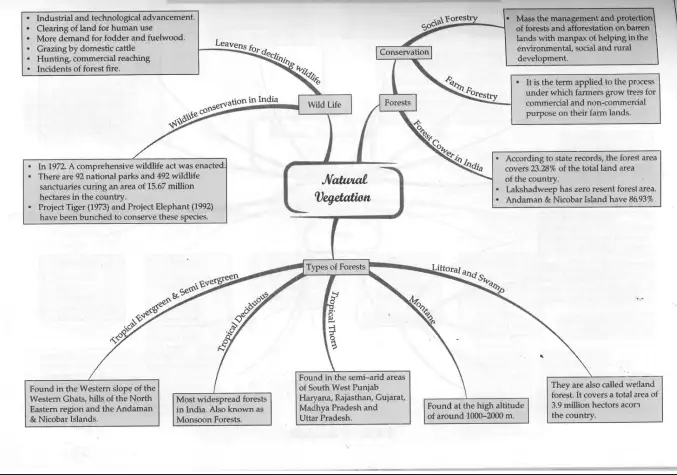
India's forests are classified into several types based on climate, rainfall, and altitude. The main types include:
- Tropical Evergreen and Semi Evergreen Forests: Found in the western slopes of the Western Ghats, northeastern hills, and Andaman and Nicobar Islands. These forests receive over 200 cm of rainfall annually and have tall, dense trees that remain green throughout the year.
- Tropical Deciduous Forests: Also called monsoon forests, they are the most widespread in India. They are divided into moist deciduous (rainfall 100-200 cm) and dry deciduous (rainfall 70-100 cm) forests.
- Tropical Thorn Forests: Found in areas with less than 50 cm rainfall, such as parts of Punjab, Rajasthan, and Gujarat. These forests have thorny trees and shrubs.
- Montane Forests: Located in mountainous regions, these forests vary with altitude and include northern mountain forests (e.g., deodar) and southern mountain forests (e.g., sholas and wattle).
- Littoral and Swamp Forests: Wetland forests found in coastal and swampy areas, including mangroves in the Sundarbans and Andaman and Nicobar Islands.
Forest cover in India varies by state, with an average of about 21.05% of the land area under forest canopy as of 2011. The Andaman and Nicobar Islands have the highest forest cover, while states like Rajasthan and Gujarat have less than 10%.
What are the main types of forests in India and where are they found?
Answer: The main forest types are tropical evergreen and semi-evergreen (Western Ghats, Northeast), tropical deciduous (widespread), tropical thorn (dry regions), montane (mountains), and littoral and swamp forests (coastal and wetland areas).
Forest Conservation, Social Forestry, Farm Forestry, Wildlife Conservation, and Biosphere Reserves
Forests are vital for environmental stability, biodiversity, and the economy. To protect and increase forest cover, India has implemented policies and programs including:
- Forest Conservation Policy: Adopted in 1952 and revised in 1988, aiming to bring 33% of the land under forest cover and maintain ecological balance.
- Social Forestry: Involves planting trees on barren lands and community lands to support environmental and social development. It includes urban forestry (trees in cities), rural forestry (agro-forestry and community forestry), and farm forestry (trees grown on farms).
- Wildlife Conservation: India enacted the Wildlife Protection Act in 1972 to protect endangered species and habitats. There are over 100 national parks and 500 wildlife sanctuaries. Special projects like Project Tiger and Project Elephant focus on conserving these species.
- Biosphere Reserves: These are protected areas recognized under UNESCO's Man and Biosphere Programme, representing unique ecosystems. India has 18 biosphere reserves, including Nilgiri, Nanda Devi, Sundarbans, and Gulf of Mannar.
What are the key objectives of India's forest conservation policy?
Answer: To increase forest cover to 33%, maintain environmental stability, conserve biodiversity, prevent soil erosion and desertification, and promote social forestry and afforestation.
What is social forestry and its types?
Answer: Social forestry is the management and protection of forests and tree planting on barren lands to aid environmental and social development. Types include urban forestry, rural forestry (agro-forestry and community forestry), and farm forestry.
What are biosphere reserves and name some in India?
Answer: Biosphere reserves are protected ecosystems recognized internationally for conservation and sustainable use. Examples in India include Nilgiri, Nanda Devi, Sundarbans, and Gulf of Mannar.
Solved Examples
Example 1:
Question: Describe the characteristics of tropical evergreen forests.
Answer: Tropical evergreen forests are found in areas with over 200 cm of rainfall and warm temperatures. They have tall, dense trees that remain green throughout the year, with multiple layers including shrubs and creepers. Common species include rosewood, mahogany, and ebony.
Example 2:
Question: What measures has India taken for wildlife conservation?
Answer: India enacted the Wildlife Protection Act in 1972, established national parks and sanctuaries, and launched projects like Project Tiger and Project Elephant to protect endangered species and their habitats.
Practice Set
Easy
- What is natural vegetation?
- Name two types of forests found in India.
Moderate
- Explain the difference between forest area and forest cover.
- What is social forestry? Mention its types.
Challenging
- Discuss the importance of biosphere reserves and name any two in India.
- Describe the main causes of wildlife decline in India.
Answer Key
- Natural vegetation: Plant communities growing naturally without human interference.
- Two forest types: Tropical evergreen, tropical deciduous.
- Forest area vs forest cover: Forest area is land notified as forest; forest cover is area actually covered by trees.
- Social forestry: Tree planting on barren and community lands; types include urban, rural, and farm forestry.
- Biosphere reserves: Protected ecosystems for conservation; examples: Nilgiri, Sundarbans.
- Causes of wildlife decline: Habitat loss, hunting, industrialization, forest fires, grazing pressure.
Quick Reference
- Natural Vegetation: Plant life adapted to local climate and soil.
- Forest Types: Tropical evergreen, deciduous, thorn, montane, littoral and swamp.
- Forest Cover: 21.05% of India’s land area (2011).
- Forest Conservation: Policies to increase forest cover and protect biodiversity.
- Social Forestry: Community and farm-based tree planting programs.
- Wildlife Protection Act: Legal framework for wildlife conservation since 1972.
- Biosphere Reserves: Internationally recognized conservation areas.
Glossary
- Natural Vegetation
- Plant communities that grow naturally without human interference.
- Forest Cover
- Area occupied by forests with tree canopy.
- Social Forestry
- Planting and managing trees on barren and community lands for environmental and social benefits.
- Wildlife Protection Act
- Law enacted in 1972 to protect wildlife and their habitats in India.
- Biosphere Reserve
- Protected area recognized internationally for conservation and sustainable use of ecosystems.
| Time Period / Year | Event / Change | Importance |
|---|---|---|
| 1952 | First Forest Policy adopted | Set goals for forest conservation and management |
| 1972 | Wildlife Protection Act enacted | Legal framework for wildlife conservation |
| 1973 | Project Tiger launched | Conservation of tiger population and habitat |
| 1986 | Nilgiri Biosphere Reserve established | First biosphere reserve in India |
| 1992 | Project Elephant launched | Conservation of wild elephants |