CLASS 11-HUMANITIES . GEOGRAPHY . INDIA PHYSICAL ENVIRONMENT . NATURAL HAZARDS-AND-DISASTERS
Chapter 6 : Natural Hazards And Disasters
Ch 6
GEOGRAPHY
CLASS 11-HUMANITIES
Natural Hazards and Disasters
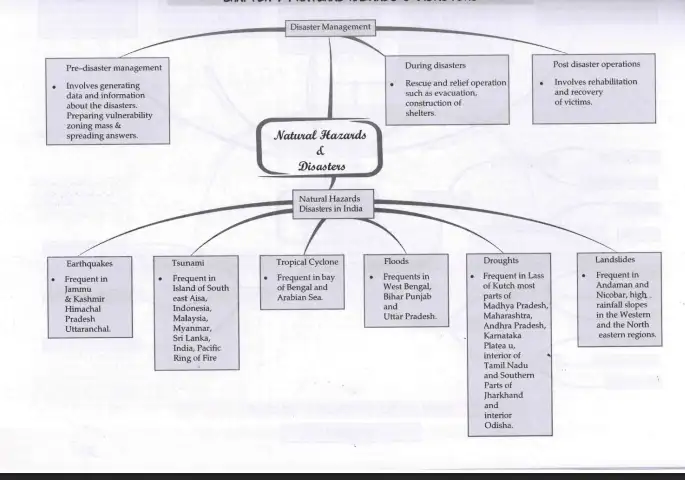
Natural hazards are elements or circumstances in the natural environment that have the potential to cause harm to people or property. Natural disasters are sudden events causing widespread death, loss of property, and disruption to social systems, often beyond human control. India experiences various natural disasters such as earthquakes, tsunamis, tropical cyclones, floods, droughts, and landslides. Effective disaster management involves three phases: pre-disaster (preparation and awareness), during disaster (rescue and relief), and post-disaster (rehabilitation and recovery).
What are natural hazards and how do they differ from natural disasters?
Answer: Natural hazards are potential threats in the environment that can cause harm, while natural disasters are actual events that cause significant damage and disruption.
Classification of Natural Disasters
Disasters can be natural or human-induced. Natural disasters include earthquakes, tsunamis, cyclones, floods, droughts, and landslides. Human activities such as deforestation, unscientific land use, and pollution can also cause or worsen disasters. Natural hazards are environmental conditions with potential harm, whereas natural disasters are sudden events causing large-scale damage and loss.
Why is it important to classify disasters?
Answer: Classification helps in understanding the causes, preparing appropriate responses, and managing disasters effectively.
Natural Disasters and Hazards in India, Disaster Management
Earthquakes: Caused by tectonic movements, earthquakes are highly destructive and unpredictable. Vulnerable areas include Jammu & Kashmir, Himachal Pradesh, Uttarakhand, Sikkim, Darjeeling, and the northeastern states. India is divided into five earthquake zones based on risk levels, with the highest risk zones experiencing the most severe earthquakes.
Socio-Environmental Consequences: Earthquakes damage infrastructure, homes, and cultural heritage, causing homelessness and economic stress. They can also trigger landslides and floods by altering river courses.
Mitigation: Establishing seismological centers, using GPS for tectonic monitoring, preparing vulnerability maps, educating the public, and adopting earthquake-resistant construction are key measures.
What are the main consequences of earthquakes in India?
Answer: Earthquakes cause loss of life, destruction of property, homelessness, and secondary disasters like landslides and floods.
Tsunamis: Result from underwater earthquakes or volcanic eruptions causing sudden ocean water displacement. Tsunamis cause massive coastal destruction, especially along the Pacific Ring of Fire and Indian coastal regions. Mitigation is difficult due to the scale of impact.
Why are tsunamis difficult to mitigate?
Answer: Because they cause large-scale destruction suddenly and affect vast coastal areas, making early warning and prevention challenging.
Tropical Cyclones: Intense low-pressure systems between 30°N and 30°S latitudes, powered by latent heat from ocean moisture. They have a warm, low-pressure eye and can extend horizontally up to 1000 km. Cyclones mainly occur in the Bay of Bengal and Arabian Sea, especially during October and November.
Consequences: High-velocity winds cause damage to coastal areas, and storm surges lead to abnormal sea level rise and flooding.
What conditions are necessary for the formation of tropical cyclones?
Answer: Warm moist air, strong Coriolis force, unstable troposphere, and absence of strong vertical wind shear.
Floods: Occur when water exceeds river channel capacity, caused by heavy rainfall, storm surges, snowmelt, or soil erosion. Common in West Bengal, Bihar, Punjab, Uttar Pradesh, and increasingly in Rajasthan, Gujarat, Haryana, and Punjab.
Consequences: Crop damage, infrastructure destruction, homelessness, and spread of waterborne diseases. Floods also deposit fertile silt beneficial for agriculture.
How do floods impact human life and the environment?
Answer: Floods cause loss of crops, damage to infrastructure, displacement of people, and spread of diseases, but also enrich soil fertility.
Droughts: Extended periods of water shortage due to low rainfall, high evaporation, and overuse of water resources. Types include meteorological, agricultural, hydrological, and ecological droughts. About 30% of India is drought-prone, affecting 50 million people.
Consequences: Crop failure, scarcity of fodder and water, death of livestock, migration, and spread of waterborne diseases.
What are the different types of droughts?
Answer: Meteorological (rainfall deficiency), agricultural (soil moisture deficit), hydrological (water storage shortage), and ecological (ecosystem productivity decline).
Landslides: Rapid downslope movement of rock and debris, influenced by geology, slope, rainfall, vegetation, and human activity. High vulnerability zones include the Himalayas, Andaman and Nicobar Islands, Western Ghats, and northeastern states.
Consequences: Road and railway blockages, river course changes causing floods, and property damage.
Mitigation: Restrict construction in vulnerable areas, promote terrace farming, afforestation, and build protective structures like embankments and cyclone shelters.
What factors contribute to landslides and how can they be mitigated?
Answer: Factors include steep slopes, heavy rainfall, deforestation, and construction. Mitigation involves controlling land use, afforestation, and engineering measures.
Disaster Management Phases
Disaster management involves three stages:
- Pre-disaster: Data collection, vulnerability mapping, and public awareness.
- During disaster: Rescue, relief, evacuation, and provision of essentials.
- Post-disaster: Rehabilitation and recovery of affected populations.
Government initiatives include the Disaster Management Bill, 2005, and the National Institute of Disaster Management.
What are the key activities in each phase of disaster management?
Answer: Pre-disaster focuses on preparedness, during disaster on emergency response, and post-disaster on rehabilitation.
Solved Examples
Example 1:
Question: Name two states in India that are highly vulnerable to earthquakes and explain why.
Answer: Jammu & Kashmir and Himachal Pradesh are highly vulnerable due to their location in the Himalayan seismic zone where tectonic plate movements cause frequent earthquakes.
Example 2:
Question: What is a storm surge and which natural disaster is it associated with?
Answer: A storm surge is an abnormal rise in sea level caused by strong winds and low pressure during a tropical cyclone, leading to coastal flooding.
Practice Set
Easy
- Define natural hazards and natural disasters.
- List two major natural disasters common in India.
Moderate
- Explain the socio-environmental consequences of earthquakes.
- Describe the phases of disaster management.
Challenging
- Discuss the causes and effects of drought in India.
- Explain the formation and impact of tropical cyclones in the Bay of Bengal.
Answer Key
Easy:
- Natural hazards are potential threats; natural disasters are actual damaging events.
- Earthquakes and floods.
Moderate:
- Earthquakes cause loss of life, damage to infrastructure, homelessness, and secondary disasters like landslides.
- Disaster management includes pre-disaster preparedness, during disaster response, and post-disaster rehabilitation.
Challenging:
- Drought is caused by inadequate rainfall and high evaporation, leading to crop failure, water scarcity, and migration.
- Tropical cyclones form over warm ocean waters, causing strong winds, heavy rain, storm surges, and damage to coastal areas.
Quick Reference
- Natural Hazard: Potential environmental threat.
- Natural Disaster: Sudden event causing damage.
- Earthquake Zones: Five zones from very high to very low risk.
- Tsunami: Seismic sea wave caused by underwater disturbances.
- Tropical Cyclone: Intense low-pressure system with strong winds.
- Flood: Overflow of water onto land.
- Drought: Extended water shortage.
- Landslide: Rapid downslope movement of earth materials.
- Disaster Management: Pre-disaster, during disaster, post-disaster phases.
Glossary
- Disaster: An event causing serious disruption and damage.
- Natural Hazard: Environmental condition with potential harm.
- Seismicity: Frequency and intensity of earthquakes.
- Storm Surge: Abnormal sea level rise during cyclones.
- Famine: Extreme food scarcity due to drought.
- Eye of the Storm: Calm center of a cyclone.
- Meteorological Drought: Prolonged inadequate rainfall.
- Agricultural Drought: Soil moisture deficit affecting crops.
- Hydrological Drought: Water shortage in reservoirs and aquifers.
- Ecological Drought: Ecosystem productivity decline due to water shortage.
Chronology of Major Natural Disasters in India
| Year | Event | Significance |
|---|---|---|
| 2001 | Gujarat Earthquake | Severe loss of life and property, highlighted need for earthquake-resistant construction. |
| 2004 | Indian Ocean Tsunami | Massive coastal destruction, led to improved tsunami warning systems. |
| 1999 | Super Cyclone in Odisha | Extensive damage, prompted better cyclone preparedness and shelters. |
| 2013 | North India Floods | Heavy rainfall caused floods and landslides, emphasizing disaster management importance. |