CLASS 11-HUMANITIES . GEOGRAPHY . FUNDAMENTAL OF PHYSICAL GEOGRAPHY . MOVEMENTS OF-OCEAN-WATER
Chapter 13 : Movements Of Ocean Water
Ch 13
GEOGRAPHY
CLASS 11-HUMANITIES
Movements of Ocean Water
Ocean water is constantly in motion due to various natural forces and factors. These movements include waves, tides, and ocean currents, each playing a significant role in shaping the marine environment and influencing climate and human activities.
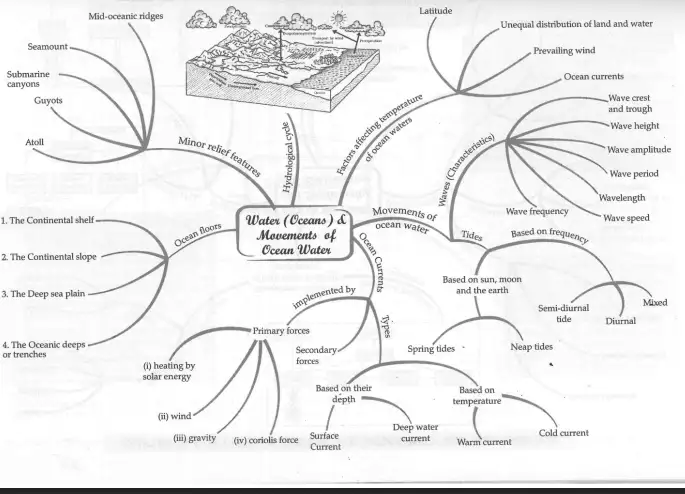
Ocean Floor Features and Minor Relief Features
The ocean floor consists of several major parts: the continental shelf, continental slope, deep sea plain, and oceanic trenches. Minor relief features include seamounts, submarine canyons, guyots, and atolls. These underwater structures influence ocean currents and marine life habitats.
Factors Affecting Ocean Temperature
Ocean temperature is influenced by latitude, uneven distribution of land and water, and prevailing winds. These factors affect the density and movement of ocean water, which in turn impact climate and weather patterns.
Waves, Tides, and Their Types
Waves are energy moving across the ocean surface, primarily caused by wind. They have characteristics such as height, amplitude, period, wavelength, frequency, and speed. Tides are the periodic rise and fall of sea levels caused mainly by the gravitational pull of the moon and the sun, along with the centrifugal force due to Earth's rotation.
Tides are classified based on frequency into semi-diurnal (two high and two low tides daily), diurnal (one high and one low tide daily), and mixed tides (unequal high and low tides). Based on the positions of the sun, moon, and Earth, tides are also categorized as spring tides (higher tides when sun and moon align) and neap tides (lower tides when sun and moon are at right angles).
Ocean Currents and Their Types
Ocean currents are continuous, directed movements of seawater influenced by primary forces such as solar heating, wind, gravity, and the Coriolis force, and secondary forces like water density differences due to temperature and salinity.
Currents are classified by depth into surface currents (upper 400 meters) and deep water currents (below 400 meters). They are also categorized by temperature into warm currents (bringing warm water to colder regions) and cold currents (bringing cold water to warmer regions). These currents regulate climate, marine ecosystems, and human activities like fishing and navigation.
Exam-Oriented Questions and Answers
Q1: What causes ocean waves and how do they move?
Answer: Ocean waves are caused mainly by wind blowing over the surface of the water. The energy from the wind moves across the ocean surface, creating waves that travel forward, while the water itself moves in circular motions.
Q2: Explain the difference between semi-diurnal and diurnal tides.
Answer: Semi-diurnal tides have two high tides and two low tides each day with approximately equal heights, while diurnal tides have only one high tide and one low tide each day.
Q3: What are the primary forces influencing ocean currents?
Answer: The primary forces influencing ocean currents are solar heating, wind, gravity, and the Coriolis force.
Q4: How do warm and cold ocean currents affect coastal climates?
Answer: Warm currents bring warm water to coastal areas, resulting in warmer and often wetter climates, while cold currents bring cold water, leading to cooler and drier coastal climates.
Solved Examples
Example 1:
Question: Describe the role of the Coriolis force in ocean currents.
Solution: The Coriolis force causes moving water to deflect to the right in the Northern Hemisphere and to the left in the Southern Hemisphere. This deflection influences the direction of ocean currents, contributing to the formation of circular current patterns called gyres.
Example 2:
Question: What causes spring tides and neap tides?
Solution: Spring tides occur when the sun, moon, and Earth are aligned, causing higher high tides and lower low tides due to combined gravitational forces. Neap tides occur when the sun and moon are at right angles relative to Earth, resulting in less extreme tides.
Practice Set
Easy
- Define ocean currents.
- What is a tidal current?
Moderate
- Explain the factors affecting ocean temperature.
- Describe the difference between surface and deep water currents.
Challenging
- Discuss how ocean currents influence global climate.
- Explain the formation and significance of tidal bulges.
Answer Key
- Ocean currents: Continuous, directed movement of ocean water caused by forces such as wind and temperature differences.
- Tidal current: Movement of water caused by tides, especially when channeled between islands or into bays.
- Factors affecting ocean temperature: Latitude, distribution of land and water, and prevailing winds.
- Surface vs Deep water currents: Surface currents occur in the upper 400 meters and are wind-driven; deep water currents occur below 400 meters and are driven by density differences.
- Ocean currents and climate: Currents transport heat, influencing temperature and precipitation patterns globally.
- Tidal bulges: Raised areas of ocean water caused by gravitational pull of the moon and sun, leading to tides.
Quick Reference
- Waves: Energy moving across ocean surface caused by wind.
- Tides: Periodic rise and fall of sea level due to gravitational forces.
- Ocean Currents: Large-scale water movements influenced by wind, temperature, salinity, and Earth's rotation.
- Coriolis Force: Deflects moving water to right in Northern Hemisphere, left in Southern Hemisphere.
- Semi-diurnal Tide: Two high and two low tides daily.
- Diurnal Tide: One high and one low tide daily.
- Spring Tide: High tide when sun and moon align.
- Neap Tide: Low tide when sun and moon are at right angles.
Glossary
- Amplitude: Half the height of a wave.
- Crest: Highest point of a wave.
- Trough: Lowest point of a wave.
- Wavelength: Horizontal distance between two wave crests.
- Perigee: Moon's closest point to Earth, causing higher tides.
- Apogee: Moon's farthest point from Earth, causing lower tides.
- Gyres: Large systems of circulating ocean currents.
| Time Period / Year | Event / Change | Importance |
|---|---|---|
| Monthly | Perigee and Apogee of Moon | Causes variations in tidal ranges (higher at perigee, lower at apogee) |
| Daily | Semi-diurnal and Diurnal Tides | Determines frequency and height of tides affecting coastal areas |
| Continuous | Ocean Currents Flow | Regulates climate, marine ecosystems, and navigation |