CLASS 11-HUMANITIES . GEOGRAPHY . FUNDAMENTAL OF PHYSICAL GEOGRAPHY . GEOMORPHIC PROCESSES
Chapter 5 : Geomorphic Processes
Ch 5
GEOGRAPHY
CLASS 11-HUMANITIES
Geomorphic Processes
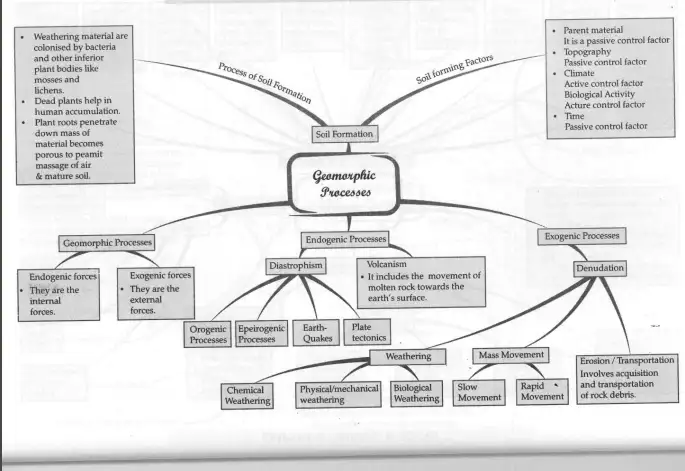
Geomorphic processes are natural forces that shape the Earth's surface. These include both internal and external processes that continuously modify the landscape. The main types of geomorphic processes are:
- Endogenic processes: Internal forces originating within the Earth, such as diastrophism (crustal movements), volcanism, earthquakes, and plate tectonics.
- Exogenic processes: External forces driven by atmospheric energy, including weathering, mass movement, erosion, and deposition.
- Soil formation: The process by which weathered material is transformed into soil through biological activity and chemical changes.
These processes work together to build up and wear down the Earth's surface, creating diverse landforms over time.
Endogenic Processes, Diastrophism and Volcanism
Endogenic processes are internal forces that build up the Earth's crust and create variations in the surface relief. These forces include:
- Diastrophism: Movements of the Earth's crust that cause folding, faulting, and warping. It includes:
- Orogenic processes: Mountain building through severe folding affecting long, narrow belts.
- Epeirogenic processes: Uplift or warping of large crustal areas.
- Earthquakes: Sudden, local movements of the crust.
- Plate tectonics: Horizontal movements of large crustal plates.
- Volcanism: Movement of molten rock (magma) onto or toward the Earth's surface, forming volcanic landforms.
Endogenic forces are mainly land-building forces, continuously elevating parts of the Earth's surface.
Exam Questions
Q1: What are endogenic processes? Give two examples.
Answer: Endogenic processes are internal forces originating within the Earth that build up the crust. Examples include diastrophism and volcanism.
Q2: Differentiate between orogenic and epeirogenic processes.
Answer: Orogenic processes involve mountain building through folding affecting narrow belts, while epeirogenic processes involve uplift or warping of large crustal areas.
Exogenic Processes and Weathering
Exogenic processes are external forces driven by the sun's energy and atmospheric conditions. They wear down the Earth's surface through:
- Weathering: Mechanical disintegration and chemical decomposition of rocks.
- Mass movement: Downslope movement of rock and soil under gravity.
- Erosion: Removal and transportation of rock debris by agents like water, wind, glaciers, and waves.
- Deposition: Settling of transported materials when the energy of the transporting agent decreases.
Weathering types include:
- Chemical weathering: Processes like solution, carbonation, hydration, oxidation, and reduction that chemically alter rocks.
- Physical or mechanical weathering: Breakdown of rocks by thermal expansion, pressure release, and other physical forces.
- Biological weathering: Breakdown caused by organisms such as plants, animals, and microbes.
Weathering is crucial for soil formation and enrichment of valuable minerals.
Exam Questions
Q1: What is weathering? Name its three types.
Answer: Weathering is the mechanical disintegration and chemical decomposition of rocks. Its three types are chemical, physical (mechanical), and biological weathering.
Q2: How does biological weathering contribute to soil formation?
Answer: Biological weathering involves organisms breaking down rocks and adding organic matter, which helps in soil formation.
Mass Movements
Mass movements are the downslope transfer of rock debris and soil under the influence of gravity without the aid of transporting agents like water or wind. They include:
- Slow movements: Such as creep and solifluction, which are gradual and often imperceptible.
- Rapid movements: Including earthflows, mudflows, and debris avalanches, common in humid regions.
- Landslides: Rapid, perceptible movements like slumps, debris slides, and rockslides.
Mass movements are influenced by factors like slope steepness, rainfall, vegetation cover, and human activities.
Exam Questions
Q1: What causes mass movements?
Answer: Mass movements are caused by gravity acting on slopes, influenced by factors such as steep slopes, heavy rainfall, removal of vegetation, and earthquakes.
Q2: Differentiate between creep and landslide.
Answer: Creep is a slow, gradual movement of soil, while landslides are rapid and perceptible movements of rock and soil.
Soil Formation
Soil is a natural body on the Earth's surface containing living and non-living components, supporting plant growth. Soil formation (pedogenesis) depends on weathering and biological activity. The five main factors controlling soil formation are:
- Parent material: The original rock or deposits from which soil develops.
- Topography: The landscape's shape affects drainage and exposure to sunlight.
- Climate: Temperature and precipitation influence chemical and biological processes.
- Biological activity: Organisms contribute organic matter and aid mineral breakdown.
- Time: Duration over which soil-forming processes act determines soil maturity.
Processes like desilication (removal of silica) and humus formation are important in soil development. Soil characteristics vary with seasons and environmental conditions.
Exam Questions
Q1: What are the main factors controlling soil formation?
Answer: Parent material, topography, climate, biological activity, and time.
Q2: Define desilication.
Answer: Desilication is the removal of silica from the soil, common in wet equatorial regions with high rainfall.
Solved Examples
Example 1: Explain the difference between endogenic and exogenic geomorphic processes.
Solution: Endogenic processes originate within the Earth and build up the crust (e.g., volcanism, diastrophism), while exogenic processes originate from external forces like the atmosphere and wear down the surface (e.g., weathering, erosion).
Example 2: Describe the role of climate in soil formation.
Solution: Climate affects soil formation through temperature and precipitation, which influence chemical reactions, moisture availability, and biological activity essential for soil development.
Practice Set
Easy
- Define geomorphic processes.
- What is weathering?
- Name two types of endogenic processes.
Moderate
- Explain the significance of mass movements.
- List the factors controlling soil formation.
- Describe the process of oxidation in weathering.
Challenging
- Discuss the relationship between endogenic and exogenic processes in shaping the Earth's surface.
- Explain how biological activity influences soil formation and weathering.
- Analyze the causes and types of landslides.
Answer Key
Easy:
- Natural forces that shape the Earth's surface.
- Mechanical disintegration and chemical decomposition of rocks.
- Diastrophism and volcanism.
Moderate:
- Mass movements transfer rock debris downslope under gravity, shaping slopes and causing hazards.
- Parent material, topography, climate, biological activity, and time.
- Oxidation is the combination of minerals with oxygen to form oxides, leading to rock decomposition.
Challenging:
- Endogenic processes build up the crust, while exogenic processes wear it down; both continuously shape the Earth's surface.
- Biological activity breaks down rocks, adds organic matter, and aids chemical weathering, influencing soil formation.
- Landslides are rapid movements caused by factors like steep slopes, heavy rainfall, and earthquakes; types include slumps, debris slides, and rockslides.
Quick Reference
- Geomorphic processes: Forces shaping Earth's surface (endogenic and exogenic).
- Diastrophism: Crustal movements causing folding and warping.
- Volcanism: Eruption of molten rock onto the surface.
- Weathering: Breakdown of rocks by chemical, physical, and biological means.
- Mass movement: Gravity-driven downslope movement of earth materials.
- Soil formation: Development of soil from weathered material influenced by various factors.
Glossary
- Gradation
- Wearing down of Earth's surface relief through erosion.
- Exogenic forces
- External forces acting on the Earth's surface, such as weathering and erosion.
- Geomorphic agents
- Mobile mediums like water, wind, ice that transport earth materials.
- Diastrophism
- Processes that move or build up portions of the Earth's crust.
- Volcanism
- Eruption of molten rock and formation of volcanic landforms.
- Denudation
- Processes including weathering, erosion, and transportation that strip the Earth's surface.
- Solifluction
- Slow downslope movement of water-saturated soil in cold regions.
- Earthflow
- Rapid movement of saturated clayey or silty earth materials down slopes.
- Slump
- Backward rotation slipping of rock debris on a slope.
- Desilication
- Removal of silica from soil in wet climates.
Chronology of Key Events in Geomorphic Processes
| Time Period / Year | Event / Change | Importance |
|---|---|---|
| Millions of years ago | Formation of Earth's crust and initiation of endogenic processes | Creation of landforms through diastrophism and volcanism |
| Since Earth's formation | Continuous exogenic processes like weathering and erosion | Wearing down and reshaping of Earth's surface |
| Recent geological times | Development of soils through weathering and biological activity | Support for plant life and ecosystems |
| Present | Human impact accelerating soil erosion and landform changes | Environmental challenges and need for conservation |