CLASS 11-HUMANITIES . GEOGRAPHY . INDIA PHYSICAL ENVIRONMENT . DRAINAGE SYSTEM
Chapter 3 : Drainage System
Ch 3
GEOGRAPHY
CLASS 11-HUMANITIES
Drainage System
The drainage system of India consists of various river patterns and river systems that play a crucial role in the country's geography and economy. Drainage patterns include radial, trellis, centripetal, and dendritic, which describe the way rivers flow and branch out. India has two main river systems: the Himalayan and the Peninsular. Rivers originate mainly from hills and flow in different directions, serving multiple purposes such as irrigation, electricity generation, and recreation.
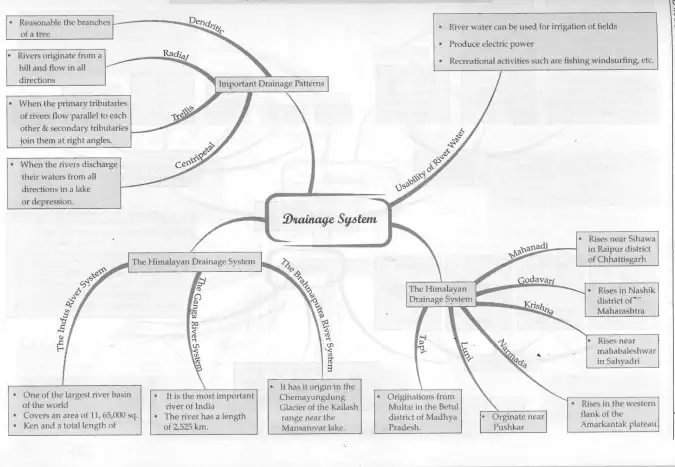
The Himalayan Drainage System
The Himalayan Drainage System has evolved over a long geological period and includes major river basins such as the Ganga, Indus, and Brahmaputra. These rivers are perennial, fed by both melting snow and rainfall. They flow through deep gorges in the mountains and meander extensively in the plains. The system is divided into three main parts: the Indus and its tributaries in the west, the Ganga and its tributaries in the center, and the Brahmaputra and its tributaries in the east.
Major River Systems of the Himalayan Drainage
- Indus System: Originates near Bokhar Chu glacier in Tibet and flows through India and Pakistan. Major tributaries include Jhelum, Chenab, Ravi, Beas, and Satluj.
- Ganga System: The largest river system in India, covering about 8.6 lakh sq. km. Important tributaries include Yamuna, Chambal, Gandak, Ghaghara, Kosi, Ramganga, Damodar, Sarda, Mahananda, and Son.
- Brahmaputra System: Originates from the Chemayungdung Glacier near Mansarovar Lake and flows through Assam into Bangladesh, where it joins the Ganga.
Exam Questions
Q1: What are the main characteristics of the Himalayan Drainage System?
Answer: The Himalayan Drainage System is perennial, fed by snowmelt and rainfall, flows through deep gorges, and has a highly tortuous course in the mountains with meandering in the plains.
Q2: Name the major tributaries of the Indus River.
Answer: The major tributaries of the Indus River are Jhelum, Chenab, Ravi, Beas, and Satluj.
The Peninsular Drainage System
The Peninsular Drainage System is older than the Himalayan system and is characterized by rivers with fixed courses, absence of meanders, and non-perennial flow. Most rivers flow eastward into the Bay of Bengal, except for a few like the Narmada and Tapi which flow westward into the Arabian Sea. The Western Ghats act as a water divide for these rivers.
Major River Systems of the Peninsular Drainage
- Mahanadi: Originates near Sihawa in Chhattisgarh and flows through Odisha into the Bay of Bengal.
- Godavari: The largest Peninsular river, also called the Dakshin Ganga, originates in Maharashtra and flows into the Bay of Bengal.
- Krishna: Originates near Mahabaleshwar in the Sahyadri range and flows eastward.
- Kaveri: Originates in the Brahmagiri hills of Karnataka and flows into the Bay of Bengal.
- Narmada: Originates from the Amarkantak plateau and flows westward into the Arabian Sea.
- Tapi: Originates from Multai in Madhya Pradesh and flows westward.
- Luni: The largest river system in Rajasthan west of Aravali, originating near Pushkar.
- Other Rivers: Mandovi and Jauri in Goa; Bharathapuzha and Periyar in Kerala.
River Regimes
River regime refers to the pattern of flow of water in a river channel over a year. Himalayan rivers are perennial due to snowmelt and rainfall, while Peninsular rivers often have seasonal flow with less water during dry seasons.
Exam Questions
Q1: What are the main features of the Peninsular Drainage System?
Answer: The Peninsular Drainage System is older, has fixed river courses, lacks meanders, and rivers are mostly non-perennial with seasonal flow.
Q2: Name two major westward flowing rivers of the Peninsular system.
Answer: Narmada and Tapi rivers flow westward into the Arabian Sea.
Key Terms in Drainage System
- Drainage: The flow of water through well-defined channels.
- Drainage System: Network of drainage channels.
- Dendritic Drainage Pattern: Resembles branches of a tree; common in northern plains.
- Radial Drainage Pattern: Rivers flow in all directions from a hill.
- Trellis Drainage Pattern: Primary tributaries flow parallel; secondary join at right angles.
- Centripetal Drainage Pattern: Rivers flow into a lake or depression from all directions.
- Catchment Area: Area from which a river collects water.
- Drainage Basin: Area drained by a river and its tributaries.
- Watershed: Boundary separating two drainage basins.
- River Basin: Catchment area of a large river.
- River System: A river with its tributaries, including source, course, and mouth.
- Meanders: Sinuous curves or bends in a river channel.
- Cusecs: Cubic feet per second, a unit of discharge.
- Cumecs: Cubic meters per second, a unit of discharge.
Exam Questions
Q1: Define drainage basin and watershed.
Answer: A drainage basin is the area drained by a river and its tributaries. A watershed is the boundary line separating two drainage basins.
Q2: What is a dendritic drainage pattern?
Answer: It is a drainage pattern resembling the branches of a tree, common in the northern plains.
Solved Examples
Example 1: Explain why the Himalayan rivers are perennial.
Solution: Himalayan rivers are perennial because they are fed by melting snow from glaciers and receive rainfall, ensuring continuous flow throughout the year.
Example 2: Name the five rivers of Punjab that form the Panjnad.
Solution: The five rivers are Satluj, Beas, Ravi, Chenab, and Jhelum.
Practice Set
Easy
- What is a drainage system?
- Name two major river systems of India.
Moderate
- Describe the main features of the Peninsular Drainage System.
- List the major tributaries of the Ganga River.
Challenging
- Explain the geological events that shaped the Peninsular Drainage System.
- Discuss the significance of the Brahmaputra River in the Himalayan Drainage System.
Answer Key
- Easy 1: The flow of water through well-defined channels.
- Easy 2: Himalayan and Peninsular river systems.
- Moderate 1: Older system, fixed courses, non-perennial flow, mostly eastward flowing rivers.
- Moderate 2: Yamuna, Chambal, Gandak, Ghaghara, Kosi, Ramganga, Damodar, Sarda, Mahananda, Son.
- Challenging 1: Subsidence of western flank, Himalaya uplift causing trough faulting, tilting of Peninsular block towards Bay of Bengal.
- Challenging 2: Originates from Kailash range, flows through Assam and Bangladesh, important for irrigation and hydroelectricity.
Quick Reference
- Drainage Patterns: Radial, Trellis, Centripetal, Dendritic.
- Major Himalayan Rivers: Indus, Ganga, Brahmaputra.
- Major Peninsular Rivers: Mahanadi, Godavari, Krishna, Kaveri, Narmada, Tapi.
- River Basin: Area drained by a river and its tributaries.
- Watershed: Boundary between drainage basins.
Glossary
- Drainage
- Flow of water through well-defined channels.
- Drainage Basin
- Area drained by a river and its tributaries.
- Watershed
- Boundary separating two drainage basins.
- Perennial River
- River that flows throughout the year.
- Non-Perennial River
- River that flows only during certain seasons.
- Tributary
- A smaller river or stream that joins a larger river.
- River Regime
- Pattern of flow of water in a river over a year.
Chronology of Indian Drainage System
| Time Period / Year | Event / Change | Importance |
|---|---|---|
| Miocene Period (5-24 million years ago) | Existence of Indo-Brahma river | Formed the basis of Himalayan river systems |
| Early Tertiary Period | Subsidence of western flank of Peninsular India | Shaped Peninsular drainage system |
| Himalayan Uplift | Formation of gorges and river courses | Defined Himalayan river patterns |
| Present | Distinct Himalayan and Peninsular drainage systems | Supports diverse ecosystems and human activities |