CLASS 11-HUMANITIES . GEOGRAPHY . FUNDAMENTAL OF PHYSICAL GEOGRAPHY . DISTRIBUTION OF-OCEANS-AND-CONTINENTS
Chapter 4 : DISTRIBUTION OF OCEANS AND CONTINENTS
Ch 4
GEOGRAPHY
CLASS 11-HUMANITIES
Distribution of Oceans and Continents
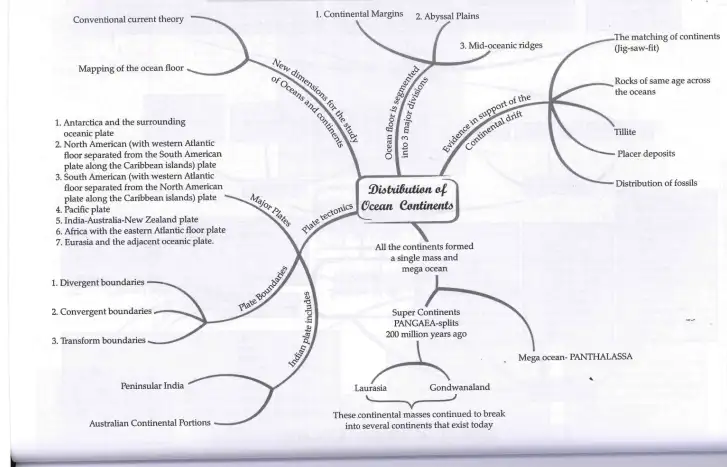
The distribution of oceans and continents has changed over millions of years due to the movement of the earth's lithospheric plates. The ocean floor consists of three main parts: continental margins, abyssal plains, and mid-oceanic ridges. These features help us understand the structure of the ocean floor and the processes that shape it.
Continental margins form the transition between continental shores and deep-sea basins and include the continental shelf, slope, rise, and deep-ocean trenches. Abyssal plains are flat areas where sediments accumulate beyond the continental margins. Mid-oceanic ridges are underwater mountain chains formed by volcanic activity and are the longest mountain ranges on earth.
The study of ocean floor configuration and plate tectonics explains the movement and distribution of continents and oceans over geological time.
Exam Question
Q: What are the three main parts of the ocean floor?
A: The three main parts of the ocean floor are continental margins, abyssal plains, and mid-oceanic ridges.
Continental Drift
Continental drift is the theory that continents have moved over geological time and were once joined together. The coastlines of the Atlantic Ocean show a remarkable fit, suggesting that continents like South America and Africa were once connected.
Abraham Ortelius first proposed this idea in 1596, and Alfred Wegener developed the comprehensive Continental Drift Theory in 1912. According to Wegener, all continents were once part of a supercontinent called Pangaea, surrounded by a mega-ocean named Panthalassa.
About 200 million years ago, Pangaea began to split into two large landmasses: Laurasia in the north and Gondwanaland in the south. These landmasses eventually broke apart into the continents we know today.
Evidence supporting continental drift includes matching coastlines, similar rock formations, tillite deposits, placer deposits, and fossils such as Mesosaurus found on widely separated continents.
Wegener suggested forces like pole-fleeing force and tidal force caused the drift, but these explanations were later replaced by the theory of plate tectonics.
Exam Question
Q: What was the name of the supercontinent proposed by Wegener, and what does it mean?
A: The supercontinent was called Pangaea, meaning "all earth."
Ocean Floor Configuration
The ocean floor is divided into three major divisions based on depth and relief: continental margins, deep-sea basins (abyssal plains), and mid-ocean ridges.
Continental margins include the continental shelf, slope, rise, and deep-ocean trenches. Abyssal plains are flat areas where sediments accumulate. Mid-ocean ridges are underwater mountain chains formed by volcanic eruptions.
Sea-floor spreading occurs at mid-ocean ridges where volcanic activity creates new oceanic crust, pushing older crust away from the ridge. This process explains why oceanic crust is younger than continental crust and why sediments on the ocean floor are thin.
Exam Question
Q: What is sea-floor spreading and where does it occur?
A: Sea-floor spreading is the process where new oceanic crust is formed by volcanic eruptions at mid-ocean ridges, causing the ocean floor to spread apart.
Plate Tectonics
Plate tectonics is the theory that the earth's lithosphere is divided into several large and small plates that move over the asthenosphere. These plates include both continental and oceanic lithosphere.
There are seven major plates: Antarctic, North American, South American, Pacific, Indian-Australian, African, and Eurasian plates, along with several minor plates such as the Cocos, Nazca, Arabian, Philippine, Caroline, and Fuji plates.
Plate boundaries are classified as divergent (plates move apart), convergent (plates move towards each other), and transform (plates slide past each other). The movement of plates causes earthquakes, volcanic activity, and the formation of mountain ranges.
The Indian plate, which includes Peninsular India and parts of Australia, moved northward from the southern hemisphere and collided with the Eurasian plate about 40-50 million years ago, leading to the uplift of the Himalayas.
Convection currents in the mantle drive the movement of plates. The process of subduction occurs where one plate sinks beneath another, destroying crust, while new crust is created at spreading sites.
Exam Question
Q: What are the three types of plate boundaries and what happens at each?
A: Divergent boundaries where plates move apart and new crust forms; convergent boundaries where plates move towards each other and one plate may subduct; transform boundaries where plates slide past each other horizontally.
Solved Examples
Example 1: Explain why the coastlines of South America and Africa appear to fit together.
Answer: The coastlines of South America and Africa fit together because they were once part of the same landmass, Gondwanaland, before the continents drifted apart due to plate tectonic movements.
Example 2: Describe the process of sea-floor spreading.
Answer: Sea-floor spreading occurs at mid-ocean ridges where magma rises from the mantle, solidifies to form new oceanic crust, and pushes the older crust away from the ridge, causing the ocean floor to spread.
Practice Set
Easy
- What is Pangaea?
- Name the three main parts of the ocean floor.
Moderate
- Explain the evidence that supports the theory of continental drift.
- What are the major tectonic plates?
Challenging
- Describe the process and significance of subduction zones.
- How did the collision of the Indian plate with the Eurasian plate affect the geography of the region?
Answer Key
- What is Pangaea? - A supercontinent that existed about 200 million years ago, comprising all the earth's landmasses.
- Name the three main parts of the ocean floor. - Continental margins, abyssal plains, mid-oceanic ridges.
- Explain the evidence that supports the theory of continental drift. - Matching coastlines, similar rock formations, tillite deposits, placer deposits, and fossils found on different continents.
- What are the major tectonic plates? - Antarctic, North American, South American, Pacific, Indian-Australian, African, Eurasian plates.
- Describe the process and significance of subduction zones. - Subduction zones are areas where one tectonic plate sinks beneath another, leading to crust destruction, earthquakes, and volcanic activity.
- How did the collision of the Indian plate with the Eurasian plate affect the geography of the region? - It caused the uplift of the Himalayas and significant geological changes in the region.
Quick Reference
- Continental Drift: Movement of continents over geological time.
- Pangaea: Supercontinent of all earth's landmasses.
- Sea-floor Spreading: Formation of new oceanic crust at mid-ocean ridges.
- Plate Tectonics: Theory explaining the movement of earth's lithospheric plates.
- Subduction Zone: Area where one plate sinks beneath another.
- Convection Currents: Circular movement in the mantle driving plate movement.
Glossary
- Tillite
- A sedimentary rock formed from glacial deposits.
- Pangaea
- A supercontinent that existed about 200 million years ago.
- Panthalassa
- The vast global ocean that surrounded Pangaea.
- Abyssal Plains
- Flat areas on the ocean floor where sediments accumulate.
- Continental Margins
- Zones between continental shelves and deep ocean basins.
- Sea-floor Spreading
- Process of new oceanic crust formation at mid-ocean ridges.
- Tectonic Plate
- Large slabs of earth's lithosphere that move over the mantle.
- Subduction
- Process where one tectonic plate sinks beneath another.
- Convergent Boundaries
- Plate boundaries where plates move towards each other.
- Divergent Boundaries
- Plate boundaries where plates move apart.
- Transform Faults
- Plate boundaries where plates slide past each other horizontally.
| Time Period / Year | Event / Change | Importance |
|---|---|---|
| 1596 | Abraham Ortelius proposes continents were once joined | Early idea of continental drift |
| 1912 | Alfred Wegener proposes Continental Drift Theory | Comprehensive explanation of continental movement |
| 1967 | Development of Plate Tectonics Theory | Explains mechanism of continental drift and ocean floor spreading |
| ~200 million years ago | Existence of Pangaea supercontinent | All continents joined as one landmass |
| ~200 million years ago | Breakup of Pangaea into Laurasia and Gondwanaland | Formation of northern and southern landmasses |
| 40-50 million years ago | Collision of Indian plate with Eurasian plate | Uplift of the Himalayas |