CLASS 11-HUMANITIES . GEOGRAPHY . FUNDAMENTAL OF PHYSICAL GEOGRAPHY . COMPOSITION AND-STRUCTURE-OF-ATMOSPHERE
Chapter 7 : Composition And Structure Of Atmosphere
Ch 7
GEOGRAPHY
CLASS 11-HUMANITIES
Composition and Structure of Atmosphere
The atmosphere is the layer of gases surrounding the Earth, essential for sustaining life and influencing weather and climate. It is composed mainly of gases, water vapour, and dust particles. The atmosphere is divided into distinct layers based on temperature and altitude, each with unique characteristics and functions.
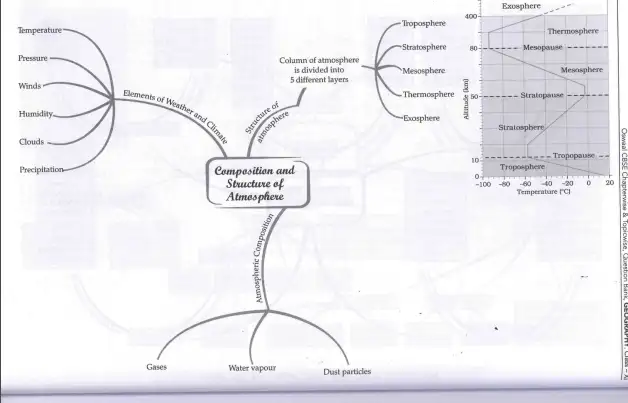
Elements of Weather and Climate
The atmosphere contains several elements that determine weather and climate, including temperature, pressure, winds, humidity, clouds, and precipitation. These elements interact to create the diverse weather patterns experienced on Earth.
Exam Question
Q: What are the main elements of weather and climate?
A: The main elements of weather and climate are temperature, pressure, winds, humidity, clouds, and precipitation.
Atmospheric Composition
The atmosphere is primarily a mixture of gases such as nitrogen, oxygen, carbon dioxide, and trace gases, along with water vapour and dust particles. The composition varies with altitude, with oxygen becoming negligible above 120 km. Carbon dioxide plays a crucial role in the greenhouse effect by absorbing and reflecting terrestrial radiation. Ozone, found between 10 and 50 km altitude, absorbs harmful ultraviolet rays from the sun. Water vapour acts as a blanket, regulating Earth's temperature and contributing to atmospheric stability. Dust particles serve as nuclei for cloud formation.
Exam Question
Q: Why is ozone important in the atmosphere?
A: Ozone absorbs ultraviolet rays from the sun, preventing them from reaching the Earth's surface and protecting living organisms from harmful radiation.
Structure of the Atmosphere
The atmosphere is divided into five layers based on temperature variations with altitude:
- Troposphere: Extends up to about 13 km, where weather changes occur and biological activity is concentrated. Temperature decreases with height.
- Stratosphere: Extends up to 50 km and contains the ozone layer, which absorbs ultraviolet radiation.
- Mesosphere: Extends up to 80 km, with temperature decreasing to about -100°C at the top.
- Ionosphere: Located between 80 and 400 km, contains electrically charged particles called ions.
- Exosphere: The outermost layer, gradually merging with outer space, with very sparse particles.
Exam Question
Q: Name the five layers of the atmosphere and one key feature of each.
A: The five layers are:
- Troposphere - weather changes and biological activity occur here.
- Stratosphere - contains the ozone layer.
- Mesosphere - temperature decreases with altitude.
- Ionosphere - contains electrically charged ions.
- Exosphere - merges with outer space and has very sparse particles.
Timeline of Atmospheric Layers
| Altitude Range (km) | Layer | Significance |
|---|---|---|
| 0 - 13 | Troposphere | Weather phenomena and biological activity |
| 13 - 50 | Stratosphere | Ozone layer absorbs ultraviolet radiation |
| 50 - 80 | Mesosphere | Temperature decreases, meteors burn up |
| 80 - 400 | Ionosphere | Contains ions, reflects radio waves |
| Above 400 | Exosphere | Transition to outer space, very thin air |
Solved Examples
Example 1
Question: Explain why the troposphere is important for life on Earth.
Answer: The troposphere is important because it contains the air we breathe and is where weather changes occur. It supports all biological activity and regulates temperature, making it essential for life.
Example 2
Question: What role does carbon dioxide play in the atmosphere?
Answer: Carbon dioxide absorbs terrestrial radiation and reflects some back to Earth, contributing to the greenhouse effect which helps maintain Earth's temperature.
Practice Set
Easy
- What is the main gas found in the atmosphere?
- Define atmosphere.
Moderate
- Describe the role of water vapour in the atmosphere.
- What is the significance of the ozone layer?
Challenging
- Explain the temperature changes in different layers of the atmosphere.
- Discuss the importance of dust particles in cloud formation.
Answer Key
- Easy:
- Nitrogen is the main gas found in the atmosphere.
- Atmosphere is the layer of gases surrounding the Earth.
- Moderate:
- Water vapour acts like a blanket, regulating Earth's temperature and contributing to atmospheric stability.
- The ozone layer absorbs harmful ultraviolet radiation, protecting life on Earth.
- Challenging:
- Temperature decreases with altitude in the troposphere and mesosphere, increases in the stratosphere due to ozone absorption, and varies in the ionosphere and exosphere.
- Dust particles act as nuclei for water vapour condensation, leading to cloud formation.
Quick Reference
- Atmosphere: Layer of gases surrounding Earth.
- Troposphere: Lowest layer, weather occurs here.
- Stratosphere: Contains ozone layer.
- Mesosphere: Middle layer with decreasing temperature.
- Ionosphere: Contains charged particles.
- Exosphere: Outermost layer merging with space.
- Ozone: Absorbs ultraviolet radiation.
- Carbon Dioxide: Contributes to greenhouse effect.
- Water Vapour: Regulates temperature and weather.
- Dust Particles: Help in cloud formation.
Glossary
- Atmosphere: The layer of gases surrounding a planet.
- Ozone: A gas in the stratosphere that absorbs ultraviolet radiation.
- Troposphere: The lowest layer of the atmosphere where weather occurs.
- Stratosphere: The layer above the troposphere containing the ozone layer.
- Mesosphere: The middle layer of the atmosphere where temperature decreases with altitude.
- Ionosphere: A layer containing electrically charged particles called ions.
- Exosphere: The outermost layer of the atmosphere, merging into space.
- Greenhouse Effect: The warming of Earth's surface due to trapped heat by gases like carbon dioxide.
- Hygroscopic Nuclei: Particles like dust around which water vapour condenses to form clouds.