CLASS 11-HUMANITIES . GEOGRAPHY . INDIA PHYSICAL ENVIRONMENT . CLIMATE
Chapter 4 : Climate
Ch 4
GEOGRAPHY
CLASS 11-HUMANITIES
Climate
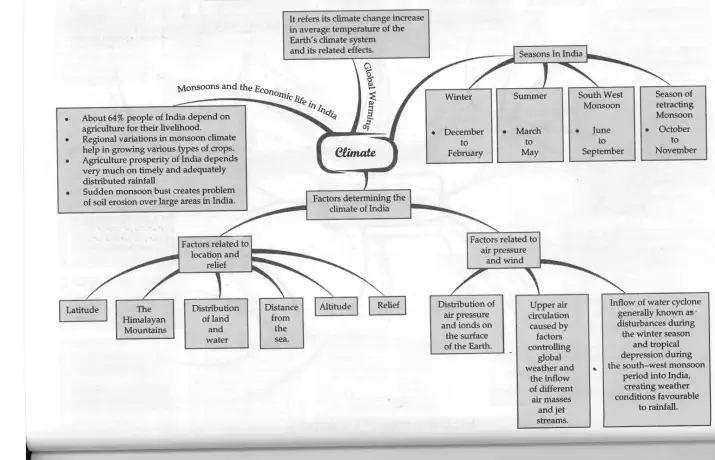
Climate refers to the average weather conditions, including temperature and precipitation, observed over a long period of time in a particular region. It is influenced by various factors such as global warming, location, relief, air pressure, and wind patterns. India experiences a unique climate characterized by four main seasons: winter, summer, south-west monsoon, and the retreating monsoon. The monsoon plays a crucial role in India's economy, especially agriculture, as many farmers depend on monsoon rains for their crops.
Exam Question
Q: What is climate and how does it affect the economy of India?
A: Climate is the average weather conditions over a long period. In India, the monsoon climate affects agriculture, which is a major part of the economy, as farmers rely on monsoon rains for crop production.
Unity and Diversity in the Monsoon Climate, Factors Determining the Climate of India
Weather is the short-term state of the atmosphere, while climate is the average of weather conditions over a longer period. India has a hot monsoonal climate with significant regional variations in wind patterns, temperature, rainfall, and seasons. The climate is influenced by two main groups of factors:
- Location and Relief: Latitude, the Himalayan Mountains, distribution of land and water, distance from the sea, altitude, and relief affect temperature, rainfall, and wind patterns.
- Air Pressure and Winds: Surface air pressure distribution, upper air circulation including jet streams, and inflow of western cyclones and tropical depressions influence rainfall and weather.
The Himalayas act as a climate barrier protecting India from cold northern winds and forcing monsoon winds to shed moisture. The differential heating of land and sea creates pressure zones that drive seasonal winds. Altitude causes temperature variations, with mountainous areas being cooler.
Exam Question
Q: What are the main factors that determine the climate of India?
A: The main factors are location and relief (latitude, Himalayas, land-water distribution, distance from sea, altitude, relief) and air pressure and winds (surface pressure, upper air circulation, jet streams, cyclones).
Mechanism of Weather in the Winter Season
During winter, a high-pressure center forms north of the Himalayas, causing dry continental winds to blow southward into India. These winds are dry and cold. The westerly jet stream flows above the Himalayas, bringing western cyclonic disturbances originating from the Mediterranean Sea. These disturbances cause winter rainfall in northwestern India. The northeast monsoon winds blow from land to sea, generally not causing rainfall except in some southeastern coastal areas.
Exam Question
Q: How does the winter season affect the weather in India?
A: A high-pressure area north of the Himalayas causes dry, cold winds to blow into India. Western cyclonic disturbances bring rainfall to northwestern India. Northeast monsoon winds generally do not cause rain except in southeastern coastal regions.
Mechanism of Weather in the Summer Season
In summer, the Inter Tropical Convergence Zone (ITCZ) shifts northwards near the Himalayas, creating a low-pressure area over northern India. The westerly jet stream withdraws, and moist maritime tropical air from the Southern Hemisphere moves northward as the southwest monsoon. An easterly jet stream flows over southern India, steering tropical depressions that bring rainfall. These monsoon winds cause widespread rain essential for agriculture.
Exam Question
Q: What causes the southwest monsoon in India during summer?
A: The northward shift of the ITCZ creates low pressure over northern India, drawing moist air from the Southern Hemisphere as the southwest monsoon. The easterly jet stream guides tropical depressions that bring rainfall.
The Nature of the Indian Monsoon, The Rhythm of Seasons, Distribution of Rainfall, Climatic Regions of India, Monsoon and the Economic Life in India
The Indian monsoon is driven by differential heating of land and sea, causing low pressure over the subcontinent in summer. The southwest monsoon arrives over Kerala by June 1 and covers the entire country by mid-July. Two main rain-bearing systems exist: the Bay of Bengal branch and the Arabian Sea branch, which bring rainfall to different regions. The monsoon has breaks or dry spells that vary regionally.
India experiences four meteorological seasons: cold weather, hot weather, southwest monsoon, and retreating monsoon. The cold season features low temperatures and occasional cyclonic depressions. The hot season has high temperatures and dry winds called 'Loo'. The southwest monsoon brings heavy rainfall, while the retreating monsoon causes rain mainly in the eastern peninsula.
Rainfall distribution varies widely, with the west coast and northeastern hills receiving the highest rainfall, while western Rajasthan and parts of the peninsula receive less than 50 cm annually. Climatic regions are classified based on temperature and rainfall patterns.
Monsoon variability affects agriculture and economy. Human activities contribute to global warming, which may impact future climate and sea levels.
Exam Question
Q: Describe the main features of the Indian monsoon and its impact on the economy.
A: The Indian monsoon is caused by differential heating creating low pressure over land, bringing moist winds that cause rainfall. It has two branches bringing rain to different regions. The monsoon supports agriculture, which is vital for the economy. Variability in monsoon affects crop production and livelihoods.
Solved Examples
- Example: Explain why the Himalayas are important for India's climate.
Solution: The Himalayas act as a barrier protecting India from cold northern winds and force monsoon winds to release moisture, resulting in rainfall. - Example: What causes the break in the monsoon?
Solution: Breaks occur due to changes in the monsoon trough or ITCZ position and wind patterns, leading to dry spells during the rainy season.
Practice Set
Easy
- Define climate.
- List the four main seasons in India.
Moderate
- Explain the role of the Himalayas in shaping India's climate.
- Describe the mechanism of the southwest monsoon.
Challenging
- Discuss the factors responsible for the spatial variation of rainfall in India.
- Analyze the impact of global warming on the Indian monsoon.
Answer Key
- Climate is the average weather conditions over a long period.
- Winter, Summer, South West Monsoon, Retreating Monsoon.
- The Himalayas block cold northern winds and cause monsoon winds to shed moisture.
- The ITCZ shifts northward creating low pressure, drawing moist air as the southwest monsoon.
- Rainfall varies due to topography, wind patterns, and monsoon branches.
- Global warming may alter temperature and rainfall patterns, affecting monsoon reliability.
Quick Reference
- Climate: Average weather over long time.
- Monsoon: Seasonal reversing winds with rainfall.
- ITCZ: Low pressure zone near equator shifting seasonally.
- Jet Streams: High altitude winds influencing weather.
- Western Cyclonic Disturbance: Winter storms bringing rain to north India.
- Loo: Hot dry winds in northern plains during summer.
Glossary
- Climate
- Average weather conditions over a long period.
- Monsoon
- Seasonal wind reversal accompanied by rainfall.
- Jet Stream
- Fast flowing air currents in the upper atmosphere.
- ITCZ (Inter Tropical Convergence Zone)
- Low pressure zone near the equator where trade winds converge.
- Western Cyclonic Disturbance
- Storms originating from the Mediterranean causing winter rain in India.
- Loo
- Hot, dry winds blowing in northern India during summer.
- Break in Monsoon
- Temporary dry spell during the monsoon season.
Chronology of Indian Monsoon Events
| Time Period / Year | Event / Change | Importance |
|---|---|---|
| April-May | Sun shines vertically over Tropic of Cancer; land heats intensely | Creates low pressure over northern India, initiating monsoon |
| 1 June | Southwest monsoon sets in over Kerala coast | Start of monsoon season, critical for agriculture |
| 10-13 June | Monsoon reaches Mumbai and Kolkata | Monsoon spreads across western and eastern coasts |
| Mid July | Monsoon covers entire Indian subcontinent | Peak monsoon period with widespread rainfall |
| October-November | Retreating monsoon season | Rainfall in eastern peninsula; end of monsoon season |