CLASS 11-COMMERCE . ECONOMICS . STATISTICS FOR ECONOMICS . INTRODUCTION
Chapter 1 : Introduction
Ch 1
ECONOMICS
CLASS 11-COMMERCE
An Introduction to Economics
Concept Explanation: Economics is the social science that studies how individuals and societies allocate scarce resources to satisfy their unlimited wants. It involves understanding the production, distribution, and consumption of goods and services.
Key Definitions / Features:
- Wealth Oriented Definition: According to Adam Smith, "Economics is an enquiry into the factors that determine the wealth of a country and its growth." This definition focuses on wealth accumulation.
- Material Welfare Oriented Definition: Marshall defined economics as "a study of mankind in the ordinary business of life," emphasizing material well-being.
- Scarcity Oriented Definition: Robbins stated, "Economics is the science which studies human behaviour as a relationship between ends and scarce means which have alternative uses." This highlights scarcity and choice.
- Growth Oriented Definition: Paul Samuelson described economics as a social science concerned with how society employs resources with alternative uses to produce goods and services for present and future consumption.
Significance of Economics:
- For Consumers: Helps analyze data, identify patterns, and compare options for better decision-making.
- For Producers: Enables data-driven decisions, demand forecasting, and production optimization.
- For Workers: Provides insights into market trends and future performance.
- For Price Determination: Assists businesses in optimizing prices to maximize profitability.
- For Solving Distribution Problems: Helps understand income distribution, standard of living, and taxable capacity.
Micro Economics: Studies economic behaviour of individual units and variables.
Macro Economics: Deals with the economy as a whole.
Illustrative Example:
Consider a consumer deciding between buying a car or saving money. Economics studies how the consumer makes this choice given limited income (scarcity) and alternative uses of money.
Practice Set:
- Level 1 – Easy: Define economics according to Adam Smith.
- Level 2 – Moderate: Explain the significance of economics for producers.
- Level 3 – Challenging: Compare and contrast microeconomics and macroeconomics with examples.
Answer Key:
- Level 1: Adam Smith defined economics as an enquiry into the factors that determine the wealth of a country and its growth.
- Level 2: Economics helps producers by enabling data-driven decision-making, forecasting demand, and optimizing production processes to maximize profits.
- Level 3: Microeconomics studies individual units like consumers and firms (e.g., demand for a product), while macroeconomics studies the economy as a whole (e.g., national income, inflation).
Quick Reference:
- Economics = Study of resource allocation under scarcity.
- Microeconomics = Individual units.
- Macroeconomics = Whole economy.
- Significance = Helps consumers, producers, workers, price determination, and distribution.
Glossary:
- Scarcity: Limited availability of resources.
- Microeconomics: Study of individual economic units.
- Macroeconomics: Study of aggregate economy.
- Production: Creation of goods and services.
Statistics for Economics
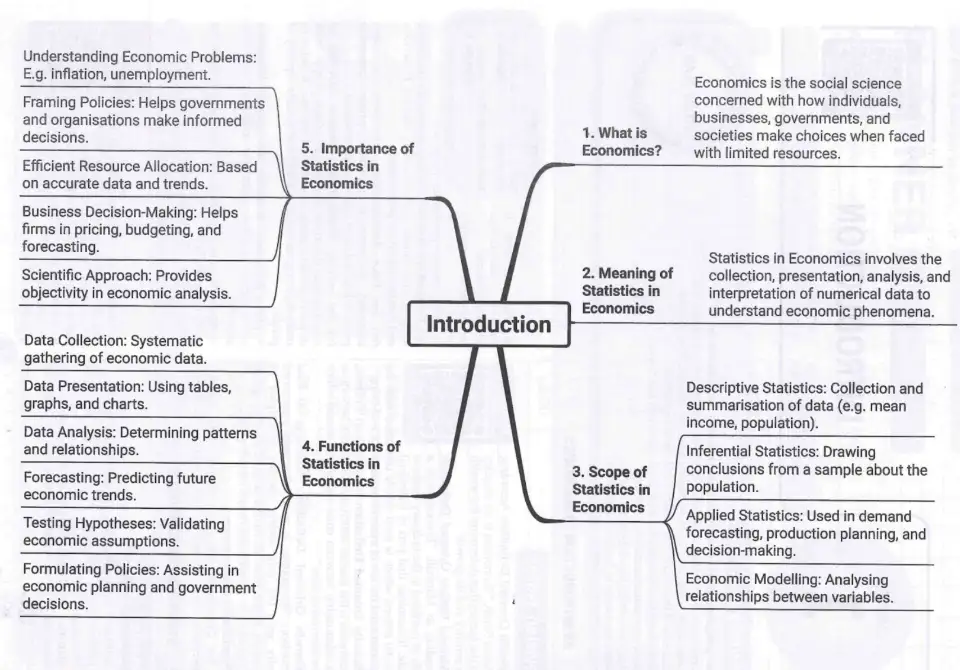
Concept Explanation: Statistics is the science of collecting, organizing, analyzing, interpreting, and presenting data. In economics, statistics helps in understanding economic phenomena by providing quantitative data and analytical tools.
Key Definitions / Features:
- Statistics in Plural Sense: Refers to quantitative data collected systematically.
- Statistics in Singular Sense: Refers to the science or methods of collecting, classifying, presenting, analyzing, and interpreting data.
Functions of Statistics:
- Simplify complex facts.
- Compare facts.
- Establish relationships.
- Enlarge knowledge and experience.
- Formulate policies.
- Measure effects.
- Test hypotheses.
- Forecast future trends.
Scope of Statistics: Includes collection, organization, analysis, interpretation, and presentation of data. Applied in economics, business, government, social sciences, and natural sciences.
Importance of Statistics in Economics: Essential for production, consumption, exchange, distribution, and economic planning.
Illustrative Example:
Using statistics, an economist can analyze average income data to understand living standards or forecast inflation trends to advise policy makers.
Practice Set:
- Level 1 – Easy: Define statistics in singular and plural senses.
- Level 2 – Moderate: List and explain three functions of statistics in economics.
- Level 3 – Challenging: Discuss the importance of statistics in economic planning with examples.
Answer Key:
- Level 1: Statistics in plural sense means quantitative data collected systematically; in singular sense, it means the science of collecting and analyzing data.
- Level 2: Functions include simplifying complex facts, establishing relationships, and forecasting future trends.
- Level 3: Statistics help economic planning by providing data on production, consumption, and distribution, enabling informed policy decisions to improve economic welfare.
Quick Reference:
- Statistics = Data + Methods.
- Functions = Simplify, Compare, Forecast.
- Scope = Collection to Presentation.
- Importance = Supports economic analysis and planning.
Glossary:
- Data: Quantitative facts collected for analysis.
- Hypothesis: A testable statement or assumption.
- Economic Planning: Process of allocating resources for economic development.
- Forecasting: Predicting future trends based on data.
Key Words
- Economy: The system of earning livelihood.
- Consumer: One who consumes goods and services to satisfy wants.
- Consumption: Using goods and services for satisfaction.
- Producer: One who produces or sells goods and services for income.
- Production: The process of creating utility.
- Saving: Income remaining after consumption.
- Investment: Expenditure on assets to generate income.
- Economic Activity: Activities performed to earn livelihood.
- Non-Economic Activity: Activities not related to wealth creation.
- Micro Economics: Study of individual economic units.
- Macro Economics: Study of the economy as a whole.
- Statistics: Presentation and analysis of economic facts.