CLASS 11-COMMERCE . ACCOUNTANCY . FINANCIAL ACCOUNTING PART I . THEORY BASE-OF-ACCOUNTING
Chapter 2 : Theory Base of Accounting
Ch 2
ACCOUNTANCY
CLASS 11-COMMERCE
Revision Notes
➤ Basic or Fundamental Accounting Assumptions :
The financial statements, comprising the Trading Account, Profit & Loss Account, Balance Sheet and Cash Flow Statement, that are prepared from the accounting information are published for use by different entities and persons. It is essential that the published information is based on defined principles, concrete concepts, and conventions.
Accounting principles are the basic guidelines that provide standards for accounting practices and procedures to be followed, ensuring uniformity in accounting transactions. Accounting concepts are the assumptions on which financial statements are prepared.
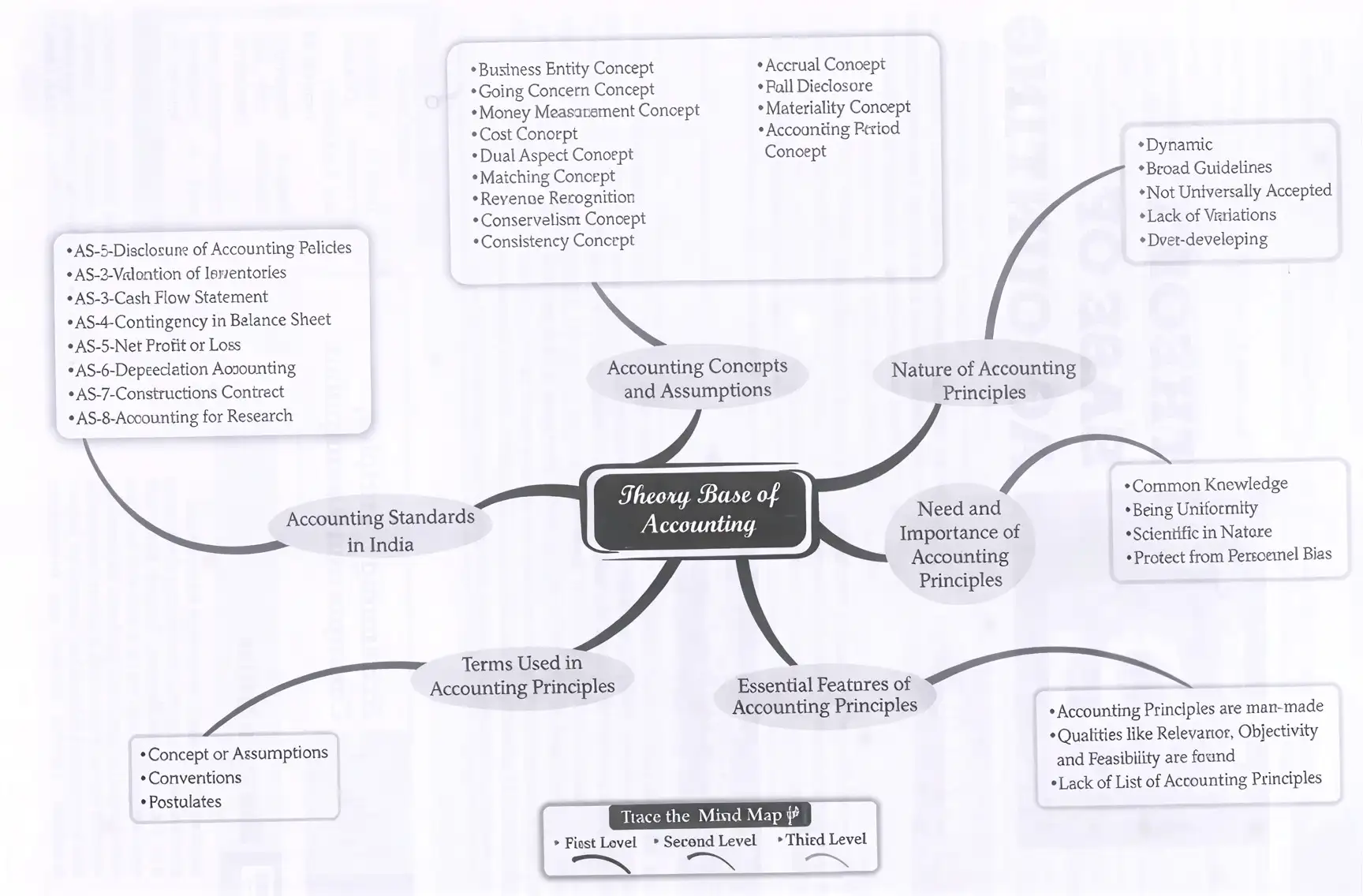
This image is a mind map outlining the "Theory Base of Accounting." It organizes key concepts, principles, standards, and the importance of accounting principles.
Step-by-step explanation:
- The central idea is the "Theory Base of Accounting."
- It branches into six main areas: Accounting Concepts and Assumptions, Nature of Accounting Principles, Need and Importance of Accounting Principles, Essential Features of Accounting Principles, Terms Used in Accounting Principles, Accounting Standards in India.
- Each branch lists important details or examples, such as business entity, cost, matching concepts, etc.
- The accounting standards section lists specific standards used in India, like disclosure policies and cash flow statements.
- Terms used include concepts, conventions, and postulates that help form accounting principles.
This mind map helps students understand the foundation and system behind accounting rules and practices.
Financial statements are prepared based on accounting conventions, which are practices followed over time. Accounting concepts, conventions, and principles together are known as GAAP (Generally Accepted Accounting Principles). Following are the fundamental accounting assumptions:
1. Consistency assumption :
Accounting practices selected and adopted should be applied consistently year after year to ensure meaningful study of business performance over time.
2. Going concern assumption :
The enterprise is assumed to have an indefinite life, with no intention to liquidate or significantly scale down operations.
3. Accrual assumption :
Revenue and expenses are recognized when earned or incurred, not when cash is received or paid.
Accounting Principles / Basic Accounting Concepts :
1. Business Entity Principle :
The business is a separate entity from its owner. Business transactions should not be mixed with personal transactions. Owner's investment is treated as capital, a liability of the business to the owner.
2. Money Measurement Principle :
Only transactions measurable in terms of money are recorded. Non-monetary factors like customer satisfaction cannot be recorded.
3. Accounting Period Principle :
The indefinite life of a business is divided into accounting periods (usually one year) to measure performance and calculate profit or loss periodically.
4. Principle of Full Disclosure :
All material facts affecting business profitability must be disclosed in financial statements, whether legally required or not.
5. Materiality Principle :
Only items significant enough to influence decision-making are disclosed. For example, small purchases like pencils are expenses, while machines are assets.
6. Conservatism or Prudence Principle :
Anticipate and provide for possible losses but not for anticipated gains. Examples include valuing closing stock at cost or market price, whichever is less, and creating provisions for bad debts.
7. Cost Concept :
Assets are recorded at their historical cost, including acquisition and installation costs.
8. Matching Principle of Revenue and Expenses :
Revenues and related expenses must be matched in the same accounting period to determine accurate profit or loss.
9. Dual Aspect Principle :
Every transaction affects two aspects of the business, maintaining the accounting equation: Equity + Liabilities = Assets.
10. Revenue Recognition Principle :
Revenue is recognized when the earning process is complete, the amount is measurable, and realization in cash or receivable is established.
11. Objectivity Concept :
Accounting entries must be supported by unbiased documentary evidence to ensure reliability.
12. Going Concern Concept :
Assumes business will continue indefinitely, justifying asset valuation at cost and systematic depreciation.
13. Consistency Concept :
Accounting policies should be applied consistently over time to allow meaningful comparisons. Changes must be disclosed with their effects.
Key Words
➤ Accounting Concepts : Necessary assumptions and theoretical ideas fundamental to accounting practice.
➤ Convention : Customs or traditions guiding preparation of accounting statements.
➤ Postulates : Basic universally accepted assumptions.
➤ Revenue Recognition Concept : Standard for recognizing revenues.
Accounting Standards and GST
Accounting Standards
History:
Accounting is the language of business, communicating financial results to users. With globalization and complexity, standardization of accounting policies became essential to ensure transparency, consistency, comparability, and reliability.
The International Accounting Standards Committee (IASC), now International Financial Reporting Board (IFRB), was formed in 1973 to formulate and improve accounting standards.
Meaning:
Accounting Standards are guidelines issued by the accounting organization of a country (e.g., Institute of Chartered Accountants of India) for preparation and presentation of financial statements to standardize diverse accounting practices.
Purpose:
Accounting Standards help in:
- Comparing financial statements easily, improving reliability.
- Providing standard accounting policies, valuation norms, and disclosure requirements.
- Reducing creative accounting for favorable presentation.
Benefits:
- Eliminates variations in accounting treatment.
- Discloses important information not statutorily required.
- Helps comparison of financial statements within and outside the country.
- Assists auditors in auditing accounts.
- Builds confidence among users of accounting information.
Limitations:
- Choosing among alternative treatments can be difficult.
- Rigid adherence may reduce flexibility.
- Cannot override laws; legal requirements prevail.
➤ Indian Accounting Standards
With India's economic growth, the importance of Accounting Standards increased to ensure transparent financial reporting. The Institute of Chartered Accountants of India formed the Accounting Standards Board (ASB) in 1977 to harmonize diverse practices.
Process of setting Accounting Standards:
- Identify areas with diverse practices.
- Prepare preliminary drafts considering legal framework and IFRS.
- Circulate drafts among organizations like SEBI, CII, Department of Company Affairs, Indian Banks Association, Comptroller and Auditor General of India for feedback.
- Finalize drafts after considering comments.
- Issue final standards under authority of ICAI Council.
➤ GST : Goods and Services Tax is a comprehensive indirect tax levied on supply of goods and services except petroleum and alcohol for human consumption.
Characteristics of GST :
- Comprehensive indirect tax replacing earlier indirect taxes except customs duty.
- Value added tax with input tax credit.
- GST paid is an asset, not a cost.
- Uniform GST rates across states.
Advantages of GST :
- Creates a common national market.
- Simplifies business by single indirect tax registration.
- Reduces cost by removing cascading effect.
- Simplifies tax regime with fewer rates.
- Improves indirect tax management.
- Makes goods cheaper.
- Attracts Foreign Direct Investment (FDI).
- Boosts Gross Domestic Product (GDP).
- Reduces cash economy.
Key Words
➤ Accounting Standards : Guidelines issued by accounting organizations for financial statement preparation.
➤ GDP : Gross Domestic Product.
System and Basis of Accounting
Revision Notes
➤ Systems of Accounting :
Transactions may be recorded under two systems:
(i) Double Entry System :
Every transaction has two aspects: debit and credit. Both are recorded, ensuring the sum of debits equals credits. For example, purchasing goods for cash debits goods and credits cash. This system is scientific and complete.
Advantages of Double Entry System :
- Complete record of transactions.
- Scientific method.
- Ensures arithmetical accuracy.
- Facilitates preparation of financial statements.
- Helps detect errors and frauds.
- Facilitates decision making through comparisons.
Disadvantages :
- Complex compared to single entry.
- Requires knowledge of accounting rules.
- Not suitable for very small or cash-only businesses.
(ii) Single Entry System :
Only one aspect of transactions is recorded, usually cash and personal accounts. Records are incomplete and unreliable. Trial balance and final accounts cannot be prepared.
Basis of Accounting :
Transactions may be recorded on:
(i) Cash Basis of Accounting :
Transactions are recorded when cash is received or paid. Revenue and expenses are recognized on actual cash flow. No adjustments for outstanding or prepaid items. Mainly used by non-profit organizations.
Advantages :
- Simple to maintain.
- Objective with minimal estimates.
- Suitable for cash-based organizations.
Disadvantages :
- Not recognized under Companies Act.
- Does not give true and fair view due to lack of adjustments.
- Does not distinguish capital and revenue expenditure.
(ii) Accrual Basis of Accounting :
Income is recorded when earned, expenses when incurred, regardless of cash flow. Adjustments for outstanding, prepaid, accrued, and advance items are made, following the Matching Concept.
Advantages :
- Gives true and fair view of profit and financial position.
- More scientific and widely used.
- Recognized under Companies Act.
- Distinguishes capital and revenue expenditure.
Disadvantages :
- More complex due to adjustments.
- Estimates may be subjective.
- Profit and financial position may be harder to ascertain.