CLASS 11-COMMERCE . ACCOUNTANCY . FINANCIAL ACCOUNTING PART II . FINANCIAL STATEMENT-I
Chapter 1 : Financial Statement – I
Ch 1
ACCOUNTANCY
CLASS 11-COMMERCE
Meaning, Usefulness and Types of Financial Statements
Financial statements, also known as final accounts, are periodic reports prepared after the agreement of the trial balance. They present the financial progress and results of a business enterprise over a specific period. These statements include the Trading Account, Profit & Loss Account, Balance Sheet, and other explanatory notes.
Usefulness:
- Assist management in planning and controlling business operations.
- Provide valuable information to creditors, shareholders, and employees.
Types of Financial Statements:
- Trading Account
- Profit & Loss Account
- Balance Sheet
- Other related statements and notes
Example: A company prepares its financial statements annually to assess profitability and financial position, aiding decision-making for stakeholders.
Trading and Profit & Loss Account
The Trading and Profit & Loss Account is prepared to determine the profit earned or loss sustained by a business during a given period.
Need:
- To ascertain the net result of business operations.
- The Trading Account shows gross profit or loss by comparing sales and cost of goods sold.
- The Profit & Loss Account shows indirect expenses and incomes to arrive at net profit or loss.
- Closing entries transfer balances of expenses and revenues to this account.
- Net profit or loss is transferred to the Capital Account.
Illustration:
Consider a business with sales of ₹5,00,000, cost of goods sold ₹3,00,000, and indirect expenses ₹1,00,000. The Trading Account will show a gross profit of ₹2,00,000, and after deducting indirect expenses, the Profit & Loss Account will show a net profit of ₹1,00,000.
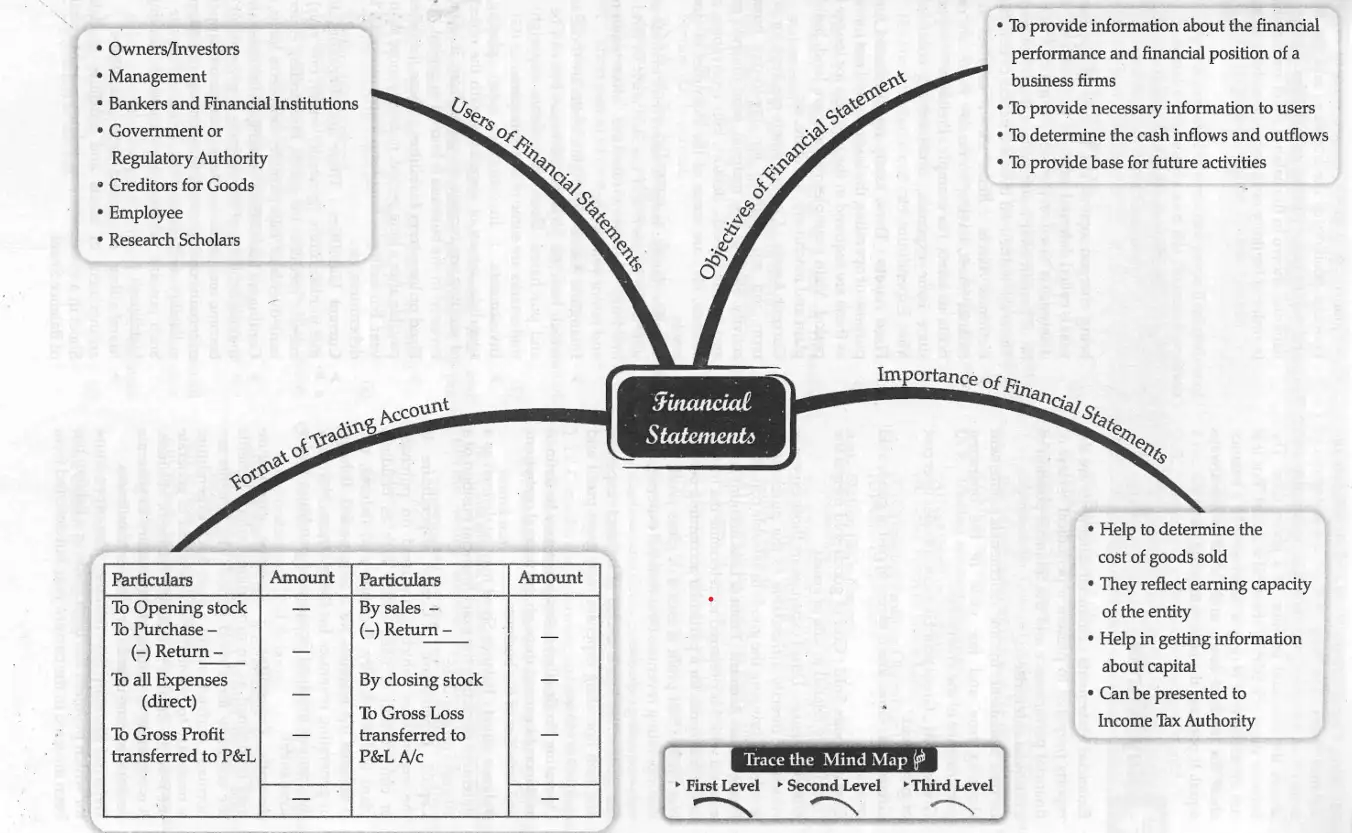
This mind map illustrates the users, objectives, importance, and format of financial statements, providing a comprehensive overview for students.
Meaning, Characteristic, Need and Structure of the Balance Sheet
The Balance Sheet is a statement showing the financial position of a business at a specific date by listing its assets and liabilities.
Characteristics:
- It is a statement, not an account.
- Assets and liabilities totals are always equal, reflecting the accounting equation: Assets = Liabilities + Capital.
Need: To provide a clear picture of the financial position for stakeholders.
Structure: Assets are classified as fixed and current, while liabilities are classified as long-term and current.
Example: A balance sheet dated 31st March 2024 shows total assets of ₹10,00,000 and total liabilities plus capital of ₹10,00,000, confirming the balance.
Key Words
Financial Statements: Reports presenting periodic financial performance and position.
Income Statement: Statement showing true and fair view of operating performance.
Gross Profit: Excess of sales over cost of goods sold.
Gross Loss: Excess of cost of goods sold over sales.
Cost of Goods Sold: Cost directly related to sale of goods.
Direct Expenses: Expenses directly attributable to purchase and preparation of goods for sale.
Profit & Loss Account: Account to determine income for a period.
Net Profit: Excess of gross profit and non-operating revenues over indirect expenses and non-operating expenses.
Net Loss: Excess of indirect expenses and non-operating expenses over gross profit and indirect revenues.
Operating Profit: Profit earned through normal business operations.
Balance Sheet: Statement depicting exact financial position on a date.
Capital Expenditure: Expenditure on fixed assets benefiting business long-term.
Revenue Expenditure: Expenditure benefiting business short-term, recurring in nature.
Deferred Revenue Expenditure: Expenditure paid but charged over future periods.
Fictitious Assets: Assets with no market value, e.g., preliminary expenses.
Fixed Assets: Assets used in business operations, not for resale.
Current Assets: Assets held for short-term use in business.
Tangible Assets: Physical assets like land and machinery.
Intangible Assets: Non-physical assets like goodwill and patents.
Investments: Money placed to earn income or profit.
Fixed or Long-term Liabilities: Liabilities payable after more than one year.
Current Liabilities: Obligations payable within one year.
Contingent Liabilities: Possible liabilities dependent on future events.
Marshalling of Assets and Liabilities: Systematic arrangement of balance sheet items.