CLASS 10 . SOCIAL SCIENCE . UNDERSTANDING ECONOMIC DEVELOPMENT . SECTORS OF-THE-INDIAN-ECONOMY
Chapter 2 : SECTORS OF THE INDIAN ECONOMY
Ch 2
SOCIAL SCIENCE
CLASS 10
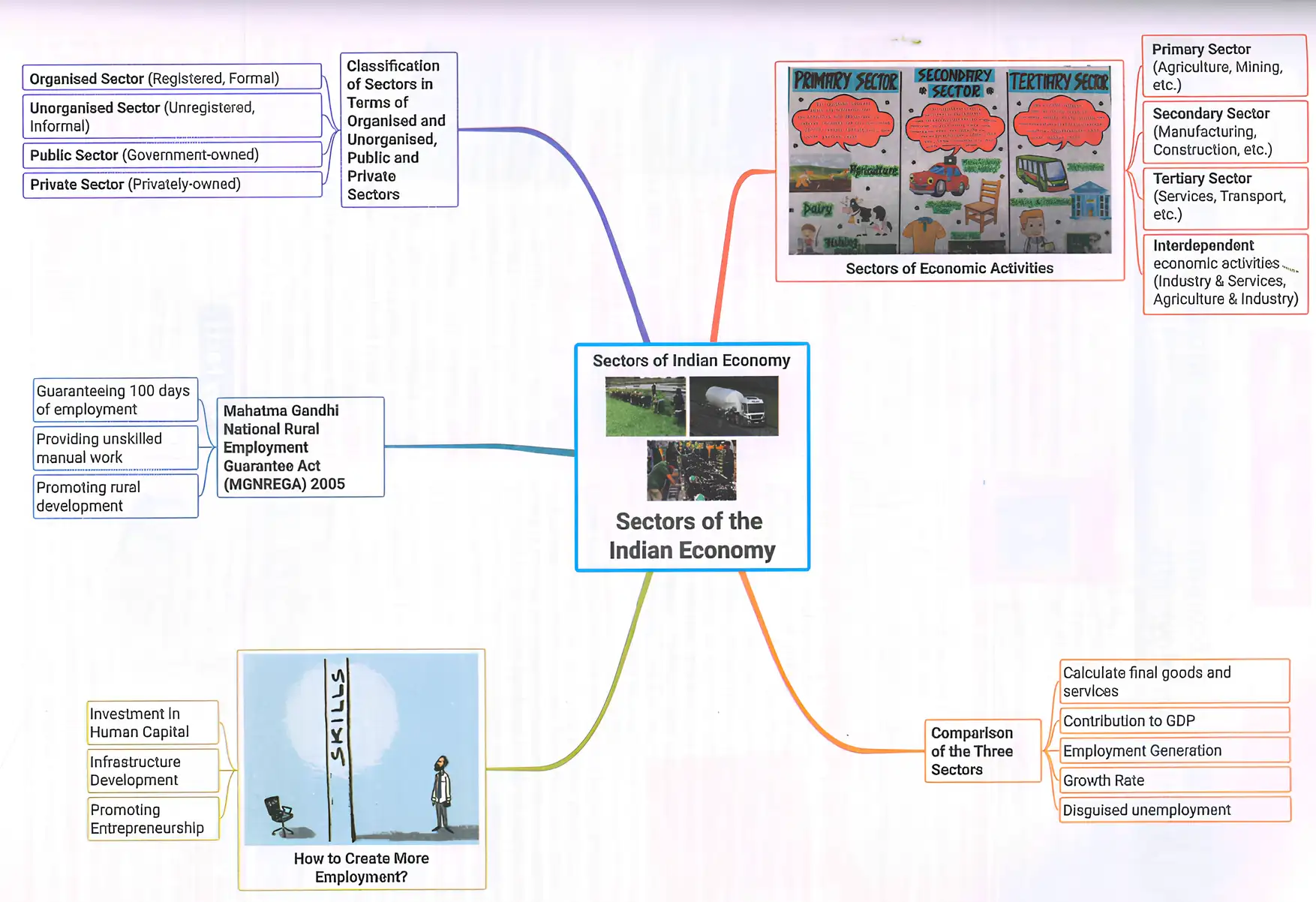
Sectors of Economic Activities
Economic activities are those activities that provide income to individuals by producing goods and services. These activities are classified into three main sectors based on the nature of production:
Primary Sector
The primary sector involves the extraction and harvesting of natural resources. Activities such as farming, fishing, forestry, and mining fall under this sector. It is the foundation of the economy as it provides raw materials for other sectors.
Secondary Sector
The secondary sector includes activities that transform raw materials into finished goods. This sector covers manufacturing, construction, and industrial production. For example, converting sugarcane into sugar is a secondary sector activity.
Tertiary Sector
The tertiary sector provides services that support the primary and secondary sectors and cater to the needs of the population. This includes services like education, healthcare, transportation, banking, and communication.
Exam-Oriented Question
Q: What are the three sectors of economic activities? Explain each briefly.
A: The three sectors are:
- Primary sector: Involves natural resource extraction like farming and mining.
- Secondary sector: Involves manufacturing and construction.
- Tertiary sector: Involves services such as education and healthcare.
Comparison of Economic Sectors
The three sectors differ in terms of their contribution to the economy, employment, and growth:
- Contribution to GDP: The tertiary sector contributes the most to India's GDP, followed by the secondary and primary sectors.
- Employment: More than half of India's workforce is engaged in the primary sector, especially agriculture.
- Growth Rate: The tertiary sector has shown rapid growth due to increased demand for services.
- Hidden Unemployment: Disguised unemployment is common in the primary sector where more people are employed than necessary.
Exam-Oriented Question
Q: Why is disguised unemployment common in the primary sector?
A: Disguised unemployment occurs when more people are employed than needed, leading to low productivity. It is common in the primary sector because many workers are engaged in agriculture but not all contribute effectively to production.
Mahatma Gandhi National Rural Employment Guarantee Act 2005
MGNREGA is a government initiative aimed at providing employment opportunities to rural households. It guarantees 100 days of wage employment per year to unskilled workers, focusing on rural development and poverty reduction.
Objectives of MGNREGA
- Provide employment opportunities to rural people for 100 days annually.
- Improve the standard of living of rural households.
- Implement the right to work as a legal entitlement.
Exam-Oriented Question
Q: What are the main objectives of MGNREGA?
A: The main objectives are to provide 100 days of employment to rural workers, improve their living standards, and ensure the legal right to work.
Division of Sectors: Organised, Unorganised, Public, and Private
Economic activities are also classified based on the nature of employment and ownership:
Organised and Unorganised Sectors
The organised sector consists of jobs with fixed working hours, job security, and benefits. The unorganised sector includes informal jobs without job security or benefits, such as daily wage workers and small shopkeepers.
Public and Private Sectors
The public sector is owned and managed by the government, providing essential services like railways and postal services. The private sector is owned by individuals or companies, such as Tata Steel or Reliance Industries.
Exam-Oriented Question
Q: Differentiate between the organised and unorganised sectors.
A: The organised sector has fixed working hours, job security, and benefits, while the unorganised sector lacks these features and includes informal employment.
Creating More Employment
To increase employment opportunities, the following measures are important:
- Investing in human skill development and technical training.
- Building infrastructure such as dams, canals, and transport facilities.
- Providing cheap credit and crop insurance to farmers.
- Encouraging entrepreneurship and small-scale industries.
Exam-Oriented Question
Q: Suggest ways to create more employment in India.
A: Employment can be increased by investing in skills, infrastructure, providing financial support to farmers, and promoting entrepreneurship.
Solved Examples
Example 1: Identify which sector the following activities belong to: (a) Teacher, (b) Farmer, (c) Factory worker.
Solution: (a) Teacher - Tertiary sector, (b) Farmer - Primary sector, (c) Factory worker - Secondary sector.
Example 2: Explain why the tertiary sector has become the largest contributor to India's GDP.
Solution: The tertiary sector has grown due to increased demand for services like education, healthcare, communication, and government services, along with rising income levels and technological advancements.
Practice Set
Easy
- Define economic activities.
- Name the three sectors of economic activities.
Moderate
- Explain the difference between final goods and intermediate goods.
- What is disguised unemployment? Give an example.
Challenging
- Discuss the objectives and significance of MGNREGA.
- Compare the organised and unorganised sectors with examples.
Answer Key
- Economic activities: Activities that provide income by producing goods and services.
- Three sectors: Primary, Secondary, Tertiary.
- Final goods: Goods consumed directly by consumers.
Intermediate goods: Goods used for further production. - Disguised unemployment: More people employed than needed, e.g., excess labor in agriculture.
- MGNREGA objectives: Provide 100 days employment, improve living standards, implement right to work.
- Organised vs Unorganised: Organised has job security and benefits; unorganised lacks these.
Quick Reference
- Primary Sector: Natural resource extraction.
- Secondary Sector: Manufacturing and construction.
- Tertiary Sector: Services.
- GDP: Total value of final goods and services produced.
- MGNREGA: Employment guarantee for rural households.
- Organised Sector: Formal employment with security.
- Unorganised Sector: Informal employment without security.
Glossary
- Economic Activities: Work done to earn income by producing goods or services.
- Gross Domestic Product (GDP): Total value of all final goods and services produced in a country in a year.
- Disguised Unemployment: Employment of more people than necessary, leading to low productivity.
- MGNREGA: Mahatma Gandhi National Rural Employment Guarantee Act, a law guaranteeing 100 days of rural employment.
- Organised Sector: Employment with fixed hours, job security, and benefits.
- Unorganised Sector: Employment without formal contracts or security.
- Public Sector: Government-owned enterprises and services.
- Private Sector: Enterprises owned by individuals or companies.
- Final Goods: Goods consumed directly by consumers.
- Intermediate Goods: Goods used to produce other goods.
Chronology of Key Events
| Year | Event | Significance |
|---|---|---|
| 2005 | Implementation of MGNREGA | Legal guarantee of 100 days employment to rural households |
| 2013-14 | Tertiary sector becomes largest contributor to GDP | Shift in economic structure towards services |
| 2022 | Sectoral GDP contributions recorded | Primary: 21.82%, Secondary: 24.29%, Tertiary: 53.89% |