CLASS 10 . SOCIAL SCIENCE . DEMOCRATIC POLITICS II . OUTCOMES OF-DEMOCRACY
Chapter 5 : OUTCOMES OF DEMOCRACY
Ch 5
SOCIAL SCIENCE
CLASS 10
Outcomes of Democracy
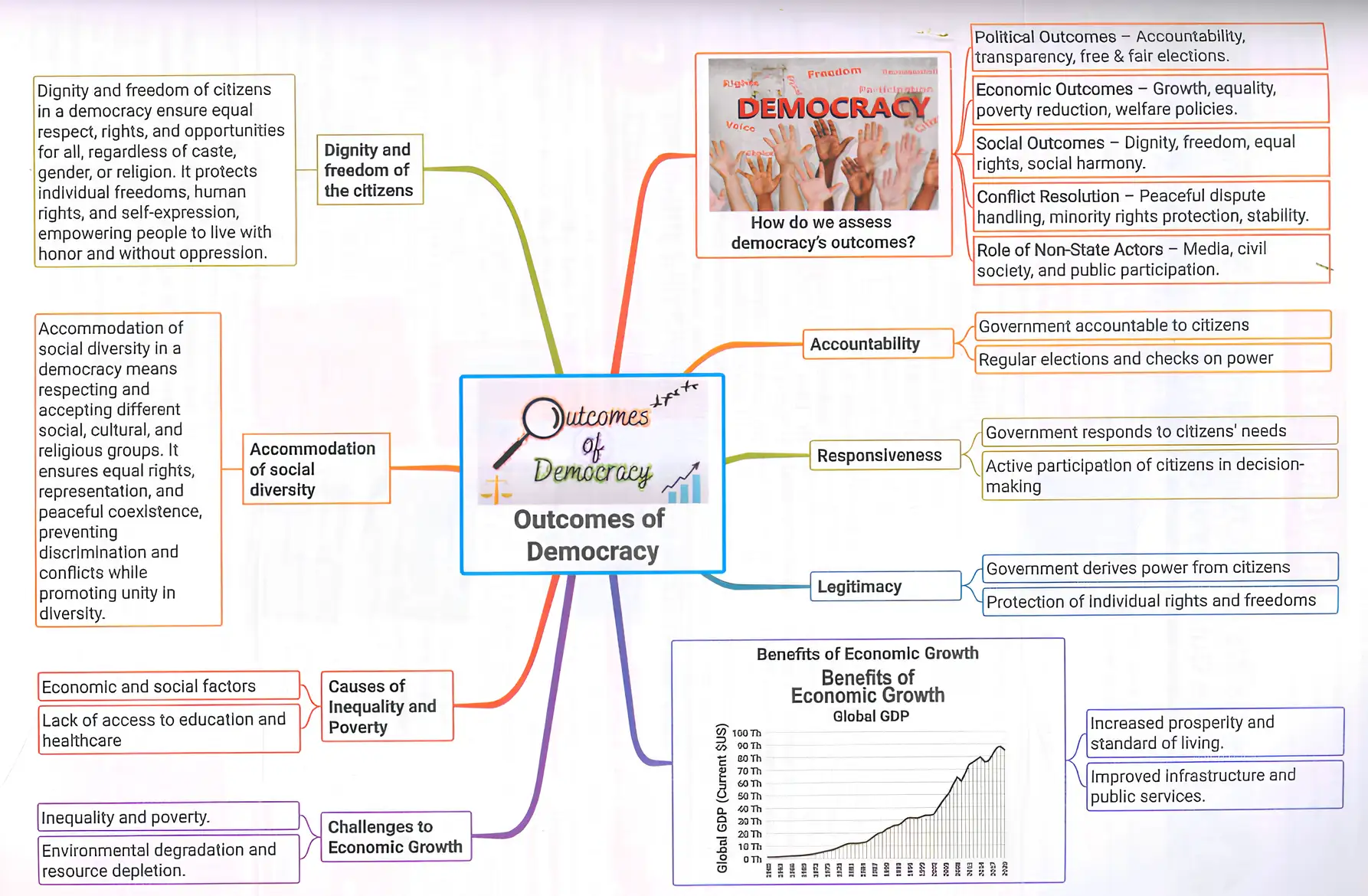
Democracy is a form of government that ensures dignity and freedom for all citizens by providing equal rights and opportunities. It respects social diversity by accepting different groups and promoting peaceful coexistence. Democracy promotes economic growth, which improves living standards and infrastructure. However, challenges such as inequality, poverty, and environmental issues remain and must be addressed for democracy to succeed.
Key democratic principles include accountability, responsiveness, and legitimacy. Accountability means the government is responsible to the people; responsiveness means the government meets citizens' needs; legitimacy means the government's power comes from the people and protects their rights.
How Do We Assess Democracy’s Outcomes and Political Outcomes of Democracy?
Is democracy a better form of government compared to dictatorship or other alternatives?
Democracy is better because:
- It promotes equality among citizens.
- It enhances the dignity of individuals.
- It improves the quality of decision-making.
- It provides a method to resolve conflicts.
- It allows room to correct mistakes.
Democratic governments may take longer to make decisions due to deliberation and negotiation, but their decisions are more acceptable and effective because they follow proper procedures.
Political outcomes of democracy include:
- An accountable, responsive, and legitimate government.
- Decision-making based on norms and procedures with transparency.
- Attention to the needs and demands of the people.
- Legitimacy as the government is chosen by the people.
Challenges in achieving expected democratic outcomes:
- Quality of government: Weak institutions and corruption can hinder democracy's effectiveness; politicians may prioritize personal interests.
- Economic well-being: Democracy does not guarantee economic prosperity; inequality and poverty may persist.
- Inequality: Social inequalities such as gender, race, ethnicity, and caste may continue.
- Social differences and conflict: Democracy may exacerbate social divisions and tensions.
- Freedom and dignity: Democracy may not always guarantee individual freedoms and minority rights.
- International factors: Global power dynamics and interference can limit democratic outcomes.
- Historical legacies: Colonialism, authoritarianism, and historical injustices affect democracy.
Exam Questions
Q1: Why is democracy considered a better form of government than dictatorship?
Answer: Democracy promotes equality, dignity, better decision-making, conflict resolution, and allows correction of mistakes, unlike dictatorship where power is concentrated in one person or group.
Q2: What are the political outcomes expected from a democracy?
Answer: An accountable, responsive, and legitimate government that follows transparent procedures and attends to people's needs.
Economic and Social Outcomes of Democracy
Economic Outcomes:
Economic development depends on factors like population size, global situation, cooperation from other countries, and economic priorities. The difference in economic development between democracies and dictatorships is often negligible. Democracy does not guarantee economic prosperity but is expected not to lag behind dictatorships.
Democracies face growing economic inequalities, with a small rich elite and many poor citizens. Democratically elected governments address poverty through welfare schemes and provide reservations for socially and economically backward groups in jobs, elections, and education.
Social Outcomes:
Democracy accommodates social diversity by developing procedures to include various social groups, reducing the risk of social tensions becoming violent. It promotes dignity and freedom by providing fundamental rights and respecting individuals.
Democracy requires that majority rule does not become domination by a majority community based on religion, race, or language. It must work with minorities to represent the general view.
Examples include the strengthening of claims for equal status and opportunity by disadvantaged castes and the progress in women's dignity and rights.
Exam Questions
Q1: How does democracy address economic inequality and poverty?
Answer: Democracies implement welfare schemes and provide reservations to socially and economically backward groups to reduce poverty and inequality.
Q2: Why is accommodating social diversity important in a democracy?
Answer: Accommodating social diversity reduces social tensions and conflicts, ensuring peaceful coexistence and representation of all groups.
Conclusion and Key Terms
Democracy continually strives for better outcomes as citizens demand more benefits and hold those in power accountable. People in a democracy are active citizens, not subjects.
| Time Period / Year | Event / Change | Importance |
|---|---|---|
| Historical | Struggles for women's rights and caste equality | Strengthened dignity and equal opportunity in democracy |
| Contemporary | Implementation of welfare schemes and reservations | Reduction of poverty and social inequality |
Glossary
- Accountable Government: Government elected by the people and responsible to them.
- Responsive Government: Government that meets the needs of the people and is transparent in decision-making.
- Legitimate Government: Government legally chosen by the people.
- Economic Development: Growth of a country's economic wealth for the well-being of its inhabitants.
- Social Diversity: Differences among people within a culture, including ethnicity, lifestyle, religion, language, and preferences.
Solved Examples
Example 1: Explain why democracy may take longer to make decisions compared to other forms of government.
Answer: Democracy involves deliberation and negotiation among various groups and follows established procedures to ensure transparency and accountability. This process takes time but results in decisions that are more acceptable and effective.
Example 2: Describe one challenge democracy faces in achieving social equality.
Answer: Democracy may not fully address social inequalities such as caste, gender, or ethnic discrimination, as structural inequalities and historical legacies persist.
Practice Set
Easy:
- Define democracy.
- What is meant by an accountable government?
Moderate:
- Explain the political outcomes expected from democracy.
- How does democracy accommodate social diversity?
Challenging:
- Discuss the challenges democracy faces in reducing economic inequality.
- Analyze why democracy is considered a legitimate form of government despite its inefficiencies.
Answer Key
- Easy:
- Democracy is a form of government where power is vested in the people, ensuring equal rights and participation.
- An accountable government is one that is responsible to the people and can be held answerable for its actions.
- Moderate:
- Political outcomes include accountability, responsiveness, legitimacy, transparency, and attention to citizens' needs.
- Democracy accommodates social diversity by including various social groups in decision-making and protecting minority rights.
- Challenging:
- Challenges include persistent economic inequalities, corruption, weak institutions, and global economic factors.
- Democracy is legitimate because it is chosen by the people and protects their rights, even if it is sometimes slow or inefficient.
Quick Reference
- Democracy: Government by the people with equal rights and freedoms.
- Accountability: Government's responsibility to the people.
- Responsiveness: Government's attention to citizens' needs.
- Legitimacy: Legal and accepted authority of the government.
- Economic Development: Growth in wealth and well-being.
- Social Diversity: Variety of social and cultural groups in society.