CLASS 10 . SOCIAL SCIENCE . INDIA AND CONTEMPORARY WORLD II . NATIONALISM IN-INDIA
Chapter 2 : NATIONALISM IN INDIA
Ch 2
SOCIAL SCIENCE
CLASS 10
Nationalism in India
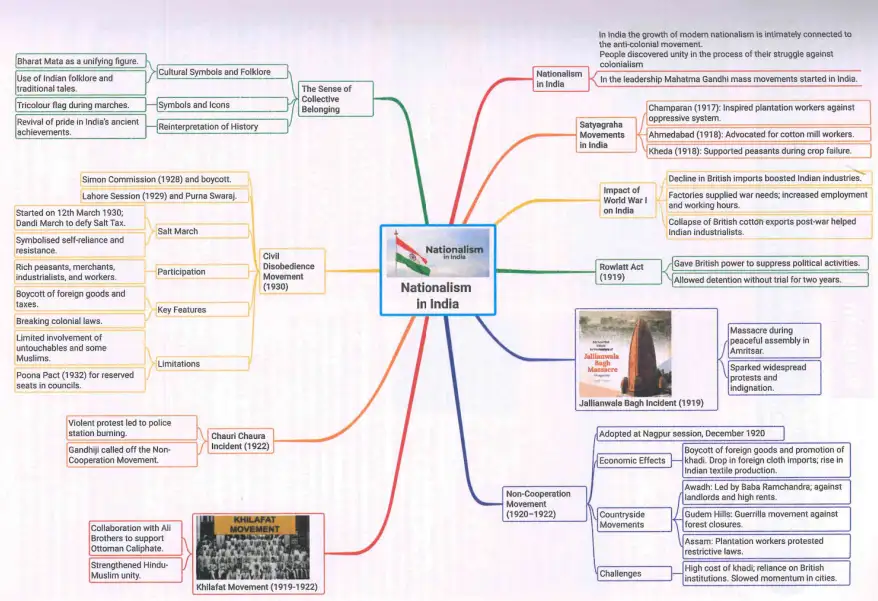
Nationalism in India was a powerful movement that united people across regions, religions, and social groups against British colonial rule. It was characterized by a sense of collective belonging, cultural pride, and the aspiration for self-rule or Swaraj. The movement drew strength from cultural symbols like Bharat Mata and the tricolor flag, folk songs, and reinterpretation of history to inspire pride in India's past achievements.
The Role of Cultural Symbols and Nationalist Reflection
Cultural symbols such as the image of Bharat Mata and the tri-color flag played a crucial role in fostering nationalism. Folk tales and songs collected by figures like Rabindranath Tagore and Natesa Sastri helped revive cultural pride. Nationalist writers encouraged Indians to take pride in their history and to strive for freedom from colonial rule.
Exam Question: How did cultural symbols contribute to the growth of nationalism in India?
Answer: Cultural symbols like Bharat Mata and the tri-color flag created a sense of unity and pride among Indians. Folk songs and tales revived cultural heritage, helping people identify with the nation and motivating them to participate in the freedom struggle.
Key Events and Movements
The nationalist movement included several important events and mass movements led by Mahatma Gandhi and others, emphasizing nonviolent resistance or Satyagraha.
- Champaran Satyagraha (1917)
- Ahmedabad Mill Workers' Movement (1918)
- Kheda Peasants' Movement (1918)
- Rowlatt Act protests and Jallianwala Bagh Massacre (1919)
- Non-Cooperation Movement (1920-22)
- Khilafat Movement (1919-22)
- Civil Disobedience Movement and Salt March (1930)
- Quit India Movement (1942)
Exam Question: What was the significance of the Non-Cooperation Movement?
Answer: The Non-Cooperation Movement marked the first large-scale mass protest against British rule, involving boycotts of foreign goods, government institutions, and promoting Indian products. It united diverse social groups and intensified the demand for Swaraj.
Effects of the First World War on India
The First World War had significant economic and social impacts on India. The war led to increased defence expenditure financed by war loans and higher taxes, causing inflation and doubling prices between 1914 and 1918. Crop failures and an influenza epidemic caused millions of deaths. Forced recruitment into the army caused widespread anger.
Exam Question: How did the First World War affect the Indian economy and society?
Answer: The war increased taxes and prices, causing hardship for common people. Crop failures and epidemics led to millions of deaths. Forced recruitment angered rural populations, contributing to unrest.
The Idea of Satyagraha
Mahatma Gandhi introduced the concept of Satyagraha, a method of nonviolent resistance based on truth and moral courage. It emphasized winning battles without physical force or aggression. Early Satyagraha movements included the Champaran peasants' struggle (1917), Ahmedabad mill workers' movement (1918), and Kheda peasants' movement (1918).
Exam Question: What are the principles of Satyagraha and how were they applied in early movements?
Answer: Satyagraha is based on truth and nonviolence, seeking to resist oppression without aggression. Gandhi applied it in movements supporting peasants and workers, encouraging peaceful protests against unjust policies.
Rowlatt Act and Jallianwala Bagh Incident
The Rowlatt Act (1919) allowed the British government to detain political activists without trial, leading to widespread protests. On 13 April 1919, British troops under General Dyer opened fire on peaceful protesters at Jallianwala Bagh in Amritsar, killing hundreds. This massacre intensified nationalist anger and protests across India.
Exam Question: What was the impact of the Jallianwala Bagh massacre on the Indian freedom struggle?
Answer: The massacre shocked the nation, leading to widespread outrage and increased support for the nationalist movement. It exposed British repression and strengthened calls for independence.
Khilafat and Non-Cooperation Movement
The Khilafat Movement (1919-22) was a joint Hindu-Muslim effort to support the Ottoman Caliphate after World War I. Gandhi allied with the Khilafat leaders to launch the Non-Cooperation Movement in 1920, which involved boycotting British goods, institutions, and promoting Swaraj. The movement united various social groups but ended in 1922 after the Chauri Chaura incident where violence broke out.
Exam Question: How did the Khilafat Movement influence the Non-Cooperation Movement?
Answer: The Khilafat Movement brought Hindus and Muslims together, strengthening the Non-Cooperation Movement by uniting diverse communities in the struggle against British rule.
Differing Strands within the Non-Cooperation Movement
Various social groups participated in the Non-Cooperation Movement with different aspirations:
- Peasants in Awadh demanded reduction of revenue and abolition of zamindari.
- Tribal peasants resisted forest laws and forced labour (begar).
- Plantation workers defied restrictions but faced repression.
- Businessmen sought an end to colonial economic policies.
- Industrial workers had a lukewarm response due to ties with industrialists.
- Dalits, led by Dr. B. R. Ambedkar, demanded separate electorates, leading to the Poona Pact with Gandhi.
- Women participated actively but were often limited to symbolic roles.
Exam Question: What were the different aspirations of social groups during the Non-Cooperation Movement?
Answer: Peasants sought relief from high rents, tribals resisted forest laws, businessmen wanted economic freedom, Dalits demanded political representation, and women participated for social reform. These diverse goals reflected the complexity of the movement.
Towards Civil Disobedience: The Sense of Collective Belonging
The Simon Commission (1928) faced nationwide protests for excluding Indians. Lord Irwin's vague offer of Dominion Status in 1929 was rejected. Gandhi's Salt March (1930) symbolized civil disobedience against the salt tax, inspiring mass participation. The British responded with repression and arrests. Gandhi signed the Gandhi-Irwin Pact (1931) but later relaunched the Civil Disobedience Movement, which lost momentum by 1934.
Different groups had varied responses: farmers fought high revenues, businessmen sought economic freedom, industrial workers were cautious, Dalits negotiated political rights, and women participated actively.
Exam Question: What was the significance of the Salt March in the Civil Disobedience Movement?
Answer: The Salt March was a symbolic act of defiance against British salt laws, uniting people across India in nonviolent protest and marking the start of the Civil Disobedience Movement.
Quit India Movement
In 1942, after the failure of the Cripps Mission and during World War II, the Indian National Congress launched the Quit India Movement demanding immediate British withdrawal. Gandhi's 'Do or Die' speech inspired mass nonviolent resistance involving all social classes. Despite severe repression, the movement demonstrated the Indian people's determination for freedom.
Exam Question: What were the causes and outcomes of the Quit India Movement?
Answer: The movement was caused by British refusal to grant independence during World War II. It led to widespread protests and arrests but strengthened the resolve for freedom and united diverse groups in the struggle.
Key Personalities in the Nationalist Movement
- Mahatma Gandhi: Leader of nonviolent resistance and mass movements.
- Dr. B. R. Ambedkar: Social reformer and champion of Dalit rights.
- Bankim Chandra Chattopadhyay: Writer of 'Vande Mataram' and creator of Bharat Mata image.
- Rabindranath Tagore: Poet and cultural nationalist.
- Natesa Sastri: Collector of Tamil folk tales.
- Lord Irwin: British Viceroy during key nationalist events.
Chronology of Key Events in the Nationalist Movement
| Year | Event | Significance |
|---|---|---|
| 1885 | First meeting of Indian National Congress | Beginning of organized nationalist politics |
| 1905 | Partition of Bengal | Triggered Swadeshi Movement and protests |
| 1915 | Gandhi returns to India | Introduction of Satyagraha and mass movements |
| 1919 | Rowlatt Act and Jallianwala Bagh Massacre | Increased repression and nationalist outrage |
| 1920-22 | Non-Cooperation Movement | Mass boycott and political awakening |
| 1930 | Salt March and Civil Disobedience Movement | Symbolic protest and widespread civil disobedience |
| 1942 | Quit India Movement | Demand for immediate British withdrawal |
Solved Examples
Example 1: Explain the significance of the Jallianwala Bagh massacre in the Indian freedom struggle.
Solution: The massacre exposed the brutal nature of British rule, united Indians in outrage, and intensified the demand for independence. It marked a turning point, leading many to support the nationalist movement.
Example 2: Describe the main features of Gandhi's Satyagraha.
Solution: Satyagraha is a method of nonviolent resistance based on truth and moral courage. It involves peaceful protests, non-cooperation with unjust laws, and winning over the oppressor without violence.
Practice Set
Easy
- What was the Rowlatt Act?
- Who was the leader of the Khilafat Movement?
Moderate
- Explain the causes and effects of the Non-Cooperation Movement.
- What was the significance of the Salt March?
Challenging
- Discuss the differing aspirations of various social groups during the Non-Cooperation Movement.
- Analyze the impact of the Jallianwala Bagh massacre on the nationalist movement.
Answer Key
- Rowlatt Act: A law passed in 1919 allowing detention of political activists without trial.
- Leader of Khilafat Movement: Muhammad Ali and Shaukat Ali.
- Causes and effects of Non-Cooperation Movement: Caused by repressive laws and desire for Swaraj; effects included mass boycott and political awakening.
- Significance of Salt March: Symbolized civil disobedience and united Indians against British salt laws.
- Differing aspirations: Peasants wanted land reforms, tribals resisted forest laws, businessmen sought economic freedom, Dalits demanded political rights, women sought social reform.
- Impact of Jallianwala Bagh massacre: Increased nationalist anger, united people, and exposed British brutality.
Quick Reference
- Satyagraha: Nonviolent resistance based on truth.
- Rowlatt Act: Repressive law passed in 1919.
- Jallianwala Bagh Massacre: 1919 killing of peaceful protesters.
- Non-Cooperation Movement: 1920-22 mass boycott movement.
- Salt March: 1930 civil disobedience against salt tax.
- Quit India Movement: 1942 demand for British withdrawal.
Glossary
- Swaraj: Self-rule or independence.
- Begar: Forced unpaid labour.
- Poona Pact: Agreement between Gandhi and Ambedkar on Dalit representation.
- Khilafat: Movement to protect the Ottoman Caliphate.
- Non-Cooperation: Refusal to cooperate with British authorities.
- Civil Disobedience: Active refusal to obey unjust laws.