CLASS 10 . SOCIAL SCIENCE . UNDERSTANDING ECONOMIC DEVELOPMENT . MONEY AND-CREDIT
Chapter 3 : MONEY AND CREDIT
Ch 3
SOCIAL SCIENCE
CLASS 10
Introduction to Money
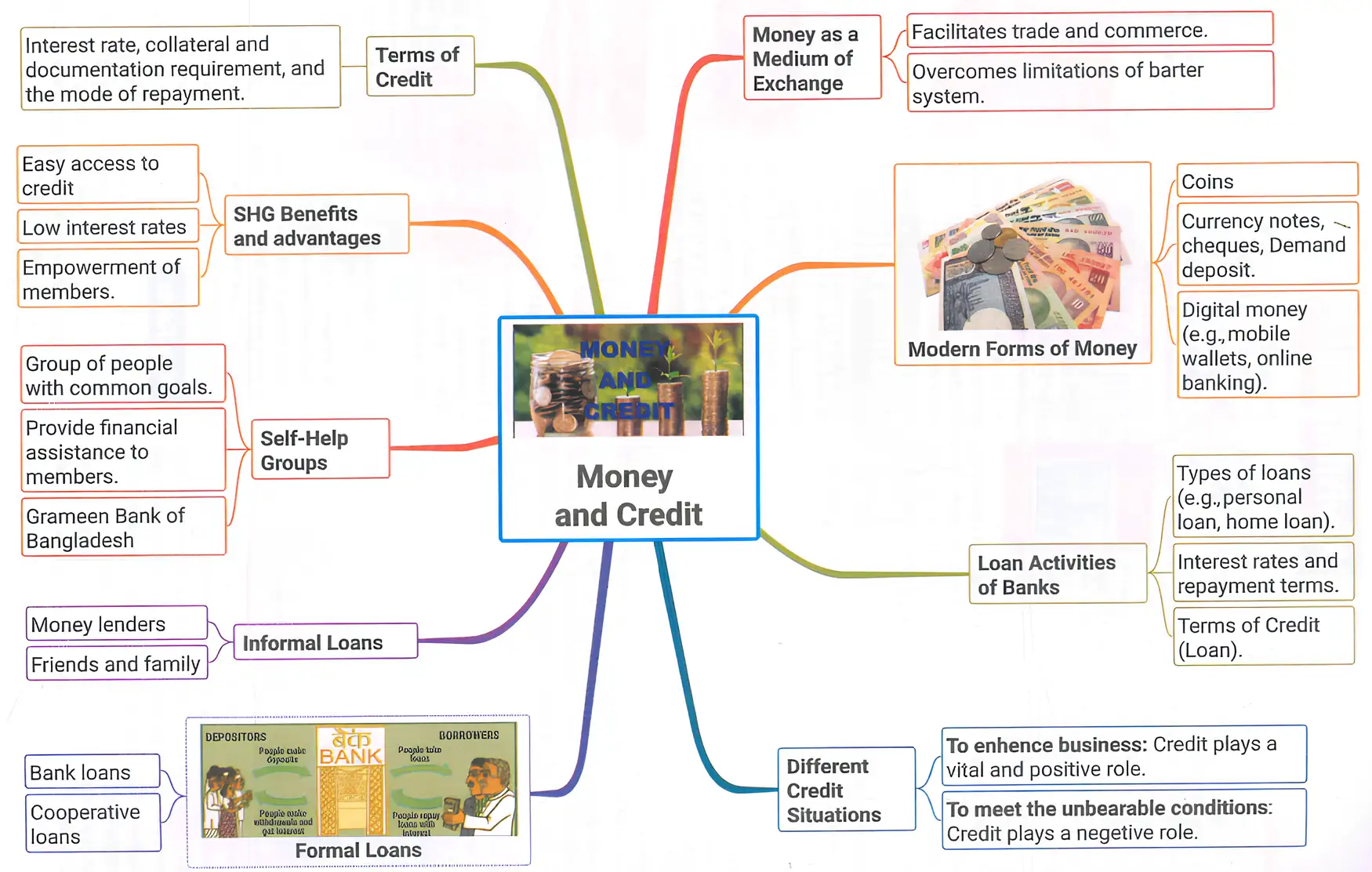
In early human societies, the barter system was used to exchange goods and services. This system required a double coincidence of wants, meaning both parties had to want what the other offered. Money was introduced to overcome this limitation by acting as a medium of exchange, facilitating trade without the need for direct barter.
Money is anything commonly accepted as a medium of exchange and for discharging debts. Historically, various items such as grains and cattle were used as money in India. Later, metallic coins made of gold, silver, and copper were introduced.
Modern currency consists of paper notes and coins made from inexpensive metals. It has no intrinsic value but is valuable because it is authorized by the government. In India, the Reserve Bank of India (RBI) is the sole authority to issue currency notes (except the one-rupee note) and coins on behalf of the central government. The Indian rupee is the official currency, and payments made in rupees are legally accepted across the country.
Exam Questions
Q1: What is the main problem with the barter system that money solves?
Answer: The barter system requires a double coincidence of wants, meaning both parties must want what the other offers. Money eliminates this problem by acting as a medium of exchange.
Q2: Who issues currency notes in India?
Answer: The Reserve Bank of India issues currency notes on behalf of the central government.
Banks and the Credit System
People deposit their surplus cash in banks, which accept deposits and pay interest to depositors. These deposits are called demand deposits because depositors can withdraw money on demand. Payments can be made directly from bank deposits using cheques, which are written instructions to the bank to pay a specified sum to a particular person.
Banks keep about 15% of deposits as cash to meet daily withdrawal demands. The remaining deposits are used to provide loans to borrowers. Banks charge interest on loans, which is higher than the interest paid on deposits. The difference is the bank's profit.
A loan given by a bank is also called credit. Credit is provided under certain conditions known as terms of credit, which include:
- Specified rate of interest
- Security or collateral to recover the loan if the borrower defaults
- Submission of documents such as proof of identity, residence, employment, and income
Collateral can be assets like land, property, vehicles, livestock, standing crops, or bank deposits. If the borrower fails to repay, the lender can sell the collateral to recover the loan amount.
Exam Questions
Q1: What are demand deposits?
Answer: Demand deposits are bank deposits on which depositors can withdraw money at any time and receive interest.
Q2: What is collateral?
Answer: Collateral is an asset pledged by a borrower to a lender as security for a loan, which the lender can seize if the borrower fails to repay.
Sources of Credit
Credit can be obtained from various sources, broadly classified as formal and informal:
- Formal Credit: Provided by banks and cooperative societies. These sources charge lower interest rates and are regulated by the Reserve Bank of India.
- Informal Credit: Provided by moneylenders, traders, landlords, relatives, and friends. They often charge higher interest rates and are not regulated, which can lead to unfair practices.
Self-Help Groups (SHGs) are community-based groups that collect savings from members and provide small loans to meet their needs. SHGs empower rural poor by offering easy access to credit.
Exam Questions
Q1: What is the difference between formal and informal credit?
Answer: Formal credit is provided by banks and cooperatives with lower interest rates and regulation by RBI, while informal credit comes from moneylenders and others with higher interest rates and no regulation.
Q2: How do Self-Help Groups help rural people?
Answer: Self-Help Groups collect savings from members and provide small loans to meet their needs, offering easy access to credit and empowerment.
Importance of Money and Credit
Money facilitates trade by acting as a medium of exchange, overcoming the limitations of the barter system. Credit helps individuals and businesses to meet their financial needs, invest in opportunities, and manage cash flow.
However, credit must be used responsibly. While it can boost business and economic activities, excessive or mismanaged credit can lead to financial difficulties.
Exam Questions
Q1: Why is money called a medium of exchange?
Answer: Because money is commonly accepted in exchange for goods and services, facilitating trade without barter.
Q2: What are the risks of taking credit?
Answer: If credit is not repaid on time, it can lead to financial problems, loss of collateral, and increased debt burden.
Solved Examples
Example 1: Ramesh wants to buy a bicycle but does not have enough money. He approaches a bank for a loan. The bank agrees to lend him the money at an interest rate of 10% per annum, with his house as collateral. Explain the terms of credit involved.
Solution: The bank has set a 10% interest rate, which Ramesh must pay along with the principal amount. The house is the collateral, meaning if Ramesh fails to repay, the bank can sell the house to recover the loan. Ramesh must also provide documents proving his identity, residence, and income.
Practice Set
Easy
- What is barter system?
- Who issues currency notes in India?
Moderate
- Explain the role of banks in the credit system.
- What is collateral? Give examples.
Challenging
- Compare formal and informal sources of credit and discuss their advantages and disadvantages.
- How do Self-Help Groups empower rural poor?
Answer Key
- Easy:
- Barter system is the exchange of goods and services directly without using money.
- The Reserve Bank of India issues currency notes in India.
- Moderate:
- Banks accept deposits, pay interest, and provide loans to borrowers, charging interest on loans.
- Collateral is an asset pledged as security for a loan, such as land, vehicles, or livestock.
- Challenging:
- Formal credit is regulated, has lower interest rates, and is provided by banks/cooperatives; informal credit is unregulated, has higher interest rates, and is provided by moneylenders and others.
- Self-Help Groups collect savings from members and provide small loans, helping rural poor access credit and improve their economic conditions.
Quick Reference
- Money: Medium of exchange, eliminates barter limitations.
- Currency: Paper notes and coins authorized by government.
- Bank Deposits: Demand deposits, payable on demand with interest.
- Cheque: Written instruction to pay from bank account.
- Credit: Loan given by banks or others with terms and interest.
- Collateral: Asset pledged as security for loan.
- Formal Credit: Provided by banks/cooperatives, regulated by RBI.
- Informal Credit: Provided by moneylenders, traders, relatives, unregulated.
- Self-Help Groups: Community groups providing small loans to members.
Glossary
- Barter System: Exchange of goods without money.
- Medium of Exchange: An item accepted for payment of goods and services.
- Demand Deposit: Bank deposit withdrawable on demand.
- Cheque: Written order to bank to pay money.
- Credit: Loan given with terms and interest.
- Collateral: Asset pledged as security for loan repayment.
- Formal Credit: Loans from regulated institutions like banks.
- Informal Credit: Loans from unregulated sources like moneylenders.
- Self-Help Group: Group of people pooling savings to provide loans.
Chronology of Money and Credit
| Time Period / Year | Event / Change | Importance |
|---|---|---|
| Early times | Use of barter system | Exchange of goods directly, limited by double coincidence of wants |
| Ancient India | Use of grains and cattle as money | Early forms of money facilitating trade |
| Later period | Introduction of metallic coins (gold, silver, copper) | Standardized medium of exchange with intrinsic value |
| Modern times | Use of paper notes and coins authorized by government | Convenient and government-backed currency system |
| Present | Formal credit system with banks and cooperatives; informal credit from moneylenders | Facilitates economic activities and financial inclusion |