CLASS 10 . SOCIAL SCIENCE . CONTEMPORARY INDIA II . MANUFACTURING INDUSTRIES
Chapter 6 : MANUFACTURING INDUSTRIES
Ch 6
SOCIAL SCIENCE
CLASS 10
Manufacturing Industries: Introduction, Location and Classification
Introduction
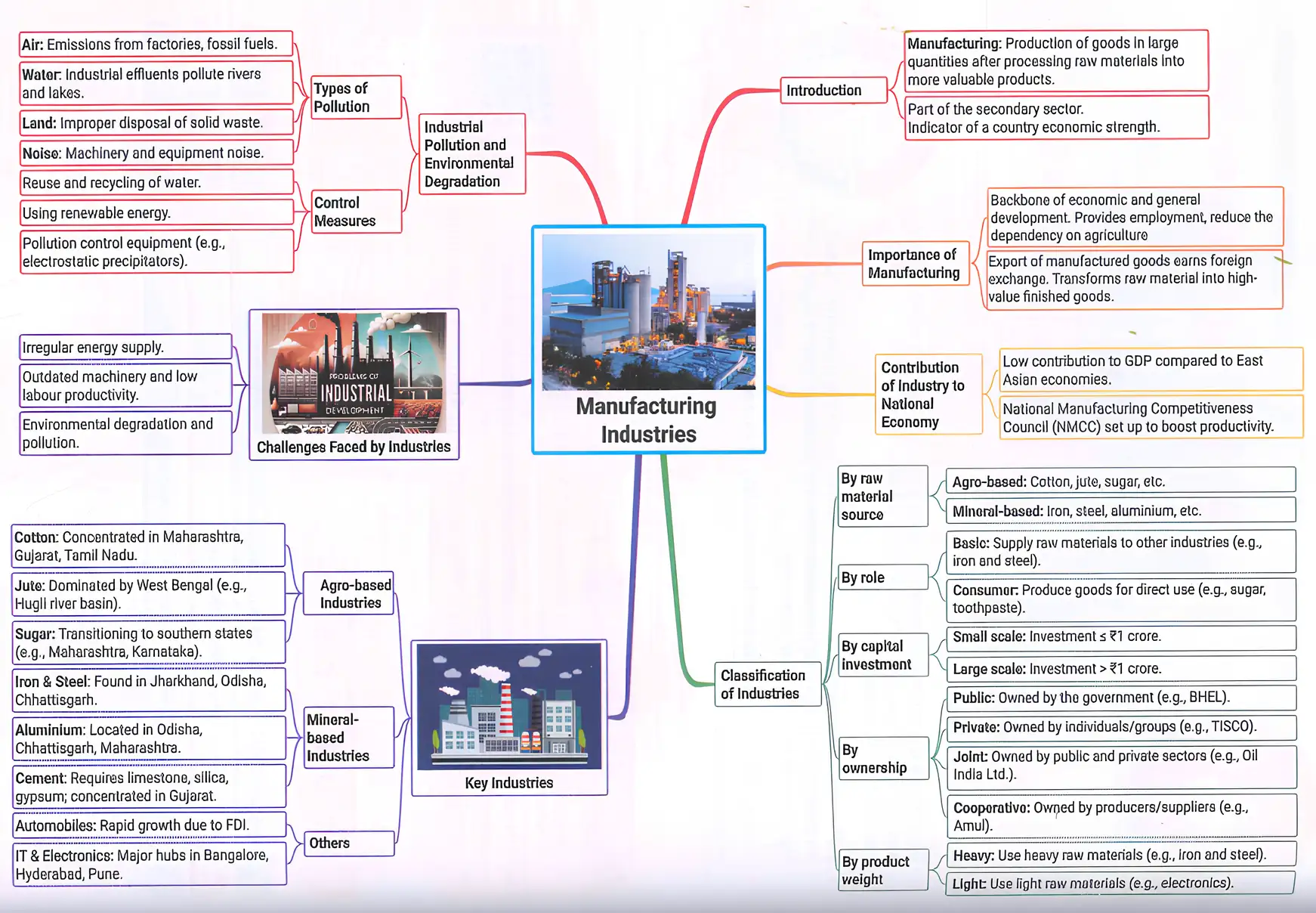
Manufacturing industries involve the production of goods in large quantities by processing raw materials into finished products. These industries are crucial for economic development as they transform primary materials into valuable goods.
Importance of Manufacturing
- Modernizes agriculture and reduces dependence on farming income.
- Generates employment in secondary and tertiary sectors.
- Helps eradicate unemployment and poverty.
- Expands trade and brings foreign exchange through exports.
- Contributes to national prosperity.
Contribution to National Economy
- Manufacturing sector contributes about 17% to GDP.
- Industry overall contributes 27% to GDP, including mining, electricity, and gas.
- Growth rate of manufacturing has been 7% in the last decade, aiming for 12% in the future.
- National Manufacturing Competitiveness Council (NMCC) works to improve productivity.
Factors Affecting Industrial Location
- Availability of raw materials, labour, capital, power, and market.
- Infrastructure and transportation facilities.
- Climate conditions.
Manufacturing Industry and Urbanisation
Manufacturing industries promote urbanisation by attracting workers and supporting services. Industrial agglomeration occurs when industries cluster together in urban areas, benefiting from shared resources and infrastructure.
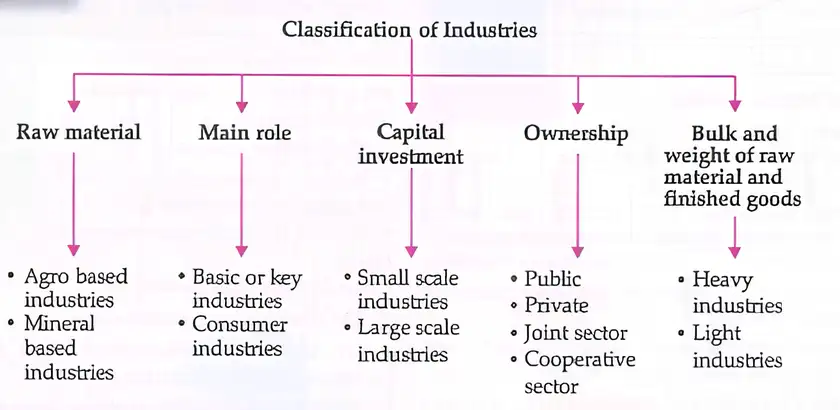
Classification of Industries
- On the basis of raw materials: Agro-based (cotton, jute, silk) and mineral-based (iron, steel, cement).
- According to main role: Basic/key industries (iron and steel) and consumer industries (sugar, paper, electronics).
- On the basis of capital investment: Small scale (up to ₹1 crore) and large scale (above ₹1 crore).
- On the basis of ownership: Public sector (government owned), private sector, joint sector, and cooperative sector.
- On the basis of bulk and weight: Heavy industries (iron and steel) and light industries (electronics).
Exam Question
Q: What are the main factors that influence the location of manufacturing industries?
A: The main factors include availability of raw materials, labour, capital, power, market, infrastructure, transportation, and climate.
Agro Based and Mineral Based Industries
Agro Based Industries
These industries use agricultural raw materials. Examples include cotton textiles, jute textiles, woollen textiles, silk textiles, sugar, tea, and coffee industries.
Types of Agro-based Industries
- Textile Industry: Contributes 14% to industrial production and employs 35 million people. Major types include cotton textiles (concentrated in Maharashtra and Gujarat), jute textiles (around Kolkata), and silk textiles (Karnataka leads in production).
- Sugar Industry: India is the second largest sugar producer, with mills concentrated in southern and western states due to longer crushing seasons.
Mineral Based Industries
These industries use minerals as raw materials. The iron and steel industry is a key basic industry. Production and consumption of steel indicate economic development.
Types of Mineral Based Industries
- Iron and Steel Industry: Uses iron ore, coal, and limestone. Located near mining areas with good transport.
- Aluminium Smelting: Uses bauxite to produce aluminium, which is light, corrosion-resistant, malleable, and a good heat conductor.
- Chemical Industry: Includes both large and small scale units producing inorganic and organic chemicals.
- Fertiliser Industry: Produces nitrogenous and complex fertilisers. Major producers include Gujarat, Tamil Nadu, Uttar Pradesh, Punjab, and Kerala.
- Automobile Industry: Manufactures vehicles and is located in major cities like Delhi, Mumbai, Chennai, and Bengaluru.
- Information Technology and Electronics Industry: Produces electronic goods and telecommunication equipment. Bengaluru is known as the electronic capital of India.
Exam Question
Q: What are the characteristics of aluminium that make it important in industries?
A: Aluminium is light in weight, resistant to corrosion, a good conductor of heat, malleable, and becomes stronger when alloyed with other metals.
Industrial Pollution and Environmental Degradation
Types of Pollution Caused by Industries
- Air Pollution: Caused by gases like sulphur dioxide and carbon monoxide from factories and burning fossil fuels. It harms health, plants, animals, and buildings.
- Water Pollution: Caused by industrial waste discharged into rivers, affecting water quality. Industries like paper, chemical, textile, and petroleum refineries are major contributors.
- Thermal Pollution: Occurs when hot water from factories is released into water bodies, affecting aquatic life.
- Noise Pollution: Harmful noise from industries causes health issues like hearing impairment and increased stress.
Steps to Control Environmental Degradation
- Treat industrial wastewater before releasing it into water bodies.
- Recycle treated water for industrial use.
- Implement rainwater harvesting for industrial water needs.
- Regulate groundwater use legally.
- Use pollution control devices like filters and scrubbers.
- Reduce smoke emissions by using cleaner fuels.
- Use silencers and sound-absorbing materials to reduce noise.
- Promote sustainable development balancing economic growth and environmental protection.
- Example: National Thermal Power Corporation (NTPC) adopts eco-friendly practices like waste minimization and green cover.
Exam Question
Q: What measures can industries take to reduce environmental pollution?
A: Industries can treat wastewater, recycle water, use cleaner fuels, install pollution control devices, reduce noise with silencers, and adopt sustainable development practices.
Solved Examples
Example 1: Explain why manufacturing industries are important for economic development.
Answer: Manufacturing industries create jobs, reduce dependence on agriculture, increase exports, and contribute to GDP growth, leading to overall economic development.
Example 2: Differentiate between agro-based and mineral-based industries.
Answer: Agro-based industries use agricultural raw materials like cotton and sugar, while mineral-based industries use minerals like iron ore and bauxite.
Practice Set
Easy
- What is a manufacturing industry?
- Name two agro-based industries.
Moderate
- List three factors affecting the location of industries.
- Explain the importance of the iron and steel industry.
Challenging
- Describe the environmental impacts of industrial pollution and suggest control measures.
- Discuss the role of industrial agglomeration in urbanisation.
Answer Key
- Easy 1: Industry producing goods by processing raw materials.
- Easy 2: Cotton textile, sugar industry.
- Moderate 1: Raw materials, labour, capital.
- Moderate 2: Iron and steel industry is a basic industry essential for other industries.
- Challenging 1: Pollution types include air, water, thermal, noise; control measures include wastewater treatment, cleaner fuels, pollution control devices.
- Challenging 2: Industrial agglomeration leads to urban growth by clustering industries and supporting services.
Quick Reference
- Manufacturing Industry: Converts raw materials into finished goods.
- Agro-based Industries: Use agricultural products.
- Mineral-based Industries: Use minerals as raw materials.
- Industrial Agglomeration: Clustering of industries in urban areas.
- Pollution Types: Air, water, thermal, noise.
- Sustainable Development: Balancing growth with environmental protection.
Glossary
- Agglomeration Economics: Benefits gained when firms and people cluster together.
- Basic Industries: Industries supplying raw materials to other industries.
- Environmental Degradation: Deterioration of environment due to pollution and resource depletion.
- Industrial Agglomeration: Concentration of industries in a specific area.
- Manufacturing: Large scale production of goods from raw materials.
- Sustainable Development: Development meeting present needs without harming future generations.
| Year | Event | Significance |
|---|---|---|
| 1854 | First cotton textile mill established in Mumbai | Beginning of cotton textile industry in India |
| 1855 | First jute mill established near Kolkata at Rishra | Start of jute textile industry |
| 2003 onwards | Manufacturing sector growth rate increased to 9-10% | Improved industrial growth and productivity |
| Recent years | Sugar mills concentrated in southern and western states | Due to longer crushing seasons in these regions |