CLASS 10 . SOCIAL SCIENCE . UNDERSTANDING ECONOMIC DEVELOPMENT . GLOBALISATION AND-THE-INDIAN-ECONOMY
Chapter 4 : GLOBALISATION AND THE INDIAN ECONOMY
Ch 4
SOCIAL SCIENCE
CLASS 10
Globalisation
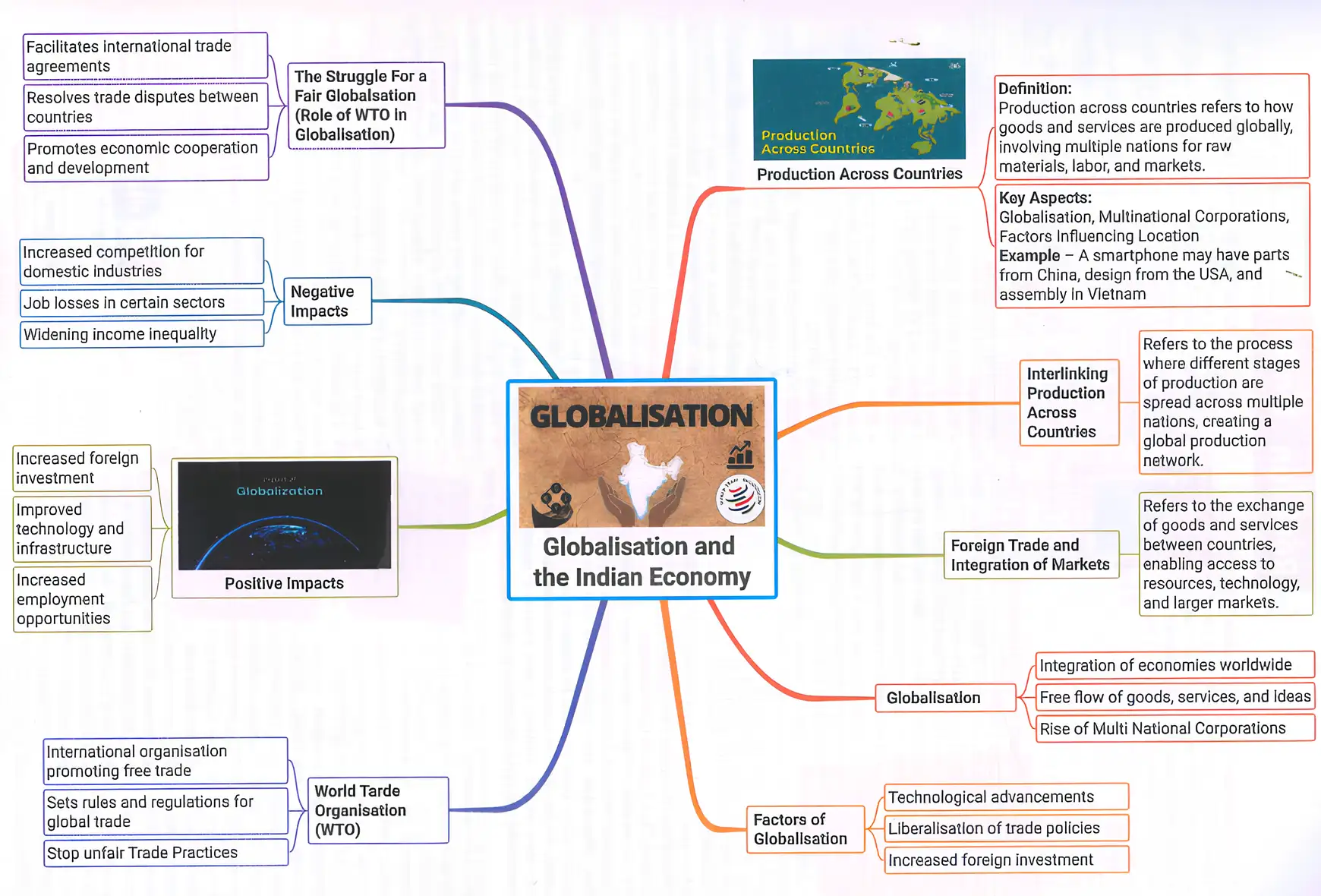
Globalisation refers to the process of integrating or interconnecting the economies of different countries through the free flow of trade, services, technology, capital, and movement of people across international borders. It involves the rapid integration of economies worldwide, allowing goods, services, and ideas to move freely.
What is Globalisation?
Globalisation means the integration of economies worldwide, enabling the free flow of goods, services, capital, and technology. It connects countries economically and culturally.
Exam Question: What does globalisation mean in the context of the world economy?
Answer: Globalisation means the integration of economies worldwide through free trade, investment, technology, and movement of people, allowing goods and services to flow freely across countries.
Factors Driving Globalisation
Key factors that have enabled globalisation include:
- Technology: Rapid improvements in information and communication technology, such as telephones, mobiles, and computers, have facilitated instant access to information and communication across the world.
- Liberalisation: The removal of government-imposed restrictions and barriers on trade and investment has opened economies to global markets.
- Foreign Investment: Increased foreign direct investment by multinational corporations (MNCs) has connected economies.
Exam Question: Name two major factors that have contributed to the growth of globalisation.
Answer: Technology improvements and liberalisation of economies are two major factors that have contributed to the growth of globalisation.
Impact of Globalisation on India
Globalisation has had multiple effects on the Indian economy:
- Increased foreign investment and job opportunities through the presence of MNCs.
- Growth in technology and infrastructure.
- Challenges for small producers and workers due to increased competition.
- Widening income inequality, benefiting mainly the skilled and educated class.
- Positive effects on sectors like services, but pressure on agriculture and small industries.
Exam Question: What are some positive and negative impacts of globalisation on India?
Answer: Positive impacts include increased foreign investment, job creation, and access to technology. Negative impacts include increased competition harming small producers, job losses in some sectors, and rising income inequality.
Role of Multinational Corporations
Multinational corporations (MNCs) operate in multiple countries and have significant capital to invest. They play a major role in driving globalisation by creating employment opportunities and linking local producers to global markets.
Exam Question: How do multinational corporations contribute to globalisation?
Answer: MNCs contribute to globalisation by investing in different countries, creating jobs, and connecting local producers to global supply chains.
Evolution and Impact of Globalisation
Globalisation has evolved over time through various historical phases:
| Time Period / Year | Event / Change | Importance |
|---|---|---|
| Ancient times | Trade routes like the Silk Route | Early economic integration between regions |
| Colonial period | Expansion of trade and colonisation | Spread of goods, culture, and economic control |
| Industrial Revolution | Technological advancements and mass production | Increased global trade and economic growth |
| Post World War II | Formation of IMF, World Bank, and WTO | Institutional support for global economic cooperation |
| 1990s onwards | Liberalisation and communication advances | Rapid growth of modern globalisation |
Globalisation has led to increased economic growth, employment, and access to global products. However, it has also caused challenges such as income inequality, environmental issues, and pressure on local industries and cultures.
Exam Question: Describe the evolution of globalisation and its impact on economies.
Answer: Globalisation evolved from ancient trade routes to modern economic integration supported by institutions like the IMF and WTO. It has increased economic growth and employment but also caused challenges like inequality and environmental concerns.
Globalisation and the Indian Economy
India's economy opened up to global markets through liberalisation policies in the 1990s, which removed many trade barriers and encouraged foreign investment.
Factors supporting globalisation in India include:
- Reduction of trade barriers to allow free flow of goods and services.
- Involvement of local producers with multinational corporations.
- Emergence of Indian companies like Tata Motors and Infosys as global players.
Exam Question: What were the key factors that supported globalisation in India?
Answer: Key factors include reduction of trade barriers, involvement of local producers with MNCs, and the rise of Indian multinational companies.
Challenges and Government Measures
Globalisation has posed challenges for small producers and workers. The government can take steps such as:
- Formulating effective labour laws to protect workers' rights.
- Protecting small producers against unfair competition from MNCs.
- Imposing trade barriers like tariffs and quotas to safeguard domestic industries.
- Collaborating with other developing countries to negotiate fair trade terms in the WTO.
Exam Question: How can the government ensure that the benefits of globalisation reach everyone?
Answer: By implementing strong labour laws, protecting small producers, imposing trade barriers, and negotiating fair trade agreements with other countries.
Role of G20 in Globalisation
The G20 is an intergovernmental forum consisting of 19 countries and the European Union, established in 1999. It represents major economies and addresses global economic issues.
Key facts about G20:
- Members include countries like India, USA, China, Germany, and the European Union.
- It contributes around 80% of the Gross World Product and covers over 60% of the world's land area.
- It works to maintain global financial stability and address issues like climate change and sustainable development.
Exam Question: What is the G20 and what role does it play in the global economy?
Answer: The G20 is a group of major economies that work together to maintain financial stability, promote sustainable development, and address global economic challenges.
India’s G20 Presidency
In 2023, India held the presidency of the G20, hosting the summit in New Delhi with the theme "One Earth, One Family, One Future" (Vasudhaiva Kutumbakam).
Highlights of India’s G20 Presidency:
- Focus on sustainable development, climate finance, and just energy transitions.
- Promotion of inclusive growth, women empowerment, and digital public infrastructure.
- Emphasis on multilateralism and global cooperation.
- India led cultural initiatives and youth engagement during the presidency.
Exam Question: What were the key themes of India’s G20 Presidency in 2023?
Answer: The key themes were sustainable development, climate action, inclusive growth, women empowerment, digital infrastructure, and global cooperation under the motto "One Earth, One Family, One Future."
Green Development, Climate Finance, and LiFE
India’s G20 Presidency emphasized the importance of addressing climate change through green development and climate finance. The LiFE (Lifestyle For Environment) movement encourages environmentally conscious practices based on India’s sustainable traditions.
Exam Question: What is the LiFE movement and how does it relate to India’s G20 priorities?
Answer: LiFE is a behaviour-based movement promoting environmentally conscious lifestyles, aligning with India’s G20 focus on sustainable development and climate action.
Accelerated, Inclusive, and Resilient Growth
India aims to promote accelerated, inclusive, and resilient growth by:
- Integrating micro, small, and medium enterprises (MSMEs) into global trade.
- Promoting labour rights and welfare.
- Addressing global skills gaps.
- Building inclusive agricultural value chains and food systems.
Exam Question: What are the focus areas for India to achieve inclusive and resilient growth during its G20 Presidency?
Answer: Focus areas include MSME integration, labour rights, skill development, and inclusive agriculture and food systems.
Accelerating Progress on Sustainable Development Goals
India’s G20 Presidency coincides with the midpoint of the 2030 Agenda for Sustainable Development. India emphasizes recommitting to the Sustainable Development Goals (SDGs) and addressing setbacks caused by the COVID-19 pandemic.
Exam Question: How does India’s G20 Presidency relate to the Sustainable Development Goals?
Answer: India’s G20 Presidency focuses on accelerating progress towards the SDGs by addressing challenges and promoting recovery from the COVID-19 pandemic.
Technological Transformation and Digital Public Infrastructure
India promotes a human-centric approach to technology, encouraging knowledge sharing in areas like digital public infrastructure, financial inclusion, and technology-enabled development in sectors such as agriculture and education.
Exam Question: What is India’s approach to technology during its G20 Presidency?
Answer: India advocates a human-centric approach to technology, focusing on digital infrastructure, financial inclusion, and tech-enabled development.
Multilateral Institutions for the 21st Century
India calls for reformed multilateralism that is more accountable, inclusive, just, equitable, and representative to address global challenges effectively in the 21st century.
Exam Question: What reforms does India seek in multilateral institutions?
Answer: India seeks reforms to make multilateral institutions more accountable, inclusive, just, equitable, and representative.
Women-led Development
India emphasizes inclusive growth with women empowerment and representation at the core, aiming to boost socioeconomic development and achieve the Sustainable Development Goals.
Exam Question: Why is women-led development important according to India’s G20 agenda?
Answer: Women-led development is important to promote inclusive growth, empower women, and achieve socioeconomic progress and SDGs.
Solved Examples
Example 1: Explain how technology has facilitated globalisation.
Solution: Technology, especially in communication and information, has enabled instant access to information and easy communication across countries. Devices like mobiles and computers help spread production and services globally, thus facilitating globalisation.
Example 2: Describe one positive and one negative impact of globalisation on Indian agriculture.
Solution: Positive impact: Access to new technologies and markets. Negative impact: Increased competition from imports has put pressure on small farmers.
Practice Set
Easy
- Define globalisation.
- Name two factors that have enabled globalisation.
Moderate
- Explain the role of multinational corporations in globalisation.
- List two challenges faced by small producers due to globalisation.
Challenging
- Discuss the significance of India’s G20 Presidency in 2023.
- Explain how India can ensure inclusive benefits from globalisation.
Answer Key
- Define globalisation: Integration of economies worldwide through free trade, investment, and technology.
- Name two factors that have enabled globalisation: Technology and liberalisation.
- Role of multinational corporations: They invest in multiple countries, create jobs, and connect local producers to global markets.
- Challenges for small producers: Increased competition and job losses.
- Significance of India’s G20 Presidency: Leadership in global economic cooperation, sustainable development, and inclusive growth.
- Ensuring inclusive benefits: Implementing labour laws, protecting small producers, and negotiating fair trade agreements.
Quick Reference
- Globalisation: Economic integration through trade, technology, and investment.
- Factors: Technology, liberalisation, foreign investment.
- Impacts: Growth, job creation, inequality, challenges for small producers.
- G20: Group of major economies addressing global economic issues.
- India’s G20: Focus on sustainability, inclusion, and global cooperation.
Glossary
- Globalisation: The process of integrating economies worldwide.
- Liberalisation: Removal of government restrictions on trade and business.
- Multinational Corporation (MNC): A company operating in multiple countries.
- G20: An international forum of 19 countries and the European Union focused on economic cooperation.
- LiFE (Lifestyle For Environment): A movement promoting environmentally conscious living.
- Sustainable Development Goals (SDGs): Global goals to achieve a better and more sustainable future.