CLASS 10 . SOCIAL SCIENCE . DEMOCRATIC POLITICS II . GENDER RELIGION-AND-CASTE
Chapter 3 : GENDER, RELIGION AND CASTE
Ch 3
SOCIAL SCIENCE
CLASS 10
Gender and Politics
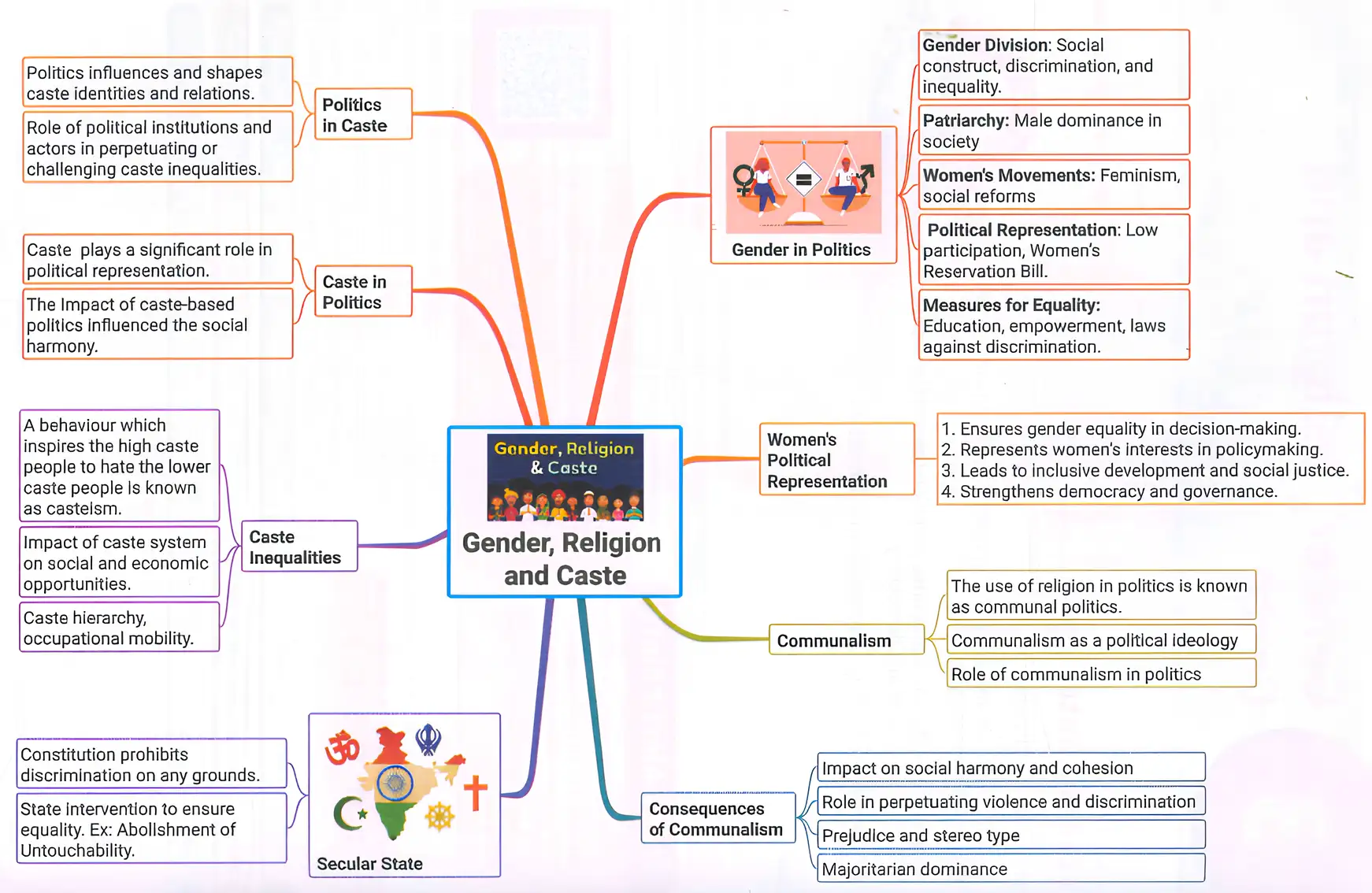
Gender division is a hierarchical social division evident in many aspects of society. Sexual division of labour assigns work based on sex. Indian society shows clear social divisions through casteism, gender inequality, and communal divisions.
Historically, only men participated in public affairs, voting, and holding office. Over time, women organized movements demanding equal political and legal rights, improved education, and career opportunities. These feminist movements seek equality in personal and family life.
India remains a male-dominated patriarchal society where women face disadvantages such as lower literacy rates, wage disparities, and social preference for sons. Women's representation in legislatures has been low, but legal measures have reserved one-third of seats in Panchayati Raj and Municipalities for women. The 2023 Nari Shakti Vandan Adhiniyam (Women's Reservation Act) reserves 33% of seats for women in Lok Sabha, State Legislative Assemblies, and Delhi Assembly.
Exam Questions
- Q: What is meant by a patriarchal society?
A: A patriarchal society is one where males hold dominance in important matters and the father or male elder has authority over the family. - Q: What legal provision has been made to increase women's political representation in India?
A: One-third of seats in local government bodies are reserved for women, and the 2023 Women's Reservation Act reserves 33% of seats in Parliament and State Assemblies for women.
Religion, Communalism and Politics
Indian democracy faces challenges such as casteism, communalism, illiteracy, unemployment, and poverty. Minorities are communities with relatively small populations. Communal politics involves using religion to create political divisions, often leading to communal representation where separate electorates exist for different communities.
Family laws govern matters like marriage and divorce. Buddhism is the major religion in Sri Lanka, Hinduism in Nepal. Political expression of religious community interests is important, but communalism promotes religious superiority and political dominance, often leading to violence and riots, as seen during Partition.
India is a secular state with no official religion. The Constitution guarantees freedom of religion and prohibits discrimination based on religion, while allowing state intervention to ensure equality within religious communities.
Exam Questions
- Q: What is communal politics?
A: Communal politics is the use of religion in politics to create divisions and promote the belief that one religion is superior to others. - Q: What are the features of a secular state like India?
A: A secular state guarantees freedom of religion, prohibits discrimination on religious grounds, and remains neutral in religious matters.
Caste and Politics
Casteism is the behaviour that causes high caste people to hate lower caste people. The caste system involved exclusion and discrimination, including untouchability. Leaders like Gandhi, Jyotiba Phule, Dr. B. R. Ambedkar, and Periyar worked to end caste discrimination.
Economic development, urbanisation, literacy, and occupational mobility have weakened caste hierarchies. The Indian Constitution prohibits caste-based discrimination and supports policies to reverse caste injustices.
Caste influences politics as parties consider caste composition when nominating candidates and appeal to caste sentiments to gain support. Universal adult franchise requires political mobilisation across castes. Caste identities have become politicised, with new caste groups emerging and demands for dignity and resources increasing. However, caste divisions can also cause tensions and violence.
Exam Questions
- Q: What is untouchability?
A: Untouchability is the practice of denying equal status to individuals based on their caste or social group. - Q: How does caste influence politics in India?
A: Political parties consider caste composition when selecting candidates and appeal to caste sentiments to secure votes, leading to caste-based political mobilisation.
Solved Examples
- Example 1: Explain the significance of the Women's Reservation Act, 2023.
Answer: The Women's Reservation Act reserves 33% of seats in Lok Sabha, State Legislative Assemblies, and Delhi Assembly for women, aiming to increase women's political representation and promote gender equality in governance. - Example 2: Describe the impact of communalism on Indian society.
Answer: Communalism divides society along religious lines, leading to prejudice, violence, and weakening social unity, as seen during the Partition riots. - Example 3: How has the Indian Constitution addressed caste discrimination?
Answer: The Constitution prohibits caste-based discrimination, abolishes untouchability, and supports policies to promote social justice and equality.
Practice Set
Easy
- Define patriarchal society.
- What is communal politics?
- Who was Dr. B. R. Ambedkar?
Moderate
- Explain the role of women’s movements in Indian politics.
- What are the consequences of communalism in India?
- How does caste influence electoral politics?
Challenging
- Discuss the measures taken by the Indian Constitution to promote equality among different castes and genders.
- Analyze the relationship between caste and politics in contemporary India.
- Evaluate the impact of political mobilisation on religious lines in India.
Answer Key
- Patriarchal society: A society where males hold dominance and authority over family and social matters.
- Communal politics: Use of religion to create political divisions and promote one religion over others.
- Dr. B. R. Ambedkar: A social reformer and architect of the Indian Constitution who worked to end caste discrimination.
- Women’s movements: Organized efforts to achieve equal rights, political representation, and social justice for women.
- Consequences of communalism: Social division, violence, prejudice, and weakening of national unity.
- Caste in electoral politics: Political parties consider caste composition and appeal to caste sentiments to win elections.
- Constitutional measures: Prohibition of discrimination, abolition of untouchability, reservation policies, and promotion of equality.
- Caste and politics relationship: Caste identities influence political mobilisation, candidate selection, and policy demands.
- Political mobilisation on religious lines: Can unify communities but also lead to communal tensions and violence.
Quick Reference
- Patriarchal society: Male dominance in social and family roles.
- Communalism: Political use of religion to divide society.
- Casteism: Discrimination based on caste hierarchy.
- Untouchability: Exclusion of certain castes from social equality.
- Secular state: State neutrality in religious matters.
- Political mobilisation: Organised efforts to gain political support.
- Reservation: Legal provision for representation of disadvantaged groups.
Glossary
- Hierarchical: Arranged according to levels of importance.
- Patriarchal society: Society where males hold dominance and authority.
- Legislature: Assembly with authority to make laws.
- Communalism: Use of religion to create political divisions.
- Political mobilisation: Organised activities to gain political support.
- Secular state: State that guarantees freedom of religion and neutrality.
- Discrimination: Unfair treatment based on characteristics like caste or religion.
- Untouchability: Denial of equal status based on caste.
- Urbanisation: Movement of population from rural to urban areas.
- Corruption: Dishonest or illegal behaviour by those in authority.
| Time Period / Year | Event / Change | Importance |
|---|---|---|
| Pre-Independence | Social reformers like Jyotiba Phule, Gandhi, Ambedkar worked against caste discrimination | Laid foundation for social equality and abolition of untouchability |
| Post-Independence | Constitution prohibits caste discrimination and untouchability | Legal framework for social justice and equality |
| Reservation Policies | Seats reserved for women in Panchayati Raj and Municipalities | Increased women's political participation |
| 2023 | Women's Reservation Act passed | 33% reservation for women in Parliament and State Assemblies |