CLASS 10 . SOCIAL SCIENCE . DEMOCRATIC POLITICS II . FEDERALISM
Chapter 2 : FEDERALISM
Ch 2
SOCIAL SCIENCE
CLASS 10
Federalism and India as a Federal Country
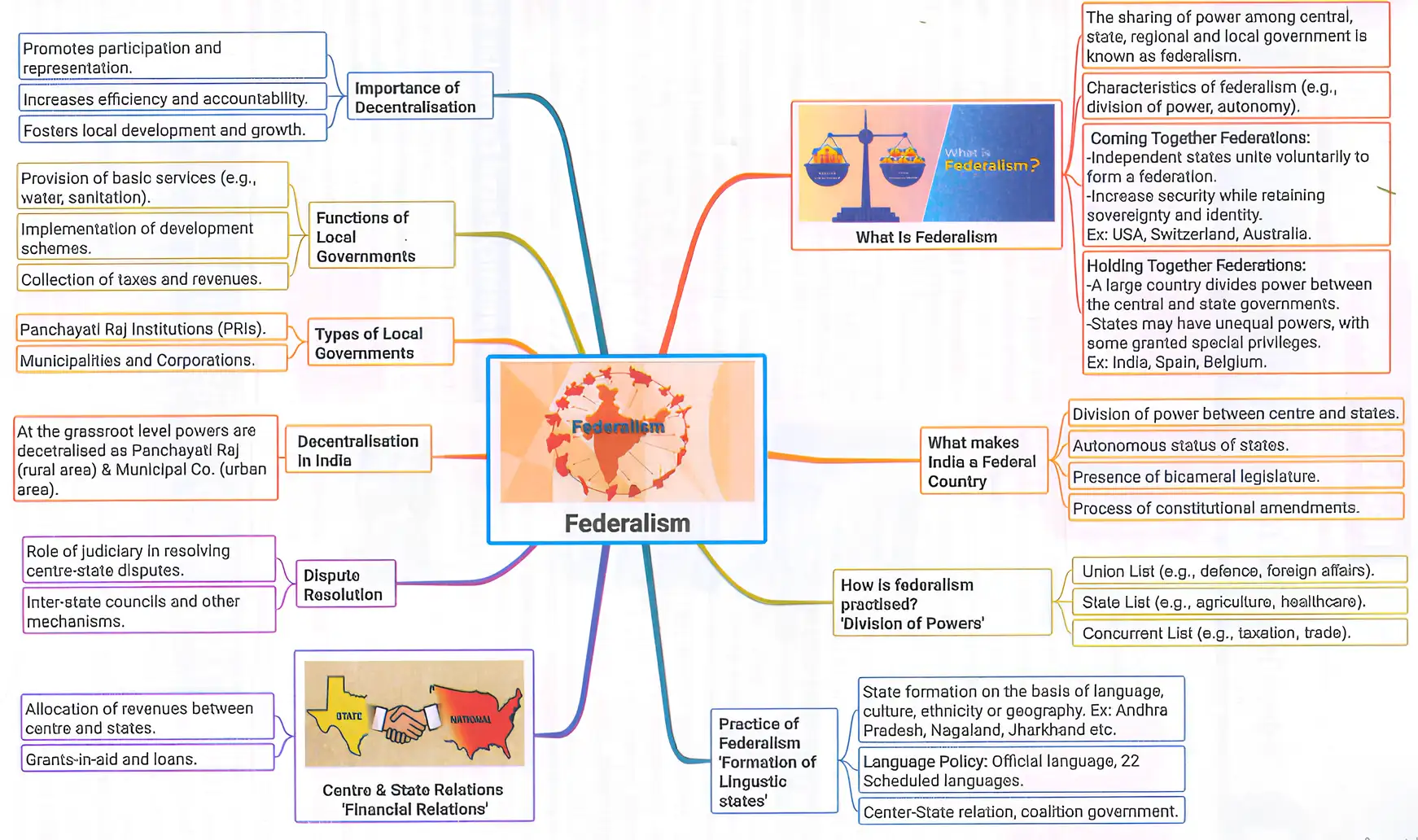
Federalism is the sharing of power among the central, state, regional, and local governments. In a federal form of government, there is a clear division of powers between the central authority and the constituent units of the country.
Key features of federalism include:
- Multiple levels of government (two or more tiers).
- Each tier governs the same citizens but has its own jurisdiction in legislation, taxation, and administration.
- Jurisdictions are specified in the Constitution.
- Fundamental constitutional provisions cannot be changed unilaterally by one level; changes require consent of both levels.
- Courts ensure legislation at all levels adheres to constitutional principles, preventing misuse of power.
- Sources of revenue for each level are clearly specified to ensure financial autonomy.
The federal system aims to safeguard and promote the unity of the country while accommodating regional diversity.
Countries with federal governments include Argentina, Austria, Australia, Belgium, Brazil, Canada, Germany, India, Mexico, Switzerland, and the United States.
The Constitution of India, under its Seventh Schedule, provides a three-fold distribution of legislative powers between the Union Government and the State Governments through three lists:
- Union List: Subjects of national importance such as defence, foreign affairs, banking, communications, and currency. Only the Union Government can legislate on these subjects.
- State List: Subjects of state and local importance such as police, trade, commerce, agriculture, and irrigation. Only State Governments can legislate on these subjects.
- Concurrent List: Subjects of common interest to both Union and State Governments such as education, forest, trade unions, marriage, adoption, and succession. Both can legislate, but Union law prevails in case of conflict.
Some units of the Indian Union are Union Territories, smaller in size and without full state powers, governed directly by the Central Government. Examples include Chandigarh, Lakshadweep, and the National Capital Territory of Delhi.
Exam Questions
Q1. What is federalism? Explain its key features in the context of India.
Answer: Federalism is the division of power between central and state governments. Key features include multiple levels of government, clear jurisdiction in legislation and administration, constitutional specification of powers, financial autonomy, and judicial oversight. In India, this is reflected in the Union, State, and Concurrent Lists.
Q2. What are Union Territories? How do they differ from States?
Answer: Union Territories are regions smaller than states and do not have full state powers. They are governed directly by the Central Government, unlike states which have their own governments and legislative powers.
Federalism in Practice and Decentralisation in India
The creation of linguistic states was a major test for democratic politics in India. Hindi was identified as the official language, and 22 other languages are recognised as Scheduled Languages by the Constitution.
States like Nagaland, Uttarakhand, and Jharkhand were created based on cultural, ethnic, or geographical differences rather than language.
Centre-State relations have been restructured to strengthen federalism. When no single party gains a majority in the Lok Sabha, coalition governments are formed involving national and regional parties.
A major step towards decentralisation was taken in 1992 through constitutional amendments to empower local governments:
- Regular elections for local government bodies became mandatory.
- Seats are reserved for Scheduled Castes, Scheduled Tribes, Other Backward Classes, and at least one-third for women.
- State Election Commissions were established to conduct Panchayat and Municipal elections.
- State Governments share powers and revenue with local bodies.
Local Government Structure:
- Panchayati Raj: Rural local government with Gram Panchayats at the village level.
- Gram Panchayat is the decision-making body for the village, supervised by the Gram Sabha, which includes all voters.
- Gram Panchayats meet at least thrice a year to approve budgets and review performance.
- Groups of Gram Panchayats form Panchayat Samitis (Block or Mandal level).
- All Panchayat Samitis in a district form the Zila Parishad, headed politically by the Zila Parishad Chairperson.
- Urban local governments include Municipalities and Municipal Corporations, headed by elected representatives such as the Municipal Chairperson or Mayor.
Exam Questions
Q1. What measures were taken in 1992 to strengthen decentralisation in India?
Answer: The 1992 constitutional amendments mandated regular local elections, reserved seats for marginalized groups and women, established State Election Commissions, and required State Governments to share powers and revenue with local bodies.
Q2. Describe the structure and functions of Panchayati Raj institutions.
Answer: Panchayati Raj includes Gram Panchayats at the village level, Panchayat Samitis at the block level, and Zila Parishads at the district level. Gram Panchayats make decisions for villages, supervised by Gram Sabhas. Panchayat Samitis link Gram Panchayats and Zila Parishads, which coordinate development at the district level.
Solved Examples
Example 1: Explain the difference between the Union List and the State List with examples.
Solution: The Union List includes subjects like defence and foreign affairs, which only the Union Government can legislate on. The State List includes subjects like police and agriculture, which only State Governments can legislate on.
Example 2: What is the significance of the Concurrent List in Indian federalism?
Solution: The Concurrent List contains subjects on which both Union and State Governments can legislate, such as education and marriage. If there is a conflict, Union law prevails, ensuring national unity while allowing state participation.
Practice Set
Easy
- Define federalism.
- What are Union Territories?
Moderate
- Explain the three lists in the Indian Constitution.
- Describe the role of Gram Sabha in Panchayati Raj.
Challenging
- Discuss how decentralisation has strengthened federalism in India.
- Explain the significance of coalition governments in Centre-State relations.
Answer Key
Easy:
- Federalism is the division of power between central and state governments.
- Union Territories are regions governed directly by the Central Government without full state powers.
Moderate:
- The three lists are Union List (central subjects), State List (state subjects), and Concurrent List (shared subjects).
- The Gram Sabha supervises the Gram Panchayat and includes all voters in the village.
Challenging:
- Decentralisation empowers local governments through constitutional amendments, regular elections, reservations, and revenue sharing, enhancing participation and governance.
- Coalition governments involve multiple parties, including regional ones, promoting cooperation and accommodating diverse interests in Centre-State relations.
Quick Reference
- Federalism: Division of power between central and state governments.
- Union List: Central government subjects like defence and foreign affairs.
- State List: State government subjects like police and agriculture.
- Concurrent List: Shared subjects like education and marriage.
- Union Territories: Regions governed by the Central Government.
- Panchayati Raj: Rural local government system.
- Gram Sabha: Village body supervising Gram Panchayat.
- Decentralisation: Transfer of power to local governments.
Glossary
- Federalism: A system of government where power is divided between a central authority and constituent units.
- Jurisdiction: The official power to make legal decisions and judgments.
- Legislation: The process of making or enacting laws.
- Autonomy: The right or condition of self-government.
- Scheduled Languages: Languages listed in the Eighth Schedule of the Indian Constitution.
- Gram Sabha: The assembly of all voters in a village.
- Panchayat Samiti: Local government body at the block or tehsil level.
- Zila Parishad: District-level local government body.
- Municipality: Urban local government body.
- Municipal Corporation: Local government body for large cities.
| Time Period / Year | Event / Change | Importance |
|---|---|---|
| 1950 | Adoption of the Constitution of India | Established federal structure with division of powers |
| 1956 | States Reorganisation Act | States reorganised on linguistic basis |
| 1992 | 73rd and 74th Constitutional Amendments | Strengthened decentralisation and local self-government |