CLASS 10 . SCIENCE . SCIENCE . THE HUMAN-EYE-AND-THE-COLOURFUL-WORLD
Chapter 10 : THE HUMAN EYE AND THE COLOURFUL WORLD
Ch 10
SCIENCE
CLASS 10
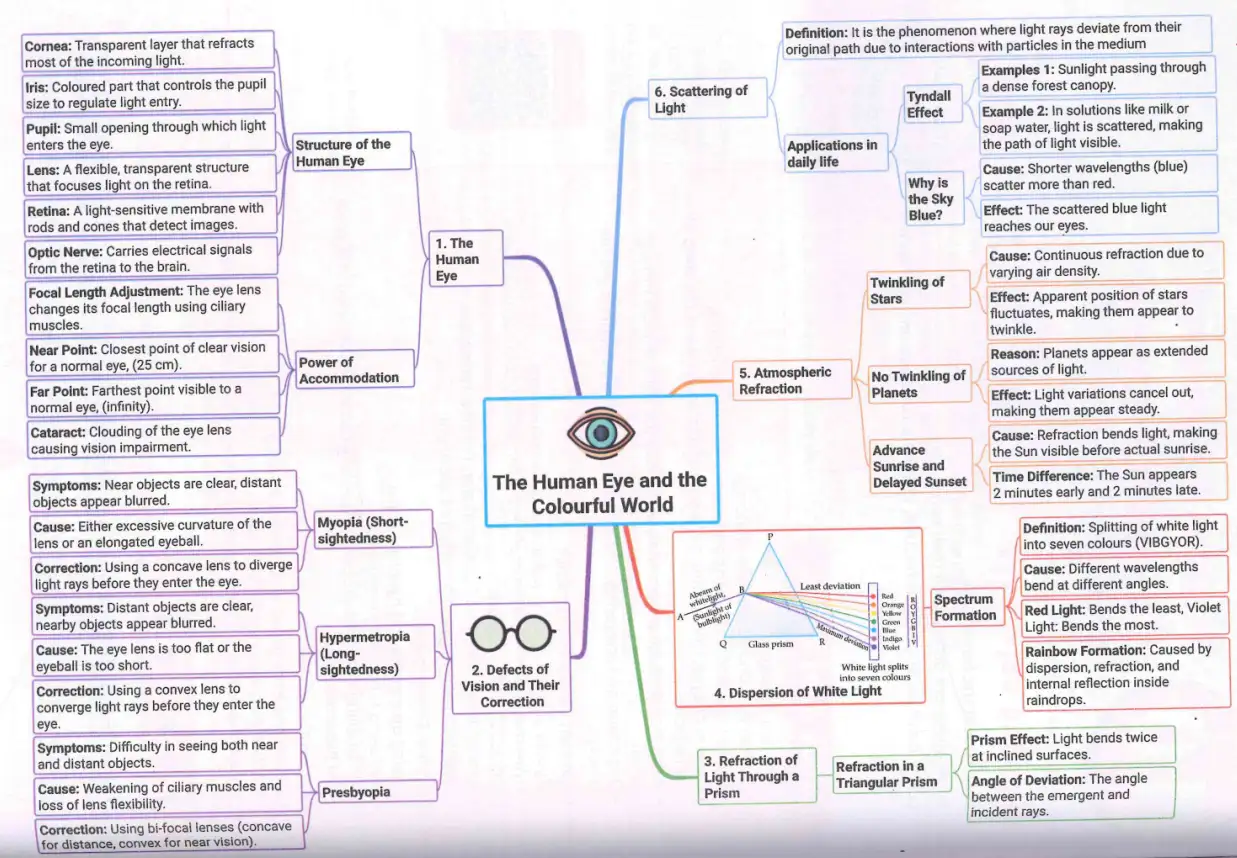
Human Eye
Structure and Function
The human eye is a natural optical device that allows us to see the world around us. It forms an inverted, real image on the retina, which is a light-sensitive surface at the back of the eye.
The retina contains two types of cells: rods and cones. Rods are sensitive to the intensity of light and help us see in dim light, while cones detect colors and function best in bright light. Signals from these cells are sent to the brain through the optic nerve, enabling vision.
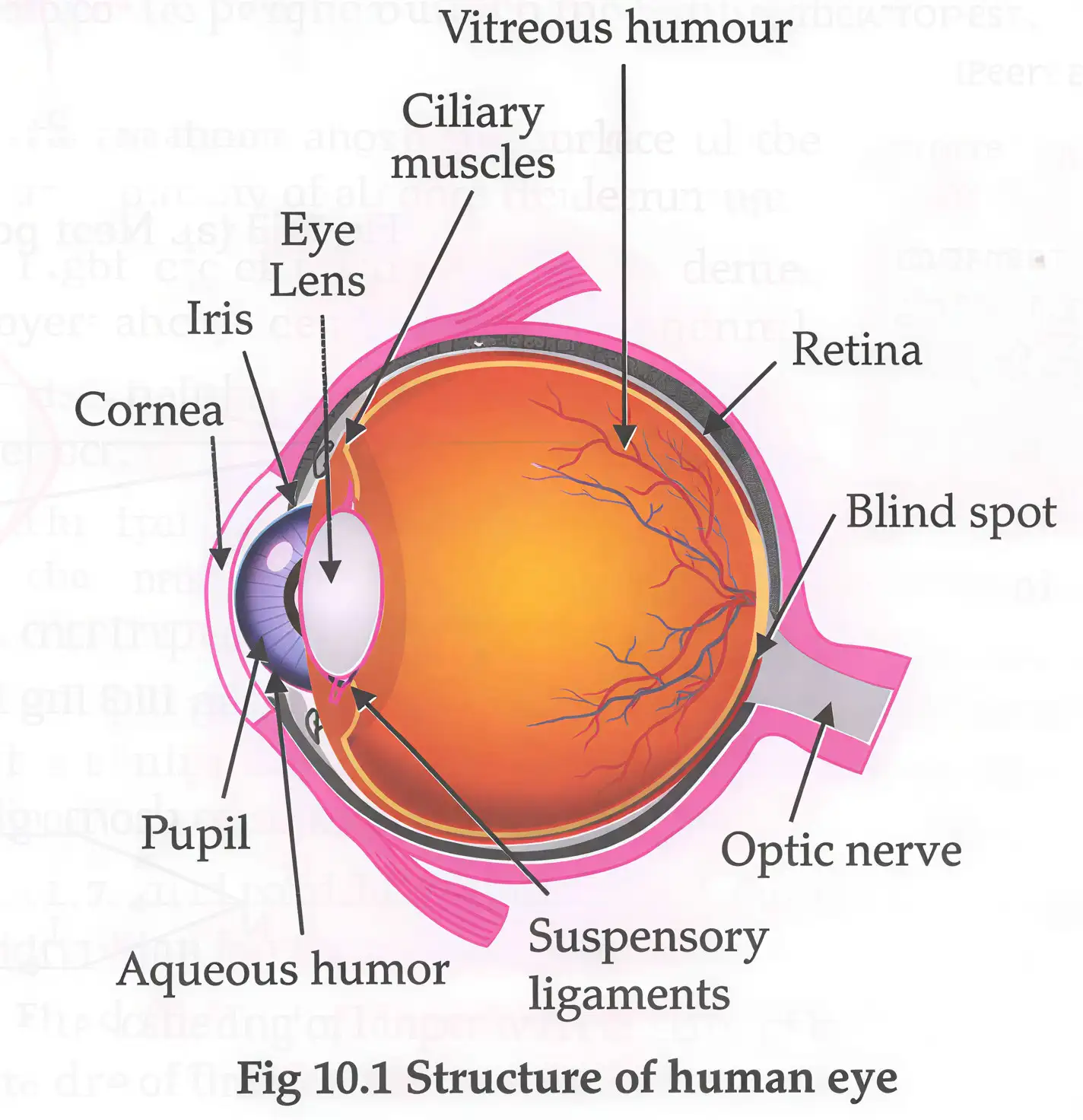
Parts of the Eye
- Cornea: The transparent outermost layer where most refraction of light occurs.
- Pupil: The opening in the iris that controls the amount of light entering the eye.
- Iris: The colored muscular diaphragm that adjusts the size of the pupil.
- Lens: A flexible, jelly-like structure that focuses light onto the retina.
- Aqueous Humour: A watery fluid between the cornea and lens.
- Vitreous Humour: A gel-like substance filling the space between the lens and retina.
- Retina: The light-sensitive layer containing rods and cones.
- Ciliary Muscles: Muscles that change the shape of the lens to focus light.
- Optic Nerve: Transmits visual information from the retina to the brain.
- Blind Spot: The point where the optic nerve exits the eye; no light-sensitive cells are present here.
- Yellow Spot: The central part of the retina with the highest concentration of light-sensitive cells.
Vision Range and Accommodation
The near point is the closest distance at which the eye can see objects clearly, typically 25 cm for a normal adult. The far point is the farthest distance at which objects are seen clearly, usually at infinity.
Accommodation is the eye's ability to adjust the focal length of the lens using ciliary muscles to focus on objects at different distances.
Defects of Vision
Myopia (Nearsightedness)
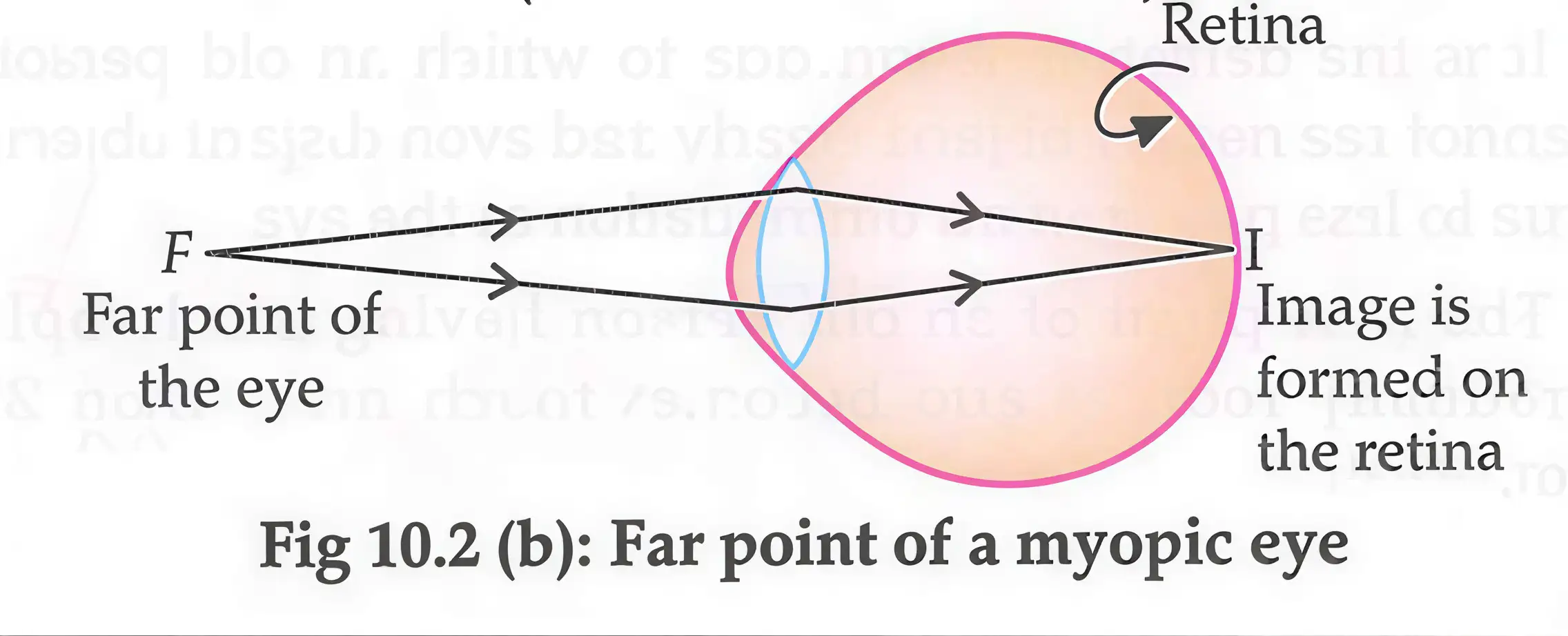
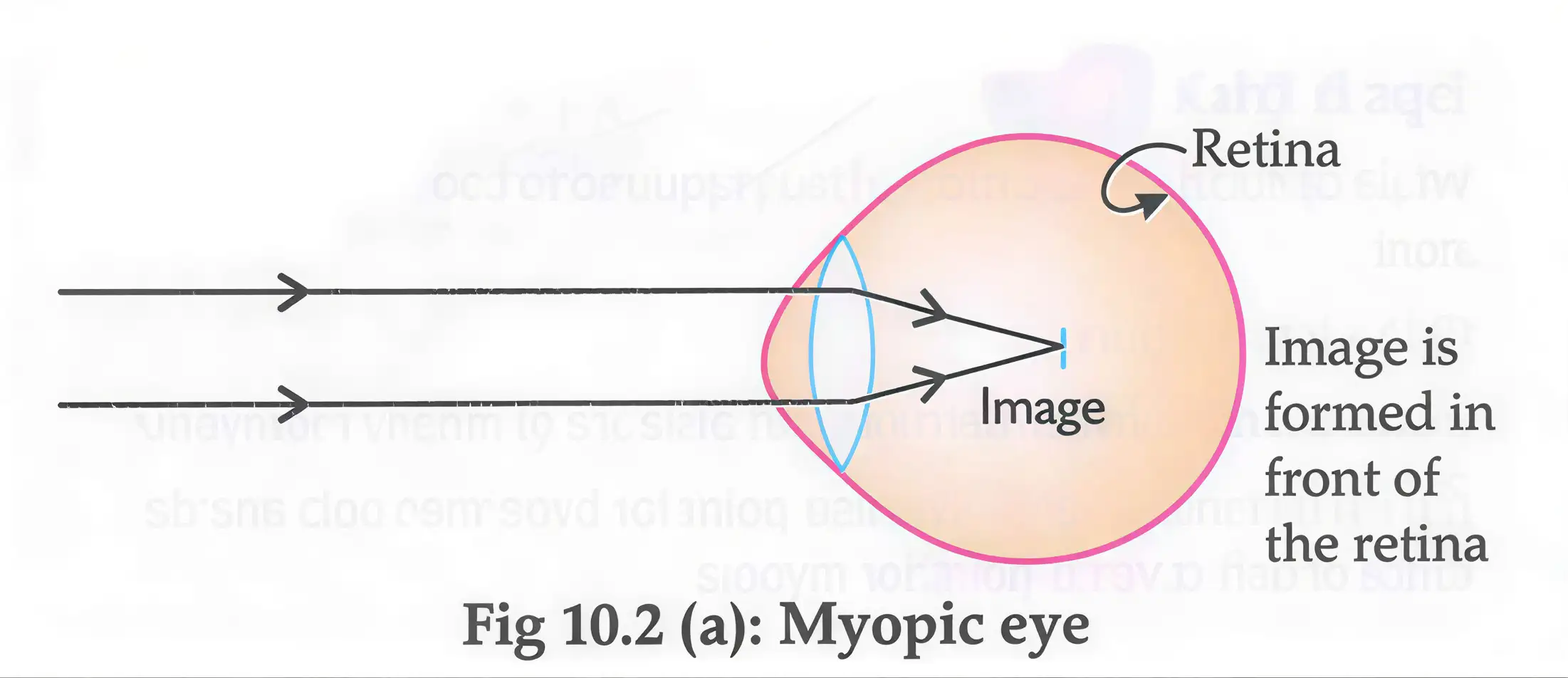
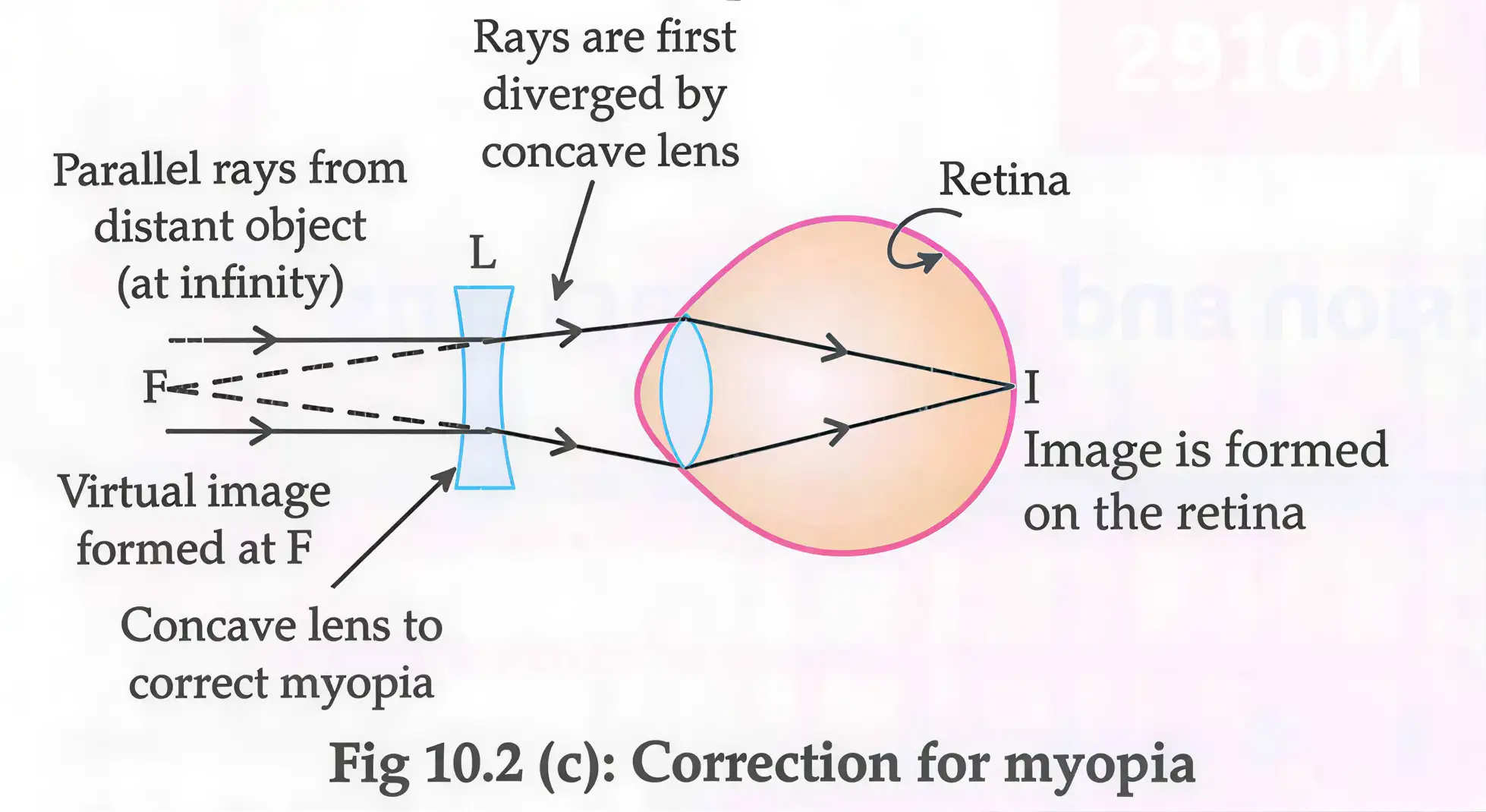
In myopia, distant objects appear blurry because the image forms in front of the retina. This occurs when the eyeball is elongated or the cornea/lens is too curved.
The far point of a myopic eye is closer than infinity.
Correction: A concave (diverging) lens is used to spread out light rays so they focus on the retina.
Hypermetropia (Farsightedness)
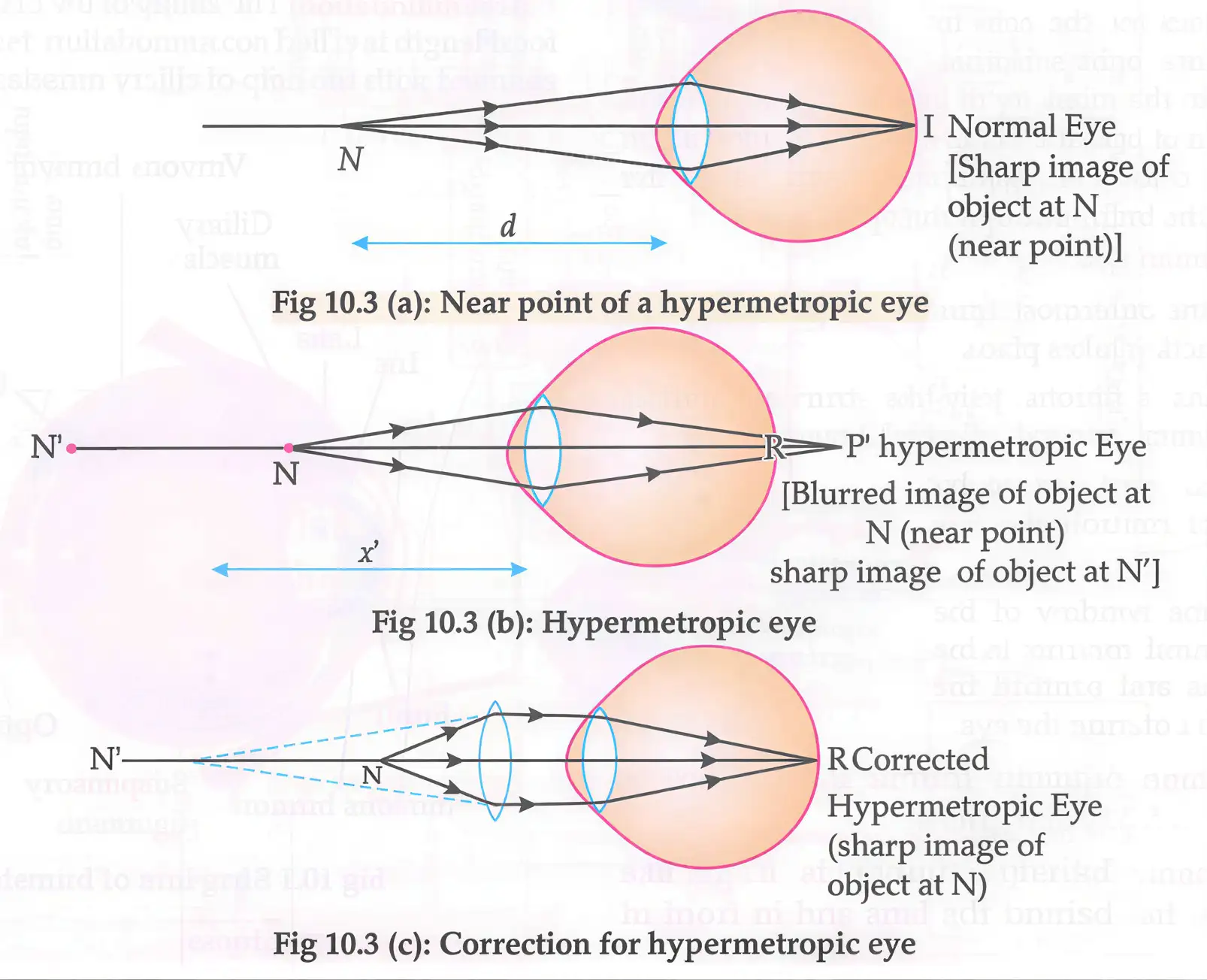
In hypermetropia, nearby objects appear blurry because the image forms behind the retina. This happens when the eyeball is too short or the cornea/lens is insufficiently curved.
The near point moves farther than 25 cm.
Correction: A convex (converging) lens is used to converge light rays before they enter the eye, allowing the image to form on the retina.
Presbyopia (Old Age Hypermetropia)
Presbyopia is caused by the weakening of ciliary muscles and loss of lens flexibility with age, leading to difficulty focusing on both near and distant objects.
Correction: Bifocal lenses are used, with the upper part being concave for distant vision and the lower part convex for near vision.
Solved Examples
Example 1
A student needs spectacles of power −0.5 D for vision correction.
(i) Identify the defect.
(ii) Find the focal length and nature of the lens.
(iii) List two causes of this defect.
Solution:
(i) The defect is myopia.
(ii) Power, P = −0.5 D
Focal length, f = 1 / P = 1 / (−0.5) = −2 m
The lens is concave (diverging).
(iii) Causes:
- Excessive curvature of the eye lens.
- Elongation of the eyeball.
Example 2
A person has difficulty seeing nearby objects due to weakening ciliary muscles. Name the defect and the type of lens used for correction. Describe the lens.
Solution:
The defect is presbyopia.
Correction is done using bifocal lenses.
The upper part is concave for viewing distant objects, and the lower part is convex for viewing nearby objects.
Practice Set
Conceptual Questions
- Level 1: What is the function of the iris in the human eye?
- Level 2: Explain why the blind spot in the eye does not affect our vision.
Application-based Question
- Level 3: A person has a far point of 80 cm. Identify the defect and calculate the power of the lens required to correct the vision. (Use lens formula and assume near point = 25 cm)
Answer Key
Conceptual Questions
- Level 1: The iris controls the size of the pupil, regulating the amount of light entering the eye.
- Level 2: The brain fills in the missing information from the blind spot using information from the other eye and surrounding visual cues, so we do not notice it.
Application-based Question
- Level 3: The defect is myopia (nearsightedness) because the far point is less than infinity.
- Using lens formula: \\frac{1}{f} = \\frac{1}{v} - \\frac{1}{u}
- Here, u = −∞ (for distant objects), v = −80 cm = −0.8 m (far point)
- Power, P = 100 / f (in cm)
- Calculate f: \\frac{1}{f} = \\frac{1}{-0.8} - \\frac{1}{-∞} = -1.25
- So, f = −0.8 m = −80 cm
- Power, P = 100 / (−80) = −1.25 D
- A concave lens of power −1.25 D is required.
Refraction, Dispersion and Scattering
Refraction Through Prism
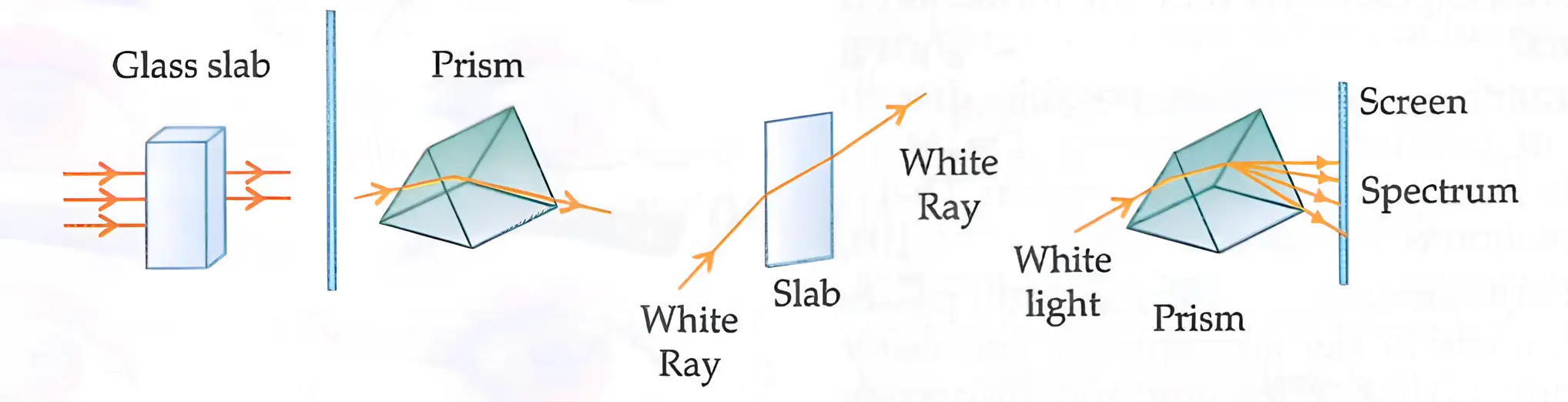
A prism is a transparent optical element with flat, polished surfaces that refract light. The angle between the two refracting surfaces is called the angle of the prism.
When white light passes through a prism, it bends (refracts) and splits into its constituent colors because different colors bend by different amounts. This phenomenon is called dispersion.
Dispersion of Light
White light is composed of seven colors: Violet, Indigo, Blue, Green, Yellow, Orange, and Red (VIBGYOR).
Each color bends differently when passing through a prism, forming a spectrum. If a second identical prism is placed inverted to the first, the colors recombine to form white light again.
Atmospheric Refraction
Light bends when passing through Earth's atmosphere due to changes in air density. This causes stars to twinkle and makes the sun appear to rise earlier and set later than it actually does.
Planets do not twinkle because they appear as larger light sources.
Scattering of Light
Scattering occurs when light changes direction after hitting small particles. Shorter wavelengths (blue light) scatter more than longer wavelengths, which explains why the sky appears blue.
This effect is known as the Tyndall Effect and can be observed when light passes through dust or fog.
Solved Examples
Example 1
Explain the formation of a rainbow.
Solution:
A rainbow is formed by the dispersion of sunlight by tiny water droplets in the atmosphere. Sunlight enters the droplets, refracts, reflects internally, and refracts again as it exits, splitting into the spectrum of colors visible as a rainbow opposite the sun.
Example 2
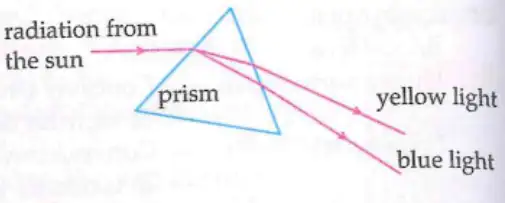
In a prism, which color of light has a higher wavelength: yellow or blue? Explain.
Solution:
During dispersion, colors with longer wavelengths bend less. Yellow light bends less than blue light, so yellow has a higher wavelength than blue.
Practice Set
Conceptual Questions
- Level 1: What causes the twinkling of stars?
- Level 2: Why does the sky appear blue during the day?
Application-based Question
- Level 3: Describe how a prism separates white light into different colors.
Answer Key
Conceptual Questions
- Level 1: Twinkling of stars is caused by atmospheric refraction as light passes through layers of varying air density.
- Level 2: The sky appears blue because blue light scatters more than other colors due to its shorter wavelength.
Application-based Question
- Level 3: A prism refracts white light, bending different colors by different amounts due to their wavelengths, causing the light to spread out into a spectrum.
Quick Reference Table
- Myopia: A defect where distant objects appear blurry because the image forms in front of the retina; corrected using concave lenses.
- Hypermetropia: A defect where near objects appear blurry because the image forms behind the retina; corrected using convex lenses.
- Presbyopia: Age-related difficulty in focusing on near and distant objects; corrected using bifocal lenses.
- Accommodation: The eye's ability to change the lens shape to focus on objects at different distances.
- Refraction: Bending of light as it passes from one medium to another, such as through the cornea or a prism.
- Dispersion: Splitting of white light into its constituent colors due to different degrees of refraction.
- Scattering: The redirection of light by small particles, responsible for phenomena like the blue sky.
- Far Point: The farthest distance at which the eye can see objects clearly; infinity for a normal eye.
- Near Point: The closest distance at which the eye can see objects clearly; typically 25 cm for a normal adult.
- Blind Spot: The point on the retina where the optic nerve exits; no photoreceptor cells are present.
- Spectrum: The band of colors produced by dispersion of light through a prism or raindrops.
- Angle of Prism: The angle between the two refracting surfaces of a prism.
- Tyndall Effect: Scattering of light by particles in a colloid or fine suspension, explaining phenomena like the blue sky and visibility of beams of light in fog.
Common Mistakes and Misconceptions
• Confusing myopia and hypermetropia.
• Mislabeling diagrams, especially the type of corrective lenses used.
• Mixing up terms like presbyopia with other defects.
Glossary
- Accommodation: The eye's ability to change the lens shape to focus on objects at different distances.
- Blind Spot: The point on the retina where the optic nerve exits; no photoreceptor cells are present.
- Concave Lens: A diverging lens used to correct myopia.
- Convex Lens: A converging lens used to correct hypermetropia.
- Dispersion: Splitting of white light into its constituent colors.
- Far Point: The farthest point at which the eye can see clearly.
- Near Point: The closest point at which the eye can see clearly.
- Presbyopia: Age-related defect causing difficulty in focusing on near and distant objects.
- Refraction: Bending of light as it passes from one medium to another.
- Scattering: The redirection of light by small particles.
- Spectrum: The band of colors produced by dispersion of light.