CLASS 10 . SCIENCE . SCIENCE . MAGNETIC EFFECTS-OF-ELECTRIC-CURRENT
Chapter 12 : MAGNETIC EFFECTS OF ELECTRIC CURRENT
Ch 12
SCIENCE
CLASS 10
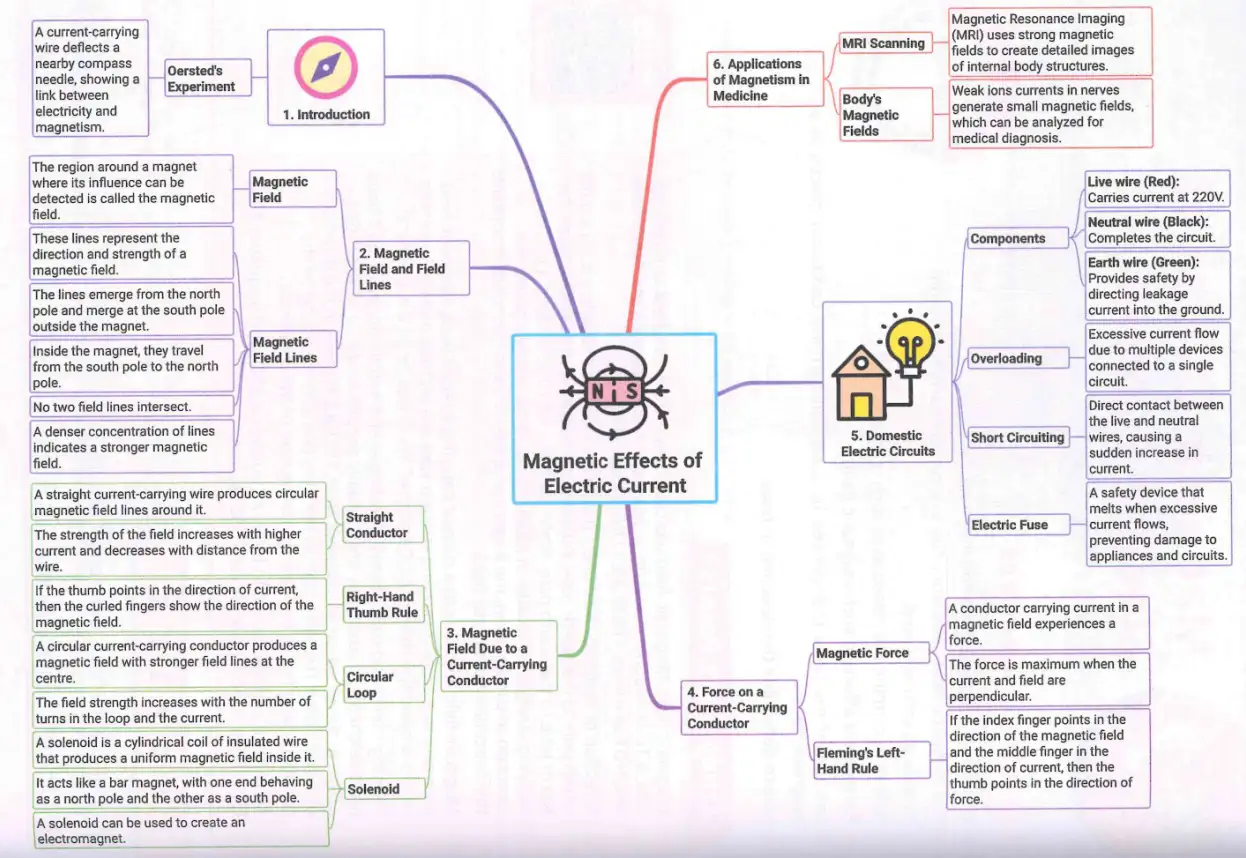
Magnetic Effects of Electric Current
Introduction to Magnetic Effects
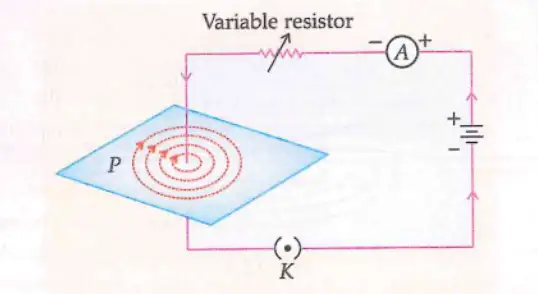
H.C. Oersted discovered that an electric current produces a magnetic field around a conductor. When a current flows through a wire, it creates a magnetic field that can deflect a magnetic needle placed nearby. The direction of this deflection changes if the current direction changes.
Magnetic Field and Field Lines
A magnetic field is the region around a magnet or current-carrying conductor where magnetic forces can be detected. It is a vector quantity with both magnitude and direction, measured in tesla (T).
Magnetic field lines are imaginary lines used to represent the magnetic field. They form continuous closed loops, never intersect, and indicate the direction and strength of the magnetic field. The closer the lines, the stronger the magnetic field.
Direction of Magnetic Field Lines
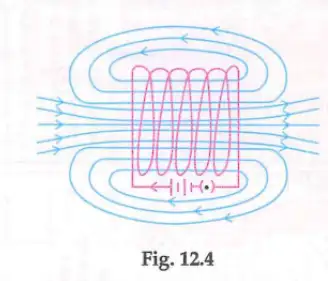
Outside a magnet or solenoid, magnetic field lines run from the North pole to the South pole. Inside the magnet or solenoid, they run from the South pole to the North pole, completing a closed loop.
Right Hand Thumb Rule
To find the direction of the magnetic field around a current-carrying straight conductor, hold the conductor in your right hand with the thumb pointing in the direction of current. The curled fingers show the direction of the magnetic field lines, which form concentric circles around the wire.
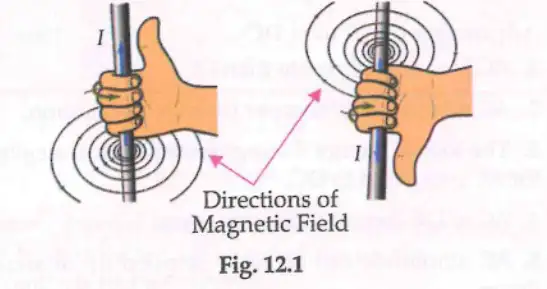
Magnetic Field Due to Current-Carrying Conductors
A straight current-carrying conductor produces magnetic field lines in concentric circles around it. The strength of the magnetic field is directly proportional to the current and inversely proportional to the distance from the conductor.
A circular loop of current also produces magnetic field lines that are concentric circles around the wire, with the field inside the loop being uniform and directed along the axis of the loop.
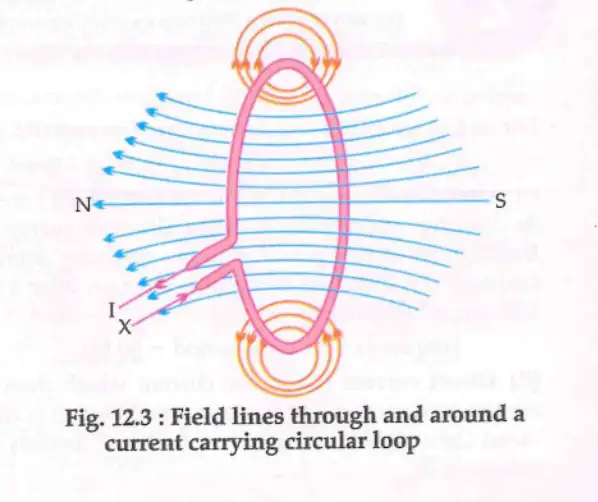
Magnetic Field of a Solenoid
A solenoid is a coil of many circular turns of insulated copper wire wrapped closely in the shape of a cylinder. When current passes through it, the solenoid behaves like a bar magnet with a magnetic field inside that is strong and uniform.
The magnetic field inside the solenoid runs from the South pole to the North pole, while outside it runs from the North pole to the South pole. The strength of the magnetic field depends on the current, number of turns, and distance from the solenoid.
Force on a Current-Carrying Conductor in a Magnetic Field
A current-carrying conductor placed in a magnetic field experiences a force. The magnitude of this force is given by F = I B l \sin \theta, where I is current, B is magnetic field strength, l is length of conductor, and \theta is the angle between the conductor and magnetic field.
The force is maximum when the conductor is perpendicular to the magnetic field and zero when parallel.
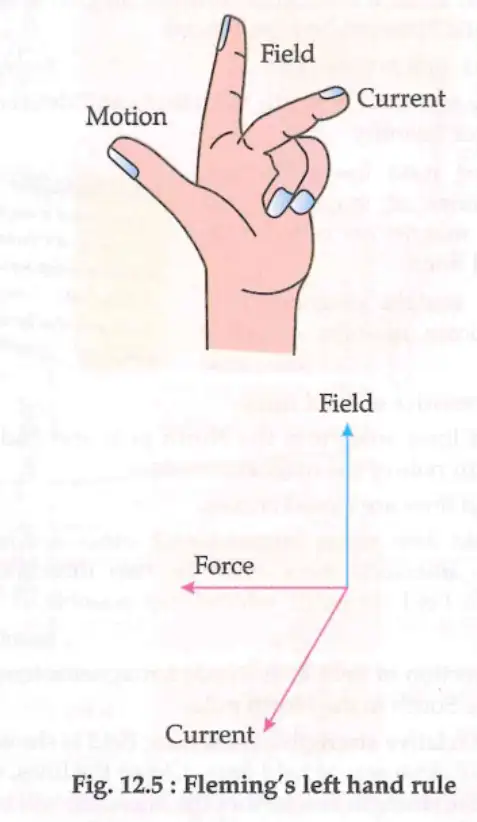
Fleming’s Left Hand Rule
This rule helps determine the direction of force on a current-carrying conductor in a magnetic field. Stretch the thumb, forefinger, and middle finger of the left hand so they are mutually perpendicular. If the forefinger points in the direction of the magnetic field, and the middle finger points in the direction of current, then the thumb points in the direction of the force acting on the conductor.
Alternating and Direct Current
Alternating Current (AC) reverses its direction periodically, with a frequency of 50 Hz in India, meaning it changes direction 50 times per second. Direct Current (DC) flows in one direction only, produced by sources like batteries and solar cells.
Domestic Electric Circuits
Electric supply in homes is AC with 220 V and 50 Hz frequency. The circuit consists of three wires:
- Live wire (red or brown insulation) carrying current to the appliance.
- Neutral wire (black or blue insulation) completing the circuit.
- Earth wire (green or yellow-green insulation) providing safety by directing leakage current to the ground.
Safety Measures
Short circuits occur when live and neutral wires touch, causing excessive current flow. Overloading happens when too many devices draw current beyond the wire's capacity, causing overheating.
Electric fuses protect circuits by melting and breaking the circuit if current exceeds safe limits. Earth wires prevent electric shocks by safely diverting leakage currents.
Solved Examples
Example 1: Find the direction of the magnetic field around a straight conductor carrying current upwards.
Solution: Using the right hand thumb rule, point your right thumb upwards (direction of current). The fingers curl around the wire, indicating the magnetic field direction is counterclockwise when viewed from above.
Example 2: Calculate the force on a 0.5 m long conductor carrying 3 A current placed perpendicular to a magnetic field of 0.2 T.
Solution: Given: I = 3 A, l = 0.5 m, B = 0.2 T, θ = 90° (perpendicular)
Force, F = I B l sin θ = 3 × 0.2 × 0.5 × sin 90° = 3 × 0.2 × 0.5 × 1 = 0.3 N
The force on the conductor is 0.3 newtons.
Example 3: A solenoid has 100 turns and carries a current of 2 A. How does increasing the number of turns affect the magnetic field?
Solution: The magnetic field inside a solenoid is directly proportional to the number of turns. Increasing the number of turns increases the magnetic field strength proportionally.
Practice Set
Conceptual Questions
- Explain why magnetic field lines never intersect.
- Describe the difference between the magnetic field inside and outside a solenoid.
Application-Based Question
- A wire carrying current is placed in a magnetic field. Using Fleming’s left hand rule, explain how to find the direction of force on the wire.
Numerical Question
- A conductor 0.8 m long carries a current of 4 A in a magnetic field of 0.3 T at an angle of 60°. Calculate the force on the conductor.
Answer Key
Conceptual Questions
- Magnetic field lines never intersect because at the point of intersection, the magnetic field would have two different directions, which is impossible.
- Inside a solenoid, magnetic field lines are parallel and close, indicating a strong and uniform field from South to North. Outside, the lines spread out and run from North to South, forming closed loops.
Application-Based Question
- Stretch the thumb, forefinger, and middle finger of the left hand perpendicular to each other. Point the forefinger in the direction of the magnetic field, the middle finger in the direction of current, then the thumb will point in the direction of the force on the wire.
Numerical Question
- Given: I = 4 A, l = 0.8 m, B = 0.3 T, θ = 60°
- Force, F = I B l sin θ = 4 × 0.3 × 0.8 × sin 60° = 4 × 0.3 × 0.8 × 0.866 = 0.83 N (approx)
Quick Reference Table
Magnetic Field (B): Vector quantity measured in tesla (T).
Right Hand Thumb Rule: Thumb points current direction; curled fingers show magnetic field direction.
Fleming’s Left Hand Rule: Forefinger = magnetic field, middle finger = current, thumb = force direction.
Force on Conductor: F = I B l sin θ
AC Frequency in India: 50 Hz, voltage 220 V.
Domestic Wiring Colors: Live - Red/Brown, Neutral - Black/Blue, Earth - Green/Yellow-Green.
Common Mistakes and Misconceptions
- Magnetic field lines are not real lines; they are imaginary representations.
- Magnetic field lines never intersect; thinking otherwise leads to confusion about field direction.
- Inside a magnet or solenoid, field lines run from South to North, opposite to outside direction.
- Confusing the direction of force using Fleming’s left hand rule by mixing up fingers.
- Assuming AC current flows in one direction like DC; AC reverses direction periodically.
Glossary
- Magnetic Field: The region around a magnet or current-carrying conductor where magnetic forces act.
- Magnetic Field Lines: Imaginary lines representing the direction and strength of magnetic fields.
- Solenoid: A coil of insulated wire that produces a magnetic field when current passes through it.
- Fleming’s Left Hand Rule: A rule to find the direction of force on a current-carrying conductor in a magnetic field.
- Alternating Current (AC): Electric current that reverses direction periodically.
- Direct Current (DC): Electric current flowing in one direction only.
- Electric Fuse: A safety device that breaks the circuit if current exceeds safe limits.
- Earth Wire: A wire that provides a path for leakage current to prevent electric shocks.