CLASS 10 . SCIENCE . SCIENCE . LIGHT REFLECTION-AND-REFRACTION
Chapter 9 : LIGHT – REFLECTION AND REFRACTION
Ch 9
SCIENCE
CLASS 10
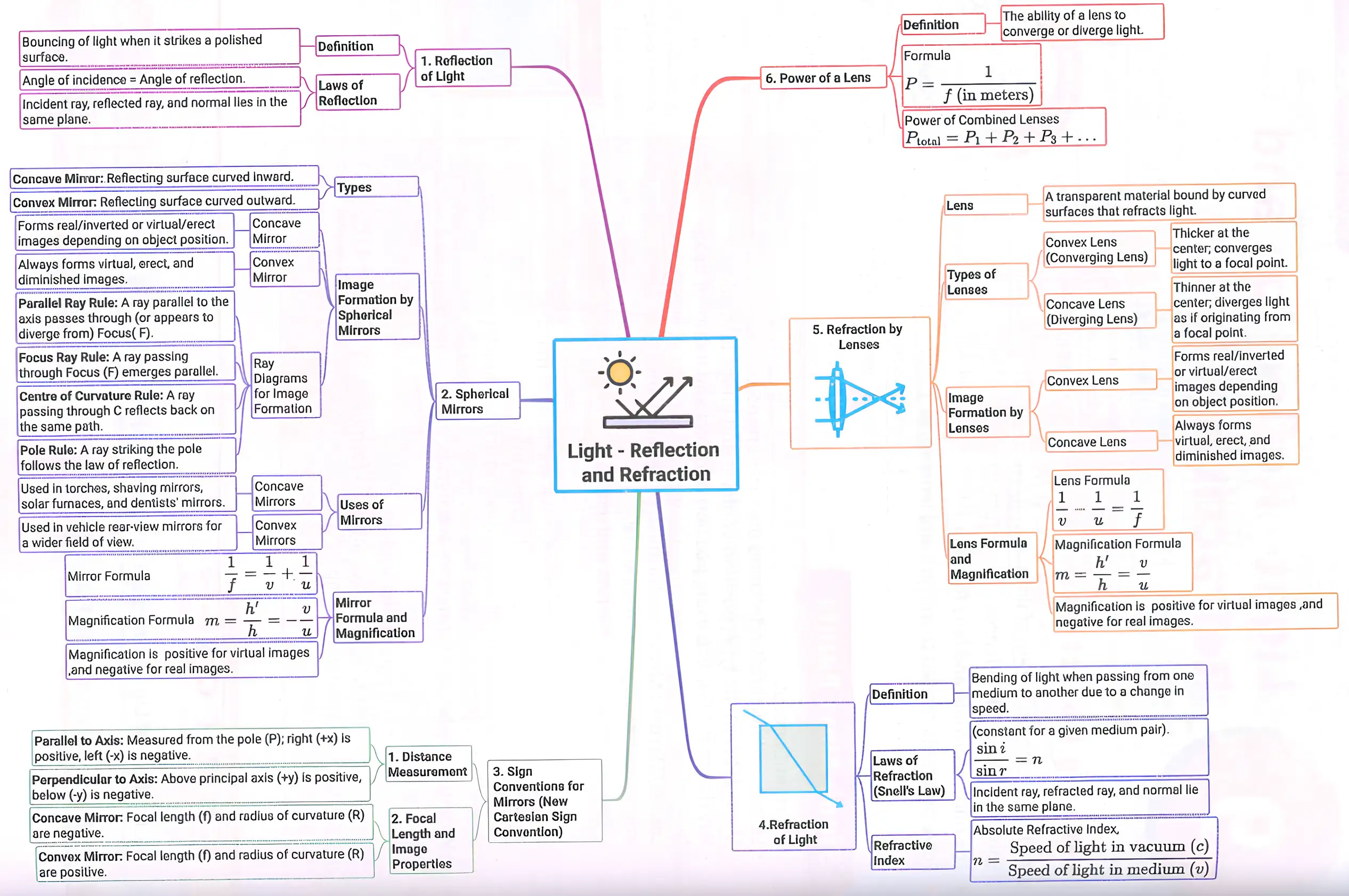
Reflection of Light
Laws of Reflection
Reflection of light is the phenomenon where light rays bounce back after striking a surface. The two fundamental laws governing reflection are:
- The incident ray, the reflected ray, and the normal to the surface at the point of incidence all lie in the same plane.
- The angle of incidence is equal to the angle of reflection.
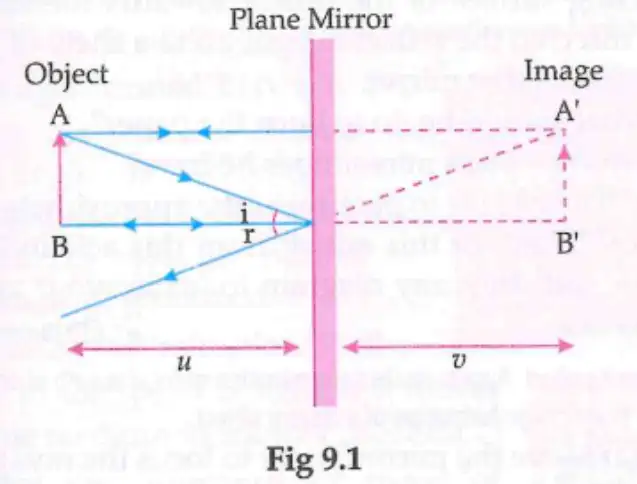
Image Formation by Plane Mirror
A plane mirror forms an image by reflecting light rays. The image formed has the following characteristics:
- It is virtual and erect.
- The size of the image is equal to the size of the object.
- The image is formed as far behind the mirror as the object is in front.
- The image is laterally inverted, meaning the left and right sides are reversed.
Spherical Mirrors
Spherical mirrors have curved reflecting surfaces and are of two types:
- Concave mirror: Reflecting surface curves inward. Can form real or virtual images depending on object position.
- Convex mirror: Reflecting surface curves outward. Always forms virtual, erect, and diminished images.
Key Terms for Spherical Mirrors
- Pole (P): The center of the mirror's reflecting surface.
- Principal axis: The line passing through the pole and the center of curvature.
- Center of curvature (C): The center of the sphere of which the mirror is a part.
- Radius of curvature (R): The radius of the sphere; R = 2f, where f is the focal length.
- Principal focus (F): The point where rays parallel to the principal axis converge (concave) or appear to diverge from (convex).
Ray Diagrams for Concave Mirror
- A ray parallel to the principal axis reflects through the principal focus.
- A ray passing through the principal focus reflects parallel to the principal axis.
- A ray passing through the center of curvature reflects back along the same path.
- A ray incident obliquely to the principal axis reflects making equal angles with the principal axis.
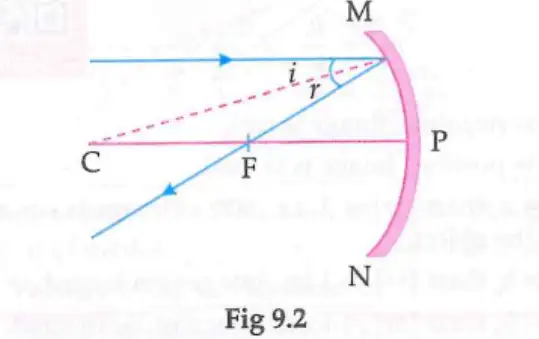
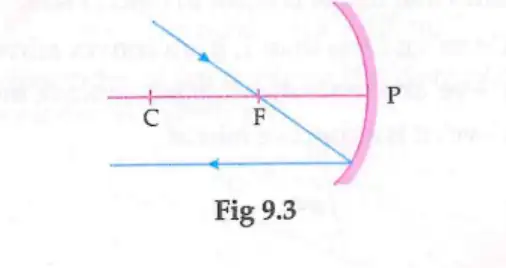
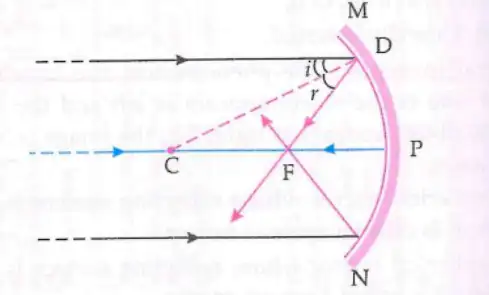
Image Formation by Concave Mirror
The nature, position, and size of the image formed by a concave mirror depend on the object's position relative to the mirror:
- Object at infinity: Image at focus, highly diminished, real, and inverted.
- Object beyond center of curvature: Image between focus and center, diminished, real, inverted.
- Object at center of curvature: Image at center, same size, real, inverted.
- Object between center and focus: Image beyond center, magnified, real, inverted.
- Object at focus: Image at infinity, highly magnified, real, inverted.
- Object between pole and focus: Image behind mirror, magnified, virtual, erect.
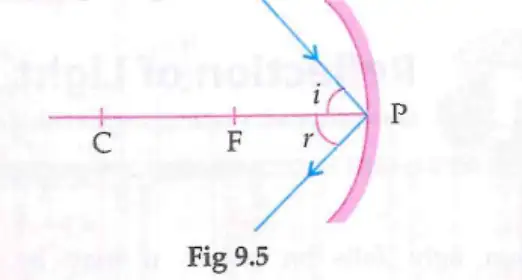
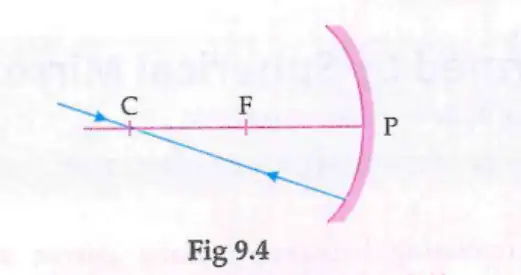
Image Formation by Convex Mirror
For all object positions, a convex mirror forms an image that is virtual, erect, diminished, and located behind the mirror between the pole and focus.
Mirror Formula and Magnification
The mirror formula relates object distance (u), image distance (v), and focal length (f):
1/u + 1/v = 1/f
Magnification (m) is the ratio of image height to object height and also related to distances:
m = h_i / h_o = -v / u
Signs of magnification indicate image nature: negative for real images, positive for virtual images.
Solved Examples
Example 1
A student directs a concave mirror towards the sun and reflects light onto a paper. To burn the paper, the student should adjust the mirror or paper to focus the rays at a point. The mirror is concave, and the focal length can be approximated by the distance from the mirror to the focused image of the sun.
Example 2
A candle flame is placed 30 cm from a mirror, and its image forms on a screen 60 cm from the mirror. Find the nature of the mirror, focal length, and image height if the flame is 2.4 cm tall.
Given: u = -30 cm, v = -60 cm, h_o = 2.4 cm
Using mirror formula:
1/f = 1/v + 1/u = 1/(-60) + 1/(-30) = -1/20
So, f = -20 cm (concave mirror)
Magnification, m = -v/u = -(-60)/(-30) = -2
Height of image, h_i = m × h_o = -2 × 2.4 = -4.8 cm (inverted)
Practice Set
- Level 1: What is the nature of the image formed by a plane mirror?
- Level 1: State the laws of reflection.
- Level 2: Describe the image formed by a convex mirror when the object is placed at infinity.
- Level 3: An object is placed 40 cm in front of a concave mirror of focal length 20 cm. Find the image distance and magnification.
Answer Key
- Level 1: The image formed by a plane mirror is virtual, erect, and of the same size as the object.
- Level 1: Laws of reflection: (i) Incident ray, reflected ray, and normal lie in the same plane. (ii) Angle of incidence equals angle of reflection.
- Level 2: The image formed by a convex mirror at infinity is virtual, erect, and highly diminished, located at the focus behind the mirror.
- Level 3: Using mirror formula: 1/f = 1/v + 1/u, 1/20 = 1/v + 1/(-40), 1/v = 1/20 + 1/40 = 3/40, v = 13.33 cm (positive, image is virtual and behind mirror). Magnification m = -v/u = -13.33 / -40 = 0.33 (image is erect and smaller).
Refraction of Light
Definition and Cause
Refraction is the bending of light when it passes from one medium to another due to a change in its speed.
Angles in Refraction
The angle of incidence is the angle between the incident ray and the normal at the point of incidence. The angle of refraction is the angle between the refracted ray and the normal.
Laws of Refraction (Snell's Law)
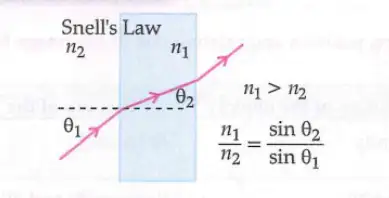
- The incident ray, refracted ray, and normal all lie in the same plane.
- The ratio of the sine of the angle of incidence to the sine of the angle of refraction is constant for a given pair of media and wavelength of light. This constant is the refractive index.
Mathematically, n = sin i / sin r
Refractive Index
The refractive index (n) of a medium is the ratio of the speed of light in vacuum to the speed of light in that medium:
n = c / v
where c = speed of light in vacuum (3 × 10⁸ m/s), v = speed of light in the medium.
Refraction through a Glass Slab
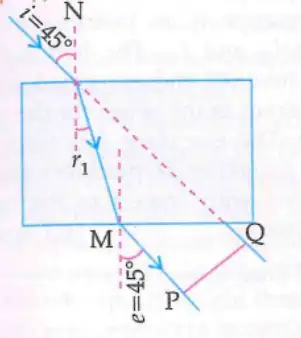
When light passes through a glass slab, it bends twice: once when entering and once when exiting. The emergent ray is parallel to the incident ray but laterally displaced.
Solved Examples
Example 3
Draw the path of a ray of light entering a glass slab at 45°. Label the angle of refraction, angle of emergence, and lateral displacement.
Answer: The ray bends towards the normal inside the slab (angle of refraction), bends away from the normal when exiting (angle of emergence), and the emergent ray is laterally displaced from the incident ray.
Practice Set
- Level 1: What causes refraction of light?
- Level 1: State Snell's law of refraction.
- Level 2: Explain why light bends towards the normal when passing from air to water.
- Level 3: A ray of light passes from air into glass with refractive index 1.5 at an angle of incidence 30°. Calculate the angle of refraction.
Answer Key
- Level 1: Refraction is caused by the change in speed of light when it passes from one medium to another.
- Level 1: Snell's law states that the ratio of sine of angle of incidence to sine of angle of refraction is constant for a given pair of media.
- Level 2: Light bends towards the normal when passing from air (rarer medium) to water (denser medium) because its speed decreases.
- Level 3: Using Snell's law: n = sin i / sin r, 1.5 = sin 30° / sin r, sin r = 0.5 / 1.5 = 1/3, r = 19.47° approximately.
Lenses
Types of Lenses
Lenses are transparent objects that refract light to form images. There are two main types:
- Convex lens: Thicker at the center, converges light rays.
- Concave lens: Thinner at the center, diverges light rays.
Ray Diagrams for Lenses
- A ray parallel to the principal axis refracts through the principal focus (convex lens) or appears to diverge from the principal focus (concave lens).
- A ray passing through the principal focus refracts parallel to the principal axis (convex lens) or directed towards the principal focus (concave lens).
- A ray passing through the optical center of the lens passes undeviated.
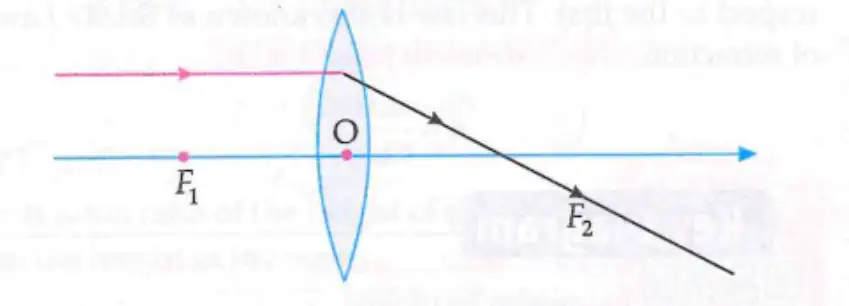
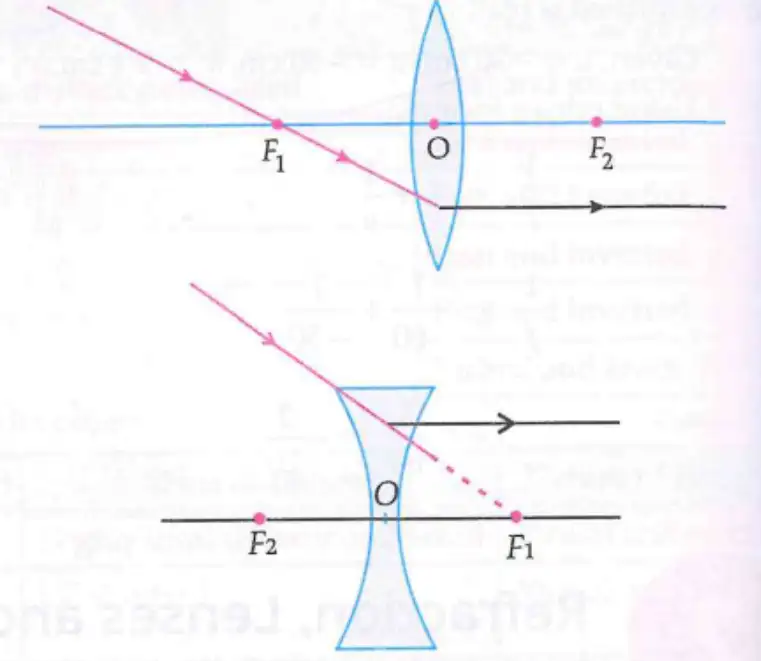
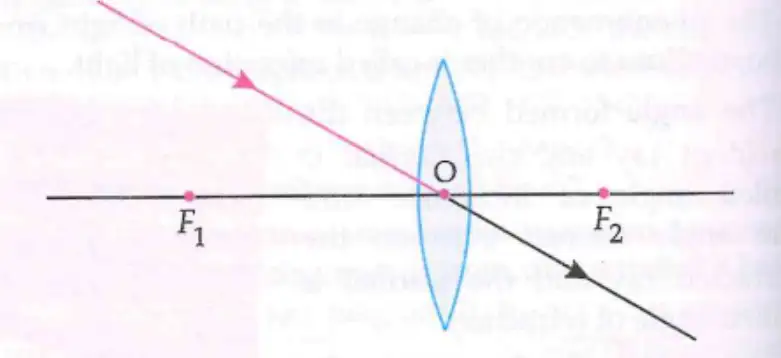
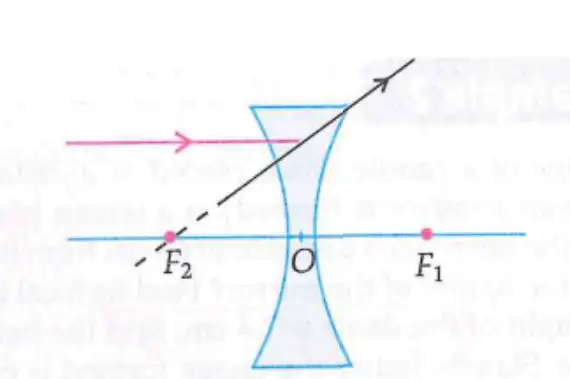
Image Formation by Convex Lens
The image formed depends on the object's position:
- Object at infinity: Image at focus, highly diminished, real, inverted.
- Object beyond 2F: Image between F and 2F, diminished, real, inverted.
- Object at 2F: Image at 2F, same size, real, inverted.
- Object between F and 2F: Image beyond 2F, magnified, real, inverted.
- Object at F: Image at infinity, highly magnified, real, inverted.
- Object between F and optical center: Image on same side, magnified, virtual, erect.
Image Formation by Concave Lens
For all object positions, the image formed is virtual, erect, diminished, and located between the focus and optical center on the same side as the object.
Lens Formula and Magnification
The lens formula relates object distance (u), image distance (v), and focal length (f):
1/v - 1/u = 1/f
Magnification (m) is given by:
m = h_i / h_o = v / u
Power of a Lens
Power (P) is the reciprocal of the focal length in meters:
P = 1/f (in meters)
Power is measured in dioptres (D), where 1 D = 1 m⁻¹.
Solved Examples
Example 4
Explain the path of a ray of light passing through a convex lens parallel to the principal axis.
Answer: The ray refracts through the lens and passes through the principal focus on the other side.
Practice Set
- Level 1: What type of lens converges light rays?
- Level 1: Define the power of a lens.
- Level 2: Describe the image formed by a concave lens for an object placed at infinity.
- Level 3: An object is placed 30 cm from a convex lens of focal length 15 cm. Find the image distance and magnification.
Answer Key
- Level 1: A convex lens converges light rays.
- Level 1: Power of a lens is the reciprocal of its focal length in meters.
- Level 2: The image formed by a concave lens for an object at infinity is virtual, erect, and highly diminished at the focus on the same side as the object.
- Level 3: Using lens formula: 1/v - 1/u = 1/f, 1/v - 1/(-30) = 1/15, 1/v + 1/30 = 1/15, 1/v = 1/15 - 1/30 = 1/30, v = 30 cm (positive, real image). Magnification m = v/u = 30 / -30 = -1 (inverted, same size).
Quick Reference Table
Reflection: Angle of incidence = Angle of reflection; Image by plane mirror is virtual, erect, same size.
Mirror Formula: 1/u + 1/v = 1/f; Magnification m = -v/u.
Refraction: Snell's Law: n = sin i / sin r; Refractive index n = c/v.
Lens Formula: 1/v - 1/u = 1/f; Magnification m = v/u.
Power of Lens: P = 1/f (in meters), unit dioptre (D).
Common Mistakes and Misconceptions
- Confusing image formation rules of concave and convex mirrors.
- Mixing up convex lens and convex mirror properties.
- Incorrect ray diagrams: missing arrows, wrong image size or position.
- Using wrong formulas for mirrors and lenses.
Glossary
- Reflection: Bouncing back of light from a surface.
- Refraction: Bending of light when passing between media.
- Concave Mirror: Mirror curved inward.
- Convex Mirror: Mirror curved outward.
- Focal Length: Distance from mirror/lens to principal focus.
- Refractive Index: Ratio of speed of light in vacuum to medium.
- Power of Lens: Measure of lens's ability to converge/diverge light.