Mendelian Genetics
Introduction to Mendel's Work
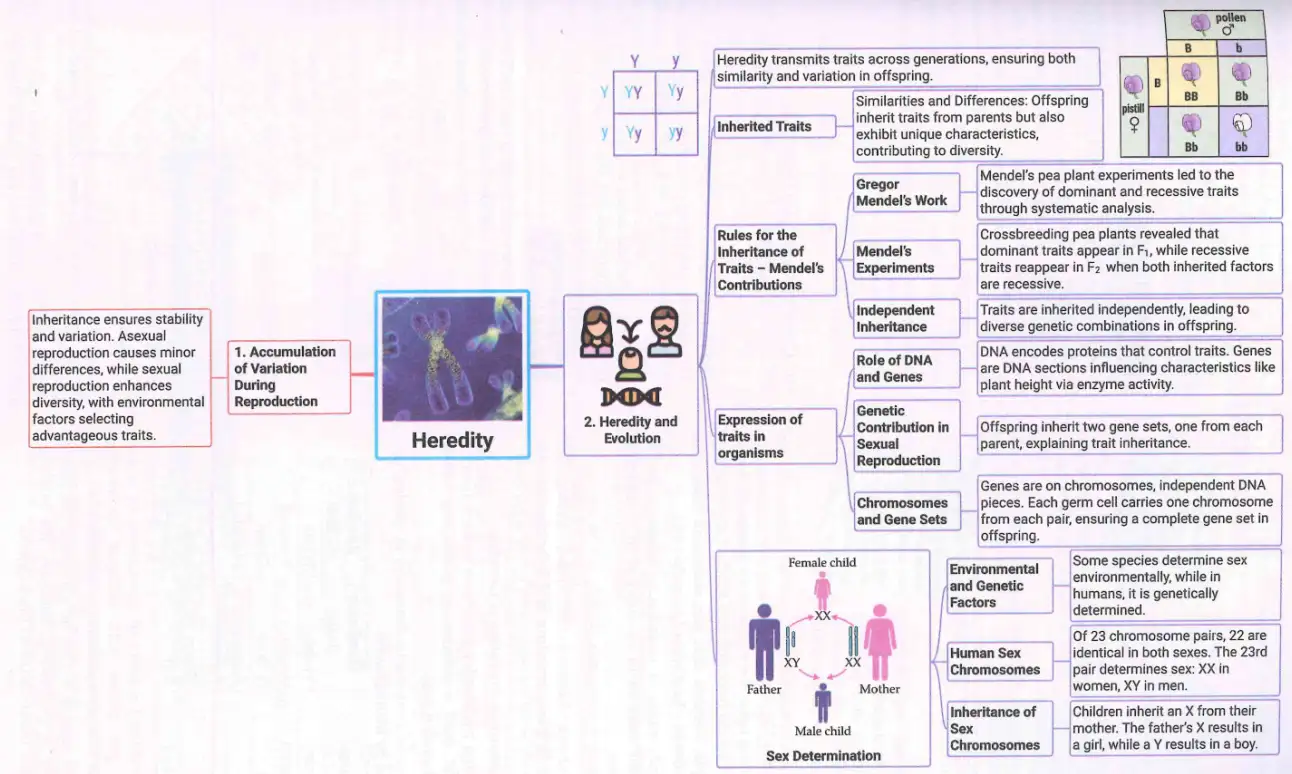
Gregor Johann Mendel, known as the Father of Genetics, conducted experiments on pea plants to understand how traits are inherited. He studied seven pairs of contrasting characters such as flower color and seed shape.
Monohybrid Cross
A monohybrid cross involves one pair of contrasting traits. For example, crossing tall and dwarf pea plants results in offspring with a phenotypic ratio of 3 tall to 1 dwarf in the second generation.
Dihybrid Cross
A dihybrid cross involves two pairs of contrasting traits, such as seed color and seed shape. The phenotypic ratio in the second generation is 9:3:3:1, representing different combinations of traits.
Mendel's Laws
Mendel proposed three laws: the Law of Dominance, where dominant traits mask recessive ones; the Law of Segregation, where alleles separate during gamete formation; and the Law of Independent Assortment, where alleles of different traits segregate independently.
Solved Examples
Example 1: In a monohybrid cross between a tall (TT) and a dwarf (tt) pea plant, what are the genotypic and phenotypic ratios in the F2 generation?
Solution:
Parental genotypes: TT (tall) × tt (dwarf)
F1 generation genotype: All Tt (tall)
F1 gametes: T and t
F2 genotypes from T × t cross: TT, Tt, Tt, tt
Genotypic ratio: 1 TT : 2 Tt : 1 tt
Phenotypic ratio: 3 tall : 1 dwarf
Example 2: In a dihybrid cross between plants with round yellow seeds (YYRR) and wrinkled green seeds (yyrr), what is the phenotypic ratio in the F2 generation?
Solution:
Parental genotypes: YYRR × yyrr
F1 genotype: YyRr (all round yellow)
F1 gametes: YR, Yr, yR, yr
F2 phenotypes and ratio: 9 round yellow : 3 round green : 3 wrinkled yellow : 1 wrinkled green
Practice Set
Conceptual Questions
- Explain the Law of Segregation in your own words. (Level 1)
- What is the difference between dominant and recessive alleles? (Level 1)
Application-based Question
- In a monohybrid cross between heterozygous tall pea plants (Tt), what are the expected genotypic and phenotypic ratios in the offspring? (Level 2)
Answer Key
Conceptual Questions
- The Law of Segregation states that each individual has two alleles for a trait, and these alleles separate during gamete formation so that each gamete carries only one allele.
- Dominant alleles express their trait even if only one copy is present, while recessive alleles express their trait only when two copies are present.
Application-based Question
- Cross: Tt × Tt
- Genotypic ratio: 1 TT : 2 Tt : 1 tt
- Phenotypic ratio: 3 tall : 1 dwarf
Chromosomes and Genes
Genes and Alleles
Genes are units of heredity located on chromosomes that determine specific traits. Alleles are different forms of a gene that can be dominant or recessive.
Chromosome Structure
Chromosomes are thread-like structures in the nucleus carrying genes. Humans have 23 pairs of chromosomes, including one pair of sex chromosomes.
Role in Traits
Each gene controls a trait by coding for proteins. Offspring inherit one allele from each parent, forming a pair that determines the trait's expression.
Solved Examples
Example 1: If a gene has two alleles, A (dominant) and a (recessive), what are the possible genotypes and phenotypes of offspring from parents with genotypes Aa and Aa?
Solution:
Possible gametes: A and a from each parent
Offspring genotypes: AA, Aa, Aa, aa
Genotypic ratio: 1 AA : 2 Aa : 1 aa
Phenotypic ratio: 3 dominant trait : 1 recessive trait
Practice Set
Conceptual Questions
- Define allele and explain its significance. (Level 1)
- How do chromosomes carry genetic information? (Level 1)
Application-based Question
- Explain how the combination of alleles from parents affects the traits of offspring. (Level 2)
Answer Key
Conceptual Questions
- An allele is a variant form of a gene that determines specific traits.
- Chromosomes carry genes, which are sequences of DNA that code for proteins controlling traits.
Application-based Question
- Offspring inherit one allele from each parent; the combination of these alleles determines the trait expressed, depending on dominance and recessiveness.
Dominance and Recessiveness
Dominant Alleles
Dominant alleles express their trait even if only one copy is present in the genotype.
Recessive Alleles
Recessive alleles express their trait only when two copies are present, i.e., when the dominant allele is absent.
Phenotype and Genotype
Phenotype is the observable trait, while genotype is the genetic makeup determining the trait.
Solved Examples
Example: In pea plants, tall (T) is dominant over dwarf (t). What is the phenotype of plants with genotypes TT, Tt, and tt?
Solution:
TT: Tall (dominant homozygous)
Tt: Tall (heterozygous)
tt: Dwarf (recessive homozygous)
Practice Set
Conceptual Questions
- What is the difference between genotype and phenotype? (Level 1)
- Explain why a recessive trait may not appear in every generation. (Level 2)
Application-based Question
- In a cross between two heterozygous tall pea plants, what percentage of offspring will be dwarf? (Level 2)
Answer Key
Conceptual Questions
- Genotype is the genetic constitution; phenotype is the physical expression of the genotype.
- Recessive traits require two copies of the recessive allele to appear, so they may skip generations if masked by dominant alleles.
Application-based Question
- Cross: Tt × Tt
- Percentage dwarf (tt) offspring = 25%
Sex Determination
Sex Chromosomes
Humans have 23 pairs of chromosomes; 22 pairs are autosomes, and 1 pair are sex chromosomes (X and Y).
Mechanism in Humans
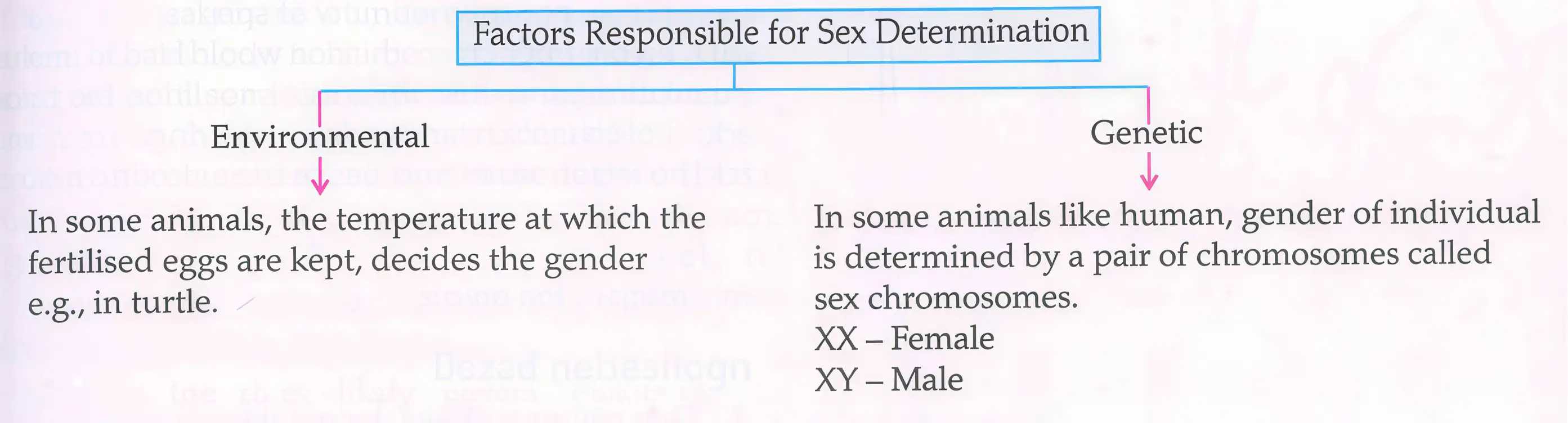
Females have two X chromosomes (XX), males have one X and one Y chromosome (XY). The sex of the child depends on whether the sperm carries an X or Y chromosome.
Other Mechanisms
Some species have environmental sex determination, such as temperature-dependent sex determination in turtles.
Solved Examples
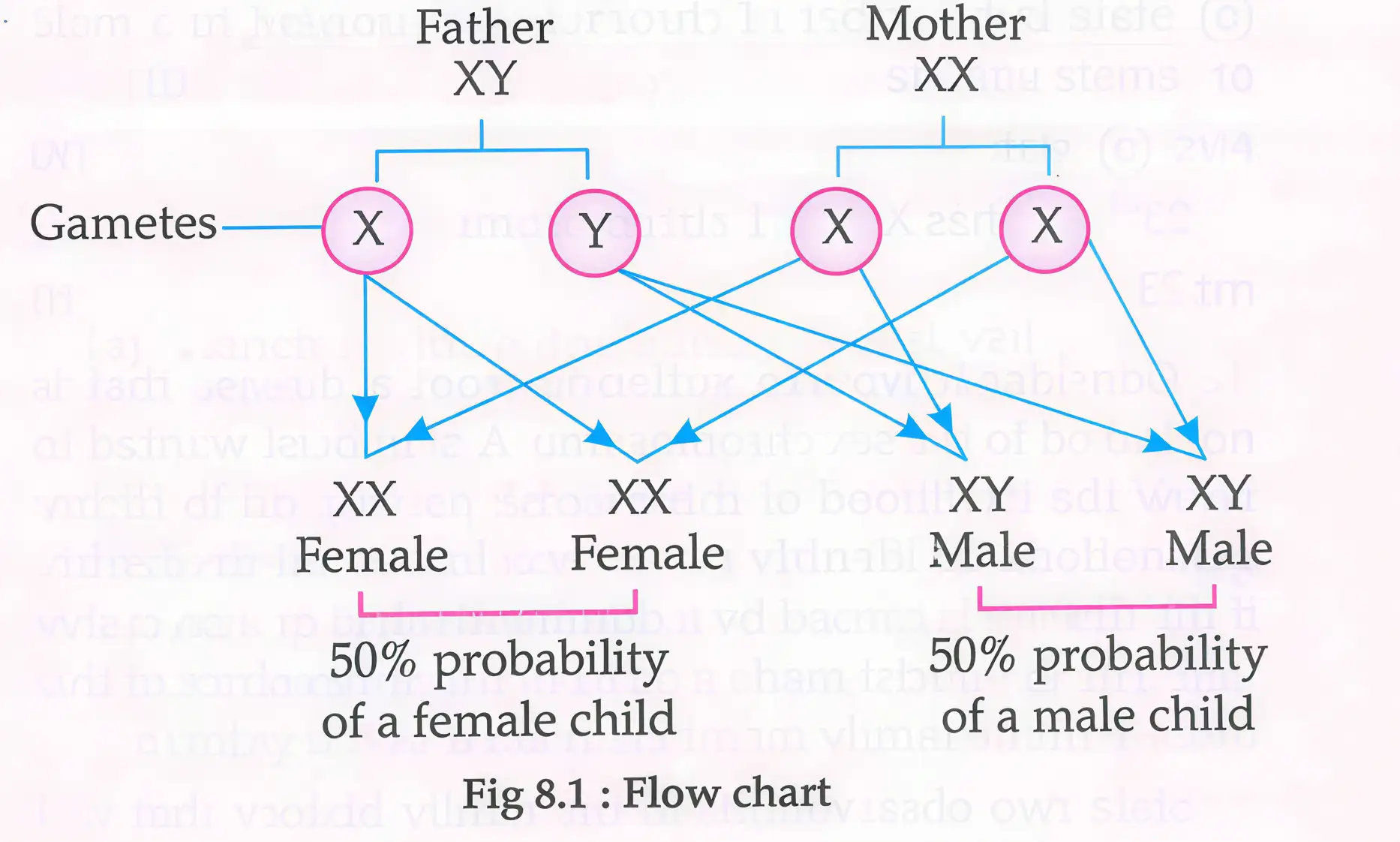
Example: If a father has XY chromosomes and a mother has XX chromosomes, what are the possible sex chromosomes of their children?
Solution:
Father's gametes: X or Y
Mother's gametes: X only
Possible combinations: XX (female), XY (male)
Probability: 50% female, 50% male
Practice Set
Conceptual Questions
- What are sex chromosomes and how do they differ from autosomes? (Level 1)
- Explain how the sex of a child is determined in humans. (Level 1)
Application-based Question
- Describe the role of the Y chromosome in sex determination. (Level 2)
Answer Key
Conceptual Questions
- Sex chromosomes determine the sex of an individual and differ in appearance; autosomes do not determine sex and are identical pairs.
- The sex of a child is determined by the sperm carrying either an X or Y chromosome fertilizing the egg, which always carries an X chromosome.
Application-based Question
- The Y chromosome carries genes that trigger male development; its presence results in a male child.
Quick Reference Table
Mendelian Genetics
- Law of Dominance: Dominant traits mask recessive traits in heterozygous individuals.
- Law of Segregation: Allele pairs separate during gamete formation, so each gamete carries one allele.
- Law of Independent Assortment: Alleles of different genes assort independently during gamete formation.
Chromosomes and Genes
- Gene: Unit of heredity located on chromosomes, controlling specific traits.
- Allele: Different forms of a gene, can be dominant or recessive.
- Chromosome: Thread-like structure in the nucleus carrying genes; humans have 23 pairs.
Dominance and Recessiveness
- Dominant Allele: Expresses trait even if only one copy is present.
- Recessive Allele: Expresses trait only when two copies are present.
- Genotype: Genetic makeup of an organism.
- Phenotype: Observable traits of an organism.
Sex Determination
- Sex Chromosomes: Chromosomes that determine sex; in humans, X and Y chromosomes.
- Female: Two X chromosomes (XX).
- Male: One X and one Y chromosome (XY).
- Sex Determination: Depends on whether sperm carries X or Y chromosome.
Common Mistakes and Misconceptions
- Do not confuse heredity with evolution; heredity is the transmission of traits, while evolution is the change in populations over generations.
- Always provide full definitions for genetic terms like genotype, phenotype, and allele to avoid partial understanding.
- Do not mix environmental sex determination mechanisms with genetic sex determination in humans.
- When drawing Punnett squares, ensure correct labeling of alleles and accurate representation of gamete combinations.
- Remember that dominant traits do not necessarily mean more common in a population.
- Do not assume that offspring are identical to parents; sexual reproduction introduces variation.
Glossary
- Allele: Different forms of a gene that determine specific traits.
- Autosomes: Chromosome pairs that do not determine sex.
- Chromosome: Thread-like structure carrying genes in the nucleus.
- Dominant Allele: Allele that expresses its trait even if only one copy is present.
- Diploid Zygote: Fertilized egg with two sets of chromosomes, one from each parent.
- Evolution: Gradual change in species over generations due to natural selection.
- Genotype: Genetic makeup of an organism.
- Heredity: Passing of traits from parents to offspring.
- Law of Dominance: Dominant trait masks recessive trait in heterozygotes.
- Law of Independent Assortment: Alleles of different genes segregate independently during gamete formation.
- Law of Segregation: Allele pairs separate during gamete formation.
- Monohybrid Cross: Cross involving one pair of contrasting traits.
- Phenotype: Observable characteristics of an organism.
- Recessive Allele: Allele that expresses its trait only when two copies are present.
- Sex Chromosomes: Chromosomes that determine the sex of an individual (X and Y in humans).
- Variation: Differences in traits among individuals of the same species.