CLASS 10 . SCIENCE . SCIENCE . CONTROL AND-COORDINATION
Chapter 6 : CONTROL AND COORDINATION
Ch 6
SCIENCE
CLASS 10
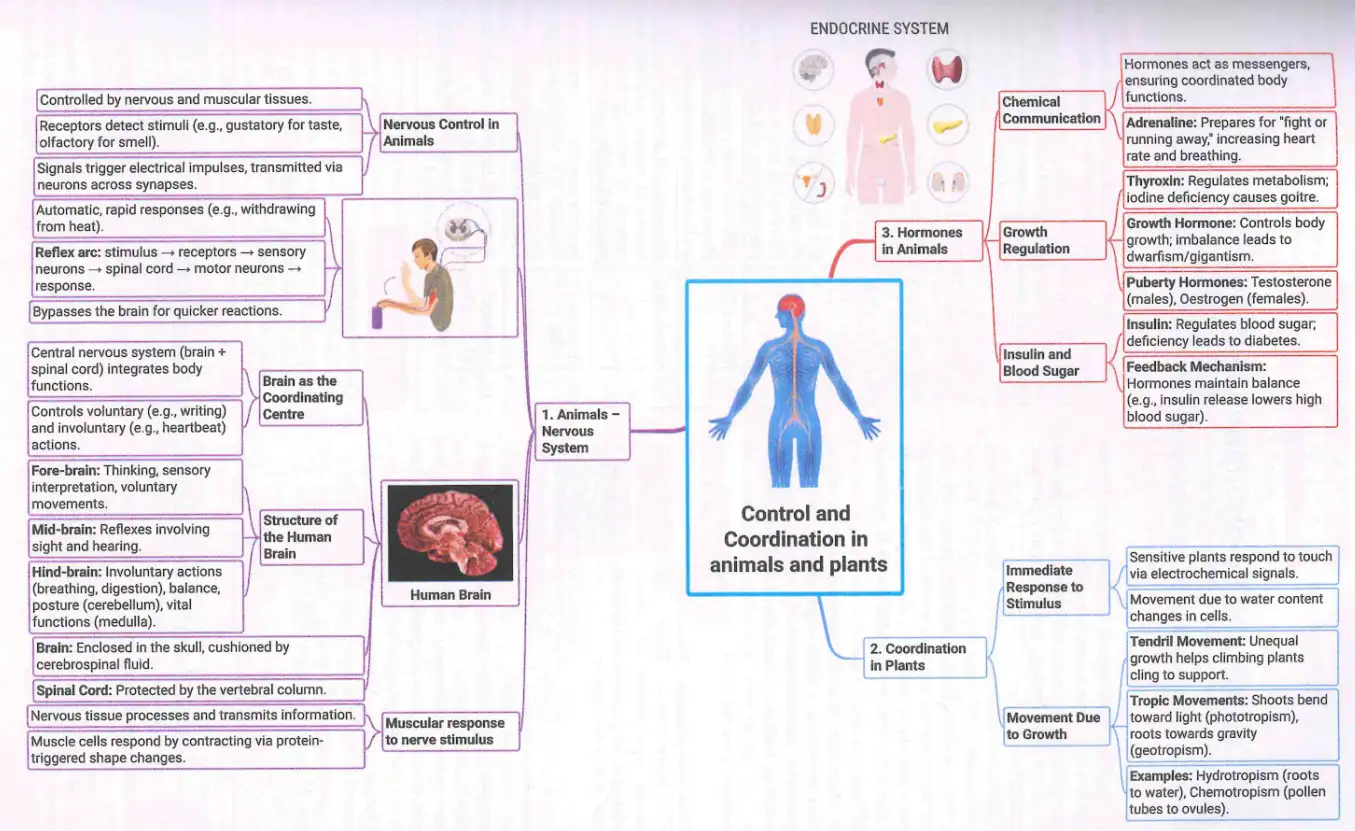
Control and Co-ordination in Plants
Introduction to Plant Responses
All living organisms respond and react to changes in their environment called stimuli, such as light, heat, cold, smell, and touch. Plants respond to stimuli differently from animals, mainly through movements of parts like shoots and roots rather than locomotion.
Tropic Movements
Tropic movements are directional growth responses of plant organs towards or away from external stimuli. Growth towards a stimulus is called positive tropism, while growth away is negative tropism.
Types of Tropic Movements
- Phototropism: Growth towards light; shoots are positively phototropic, roots negatively phototropic.
- Geotropism: Growth in response to gravity; roots grow downward (positive geotropism), shoots grow upward (negative geotropism).
- Chemotropism: Growth towards chemicals; for example, pollen tube growth towards ovules.
- Hydrotropism: Growth towards water; roots exhibit positive hydrotropism.
Growth-Independent Movements
These are non-directional movements caused by environmental changes, such as the folding of leaves in the 'Touch me not' plant when touched, known as seismonasty.
Plant Hormones (Phytohormones)
Plant hormones are natural chemical compounds produced in small amounts that regulate growth and physiological functions at sites distant from their production. They coordinate growth, development, and environmental responses.
Main Plant Hormones and Functions
- Auxins: Produced at shoot tips; promote cell elongation and guide growth towards light and gravity.
- Gibberellins: Promote stem elongation and seed germination.
- Cytokinins: Stimulate cell division, especially in fruits and seeds.
- Abscisic Acid: Acts as a stress hormone; inhibits growth, causes leaf wilting, and closes stomata.
- Ethylene: A gaseous hormone that promotes fruit ripening and leaf abscission.
Solved Examples
Example 1: Explain why shoots grow towards light while roots grow away from it.
Solution: Shoots exhibit positive phototropism, growing towards light to maximize photosynthesis. Roots show negative phototropism, growing away from light to anchor the plant and seek water and nutrients in the soil.
Example 2: Describe the role of auxins in phototropism.
Solution: Auxins accumulate on the shaded side of the shoot, causing cells there to elongate more than on the lighted side. This differential growth causes the shoot to bend towards the light.
Practice Set
- Level 1: What is phototropism?
- Level 2: How does abscisic acid help plants during stress?
- Level 3: Explain the difference between tropic and nastic movements with examples.
Answer Key
- Level 1: Phototropism is the growth movement of plant parts towards light.
- Level 2: Abscisic acid helps plants during stress by inhibiting growth, causing leaves to wilt, and closing stomata to reduce water loss.
- Level 3: Tropic movements are directional growth responses towards or away from stimuli (e.g., phototropism), while nastic movements are non-directional responses to stimuli (e.g., folding of 'Touch me not' leaves).
Control and Co-ordination in Animals
Nervous System Overview
The nervous system controls body activities by transmitting electrical impulses through a network of nerves and muscles. It receives stimuli via receptors and generates appropriate responses.
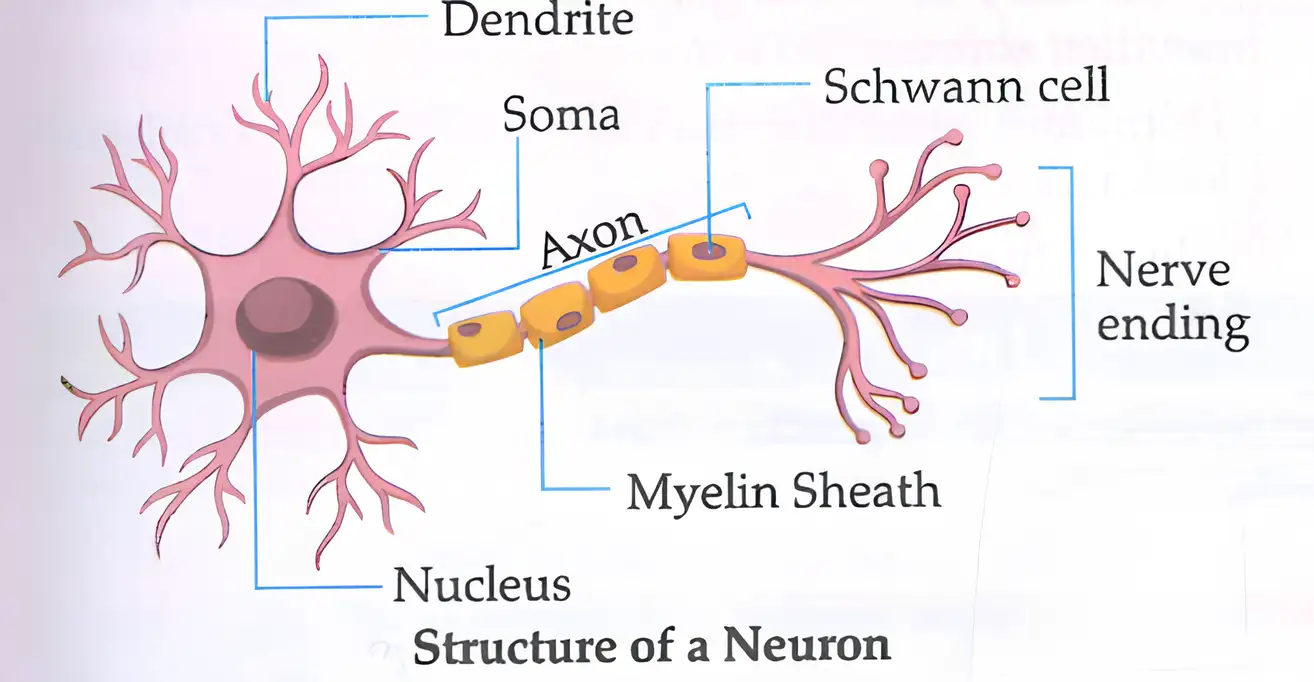
Neuron Structure
A neuron consists of:
- Cell Body (Cyton): Contains the nucleus and cytoplasm; processes information.
- Dendrites: Receive nerve impulses from other neurons.
- Axon: Long fiber transmitting impulses away from the cell body to other neurons or muscles.
- Myelin Sheath: Insulating layer around the axon that speeds up impulse transmission.
- Synapse: Junction between neurons where electrical signals convert to chemical signals for transmission.
Neuromuscular Junction
A chemical synapse between a motor neuron and a muscle fiber, enabling muscle contraction upon nerve stimulation.
Types of Neurons
- Sensory Neurons: Carry impulses from receptors to the brain or spinal cord.
- Motor Neurons: Transmit impulses from the brain or spinal cord to effectors like muscles and glands.
Nerve Impulse Transmission
Impulse travels from dendrites to cell body, then along the axon to nerve endings, crossing synapses chemically to the next neuron.
Voluntary and Involuntary Actions
- Voluntary Actions: Conscious actions controlled by the forebrain, e.g., speaking, writing.
- Involuntary Actions: Automatic actions controlled by midbrain and hindbrain, e.g., heartbeat, breathing.
Reflex Action and Reflex Arc
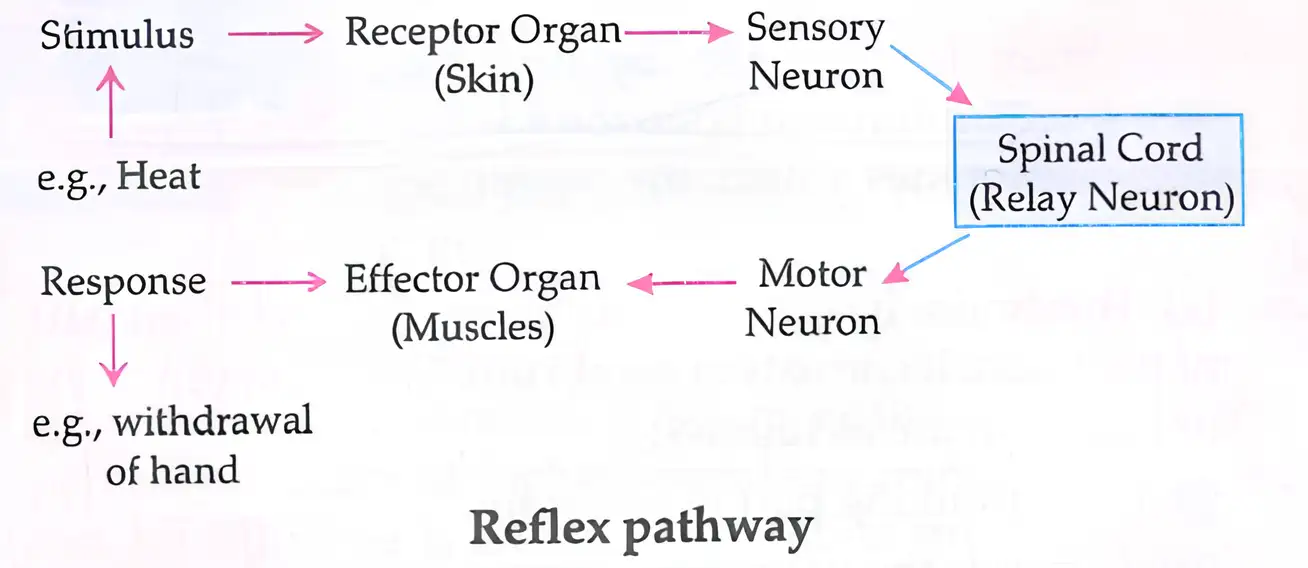
Reflex actions are rapid, automatic responses to stimuli that bypass the brain for quick reaction, controlled by the spinal cord.
The reflex arc pathway includes receptor → sensory neuron → spinal cord (relay neuron) → motor neuron → effector.
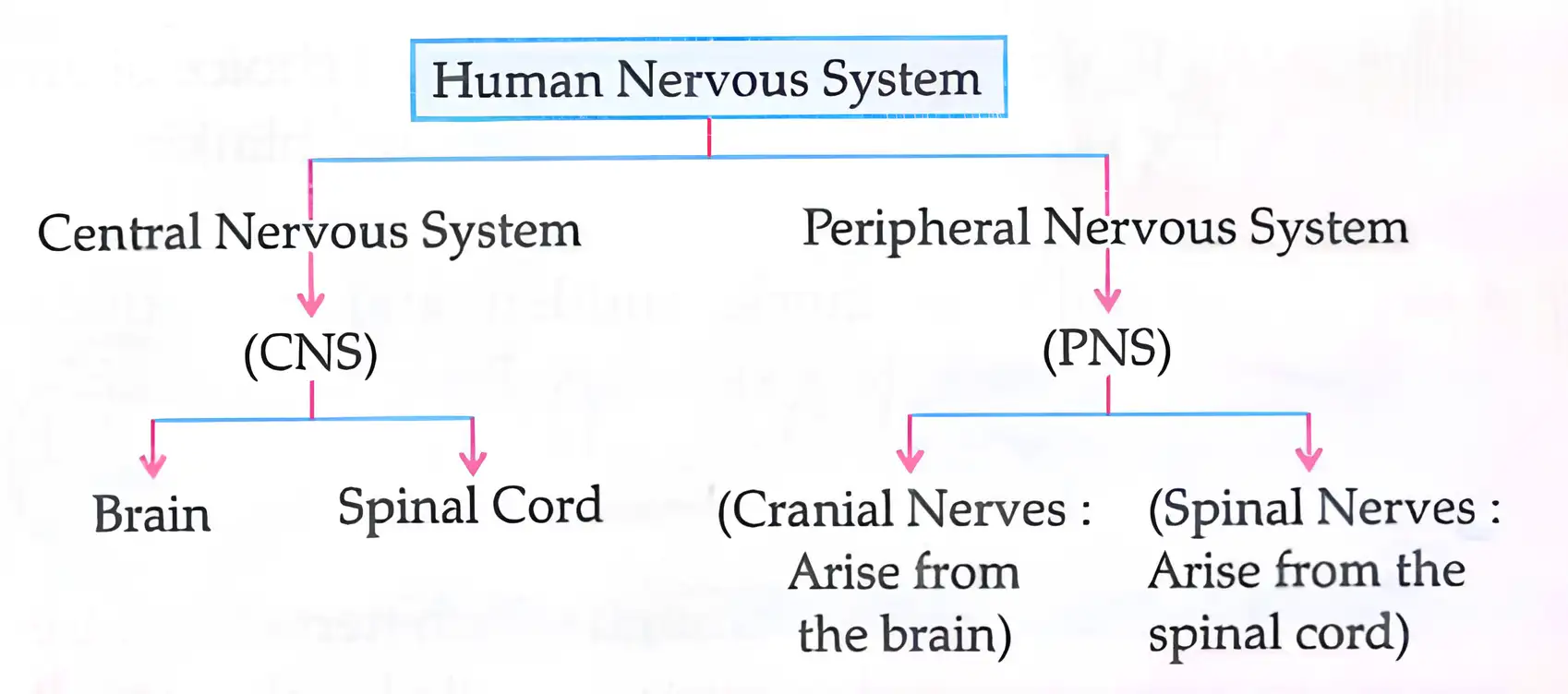
Human Nervous System
Divided into Central Nervous System (CNS) comprising brain and spinal cord, and Peripheral Nervous System (PNS) consisting of cranial and spinal nerves.
Brain Parts and Functions
- Forebrain: Contains cerebrum; controls voluntary actions, thinking, memory, and sensory processing.
- Midbrain: Controls involuntary actions.
- Hindbrain: Includes cerebellum (balance and posture), medulla (involuntary functions like heartbeat), and pons (respiration regulation).
Endocrine System
Comprises ductless glands that secrete hormones acting as chemical messengers to regulate body functions.
Major Endocrine Glands and Hormones
- Hypothalamus: Controls pituitary gland.
- Pituitary Gland: Produces growth hormone for cell growth.
- Thyroid Gland: Produces thyroxine regulating metabolism and calcium levels.
- Adrenal Gland: Produces adrenaline for stress response.
- Pancreas: Produces insulin and glucagon to regulate blood sugar.
- Testis: Produces male sex hormones.
- Ovary: Produces female sex hormones.
Hormonal Disorders
- Dwarfism: Caused by deficiency of growth hormone.
- Gigantism: Caused by excess growth hormone.
- Goitre: Caused by iodine deficiency affecting thyroxine production.
- Diabetes: Caused by insulin deficiency; treated with insulin injections.
Feedback Mechanism
Hormone levels are regulated by feedback loops to maintain balance. For example, high blood sugar triggers insulin release to lower it, and as sugar levels normalize, insulin secretion decreases.
Solved Examples
Example 1: Describe the pathway of a reflex action when touching a hot object.
Solution: The stimulus (heat) is detected by receptors in the skin. A sensory neuron carries the impulse to the spinal cord, where a relay neuron processes it. The motor neuron then sends an impulse to the muscles, causing the hand to withdraw quickly.
Example 2: What is the role of the myelin sheath in neurons?
Solution: The myelin sheath insulates the axon and increases the speed of electrical impulse transmission along the neuron.
Practice Set
- Level 1: What is a neuron?
- Level 2: Differentiate between voluntary and involuntary actions.
- Level 3: Explain the feedback mechanism in blood sugar regulation.
Answer Key
- Level 1: A neuron is a nerve cell that transmits electrical impulses in the nervous system.
- Level 2: Voluntary actions are conscious and controlled by the forebrain, while involuntary actions are automatic and controlled by midbrain and hindbrain.
- Level 3: When blood sugar rises, the pancreas secretes insulin to lower it. As sugar levels fall, insulin secretion decreases, maintaining balance.
Quick Reference Table
Nervous System
- Neuron: Basic unit of the nervous system transmitting electrical impulses.
- Reflex Arc: Pathway for rapid, automatic responses involving receptor, sensory neuron, spinal cord, motor neuron, and effector.
- Voluntary Actions: Conscious actions controlled by the forebrain.
- Involuntary Actions: Automatic actions controlled by midbrain and hindbrain.
Endocrine System
- Hormones: Chemical messengers secreted by ductless glands regulating body functions.
- Major Glands: Pituitary, thyroid, adrenal, pancreas, testis, ovary.
- Feedback Mechanism: Regulation of hormone secretion to maintain balance, e.g., insulin controlling blood sugar.
Plant Responses
- Tropic Movements: Directional growth responses to stimuli such as light (phototropism), gravity (geotropism), chemicals (chemotropism), and water (hydrotropism).
- Growth-Independent Movements: Non-directional movements like seismonasty (touch response).
- Plant Hormones: Auxins, gibberellins, cytokinins, abscisic acid, and ethylene regulate growth and development.
Common Mistakes and Misconceptions
• Confusing functions of different brain parts or hormones.
• Mixing reflex actions with voluntary nervous responses.
• Incorrectly labelling neuron parts, glands, and brain regions.
• Omitting components of reflex arcs, neurons, and endocrine glands in diagrams.
Glossary
Auxins: Plant hormones promoting cell elongation and growth towards stimuli.
Neuron: Nerve cell transmitting electrical impulses.
Reflex Arc: Neural pathway for rapid automatic responses.
Hormones: Chemical messengers regulating body functions.
Phototropism: Growth of plant parts towards light.
Endocrine Glands: Ductless glands secreting hormones.