CLASS 10 . SCIENCE . SCIENCE . CHEMICAL REACTIONS-AND-EQUATIONS
Chapter 1 : CHEMICAL REACTIONS AND EQUATIONS
Ch 1
SCIENCE
CLASS 10
Chemical Reactions
Definition and Characteristics
A chemical reaction is a process in which the original substance(s) loses its nature and identity and forms new substance(s) with different properties. This occurs due to breaking of chemical bonds and formation of new chemical bonds.
The substances that take part in a chemical reaction are called reactants, and the substances formed are called products.
Identification of Chemical Reactions
Chemical reactions can be identified by the following observations:
- Change in state (e.g., solid to liquid or gas)
- Change in colour
- Evolution of gas
- Change in temperature
- Formation of a precipitate (solid)
Examples of Characteristics
For example, burning candle wax changes state and colour; zinc reacting with sulfuric acid produces hydrogen gas; quicklime reacting with water produces heat; mixing sodium sulfate and barium chloride forms a white precipitate of barium sulfate.
Chemical Equations
Definition and Representation
A chemical equation is the symbolic representation of a chemical reaction using symbols and formulae. It concisely shows the reactants and products involved.
Word and Chemical Equations
Example of a word equation:
Magnesium + Oxygen → Magnesium oxide
This can be converted into a chemical equation:
2Mg + O₂ → 2MgO
Writing Chemical Equations
- Write symbols and formulae of reactants on the left side separated by plus (+) signs.
- Write symbols and formulae of products on the right side separated by plus (+) signs.
- Use an arrow (→) between reactants and products.
- Mention physical states of substances (solid, liquid, gas, aqueous) in brackets.
Skeletal and Balanced Equations
A skeletal chemical equation shows only the symbols and formulae of reactants and products without balancing.
Example: Mg + O₂ → MgO
A balanced chemical equation has equal numbers of atoms of each element on both sides, satisfying the Law of Conservation of Mass.
Example of balancing:
Unbalanced: Fe + H₂O → Fe₃O₄ + H₂
Balanced: 3Fe + 4H₂O → Fe₃O₄ + 4H₂
Types of Chemical Reactions
Combination Reaction
Two or more reactants combine to form a single product.
Examples:
- Burning of coal: C(s) + O₂(g) → CO₂(g)
- Formation of water: 2H₂(g) + O₂(g) → 2H₂O(l)
- Quicklime formation: CaO(s) + H₂O(l) → Ca(OH)₂(aq) + Heat
Exothermic Reactions
Reactions that release heat along with products.
Examples:
- Burning of natural gas: CH₄(g) + 2O₂(g) → CO₂(g) + 2H₂O(l) + Heat
- Respiration: C₆H₁₂O₆(s) + 6O₂(g) → 6CO₂(aq) + 6H₂O(l) + Energy
Decomposition Reaction
A compound splits into two or more simpler substances.
General form: A → B + C
Thermal Decomposition
Decomposition by heating.
Examples:
- Heating ferrous sulfate: FeSO₄·7H₂O (green) → Fe₂O₃ (red-brown) + SO₂ + SO₃
- Heating limestone: CaCO₃ → CaO + CO₂
Electrolytic Decomposition
Decomposition by passing electricity.
Example:
2H₂O(l) → 2H₂(g) + O₂(g)
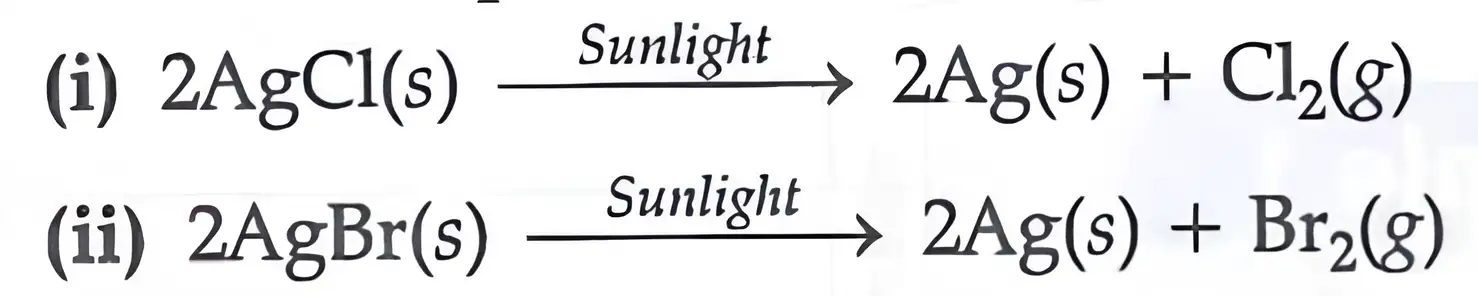
Photolytic Decomposition
Decomposition in presence of sunlight.
Examples:
- 2AgCl → 2Ag + Cl₂ (on exposure to sunlight)
- 2AgBr → 2Ag + Br₂ (on exposure to sunlight)
Endothermic Reaction
Reactions that require energy (heat, light, or electricity) to proceed.
Example:
NH₄Cl(s) + H₂O(l) → NH₄Cl(aq) − Heat
Displacement Reaction
A more reactive element displaces a less reactive element from its salt solution.
Examples:
- Fe + CuSO₄(aq) → FeSO₄(aq) + Cu
- Zn + CuSO₄(aq) → ZnSO₄(aq) + Cu
Double Displacement Reaction
Mutual exchange of ions between two compounds forming new compounds.
Example:
Na₂SO₄(aq) + BaCl₂(aq) → BaSO₄(s) + 2NaCl(aq)
The formation of BaSO₄ precipitate is called a precipitation reaction.
Oxidation and Reduction
Oxidation is the loss of electrons or gain of oxygen; reduction is the gain of electrons or loss of oxygen.
Example of oxidation:
2Cu + O₂ → 2CuO (with heat)
Example of reduction:
CuO + H₂ → Cu + H₂O
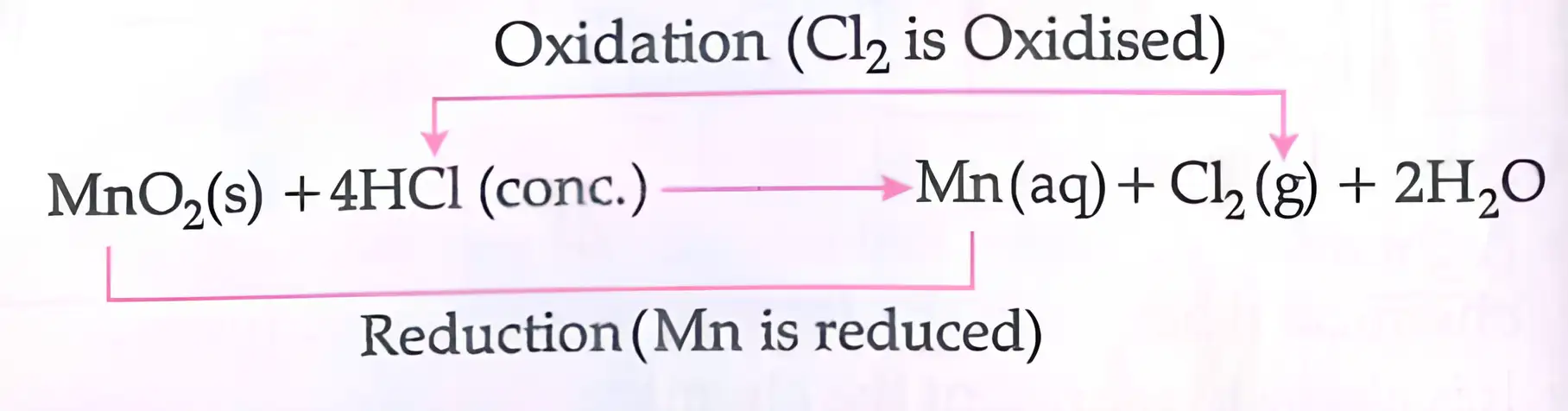
Redox Reaction
A reaction involving simultaneous oxidation and reduction.
Example:
MnO₂ + 4HCl → MnCl₂ + Cl₂ + 2H₂O
In this reaction, chlorine is oxidized and manganese is reduced.
Solved Examples
Example 1
Q. Balance the chemical equation: Fe + H₂O → Fe₃O₄ + H₂
Solution:
Step 1: Write unbalanced equation:
Fe + H₂O → Fe₃O₄ + H₂
Step 2: Count atoms on both sides:
- Fe: Left = 1, Right = 3
- H: Left = 2 (from H₂O), Right = 2 (from H₂)
- O: Left = 1, Right = 4
Step 3: Balance Fe by putting 3 in front of Fe:
3Fe + H₂O → Fe₃O₄ + H₂
Step 4: Balance O by putting 4 in front of H₂O:
3Fe + 4H₂O → Fe₃O₄ + H₂
Step 5: Balance H by putting 4 in front of H₂:
3Fe + 4H₂O → Fe₃O₄ + 4H₂
Balanced equation achieved.
Example 2
Q. Write the chemical equation for the formation of water from hydrogen and oxygen.
Solution:
Step 1: Write reactants and products:
Hydrogen + Oxygen → Water
Step 2: Write word equation:
Hydrogen + Oxygen → Water
Step 3: Write chemical symbols and formulae:
H₂ + O₂ → H₂O
Step 4: Balance the equation:
2H₂ + O₂ → 2H₂O
Balanced chemical equation.
Practice Set
Conceptual Questions
- Level 1: What is a chemical reaction? List two observations that indicate a chemical reaction has occurred.
- Level 2: Explain the difference between a skeletal chemical equation and a balanced chemical equation.
Application-based Question
- Level 3: Balance the following chemical equation and identify the type of reaction:
Al + HCl → AlCl₃ + H₂
Answer Key
Conceptual Questions
- Level 1: A chemical reaction is a process where substances change to form new substances with different properties. Observations include change in colour and evolution of gas.
- Level 2: A skeletal equation shows reactants and products without balancing atoms. A balanced equation has equal numbers of atoms of each element on both sides.
Application-based Question
- Level 3: Balanced equation: 2Al + 6HCl → 2AlCl₃ + 3H₂
Type: Displacement reaction (aluminium displaces hydrogen from hydrochloric acid).
Quick Reference Table
Chemical Reactions: Process where reactants form products with new properties.
Chemical Equation: Symbolic representation of a chemical reaction.
Types of Reactions:
- Combination: A + B → AB
- Decomposition: AB → A + B
- Displacement: A + BC → AC + B
- Double Displacement: AB + CD → AD + CB
- Exothermic: Releases heat
- Endothermic: Absorbs heat
- Redox: Simultaneous oxidation and reduction
Balancing Equations: Equal number of atoms on both sides to satisfy conservation of mass.
Common Mistakes and Misconceptions
- Confusing decomposition with double decomposition reactions.
- Not balancing chemical equations properly.
- Mixing up names of different types of reactions.
- Ignoring physical states in chemical equations.
Glossary
- Reactants: Substances that undergo change in a chemical reaction.
- Products: New substances formed after a chemical reaction.
- Precipitate: Insoluble solid formed in a solution during a reaction.
- Oxidation: Loss of electrons or gain of oxygen.
- Reduction: Gain of electrons or loss of oxygen.
- Redox Reaction: Reaction involving both oxidation and reduction.
- Exothermic Reaction: Reaction releasing heat.
- Endothermic Reaction: Reaction absorbing heat.