CLASS 10 . SCIENCE . SCIENCE . ACIDS BASES-AND-SALTS
Chapter 2 : ACIDS, BASES AND SALTS
Ch 2
SCIENCE
CLASS 10
Acids Bases Salts
Acids
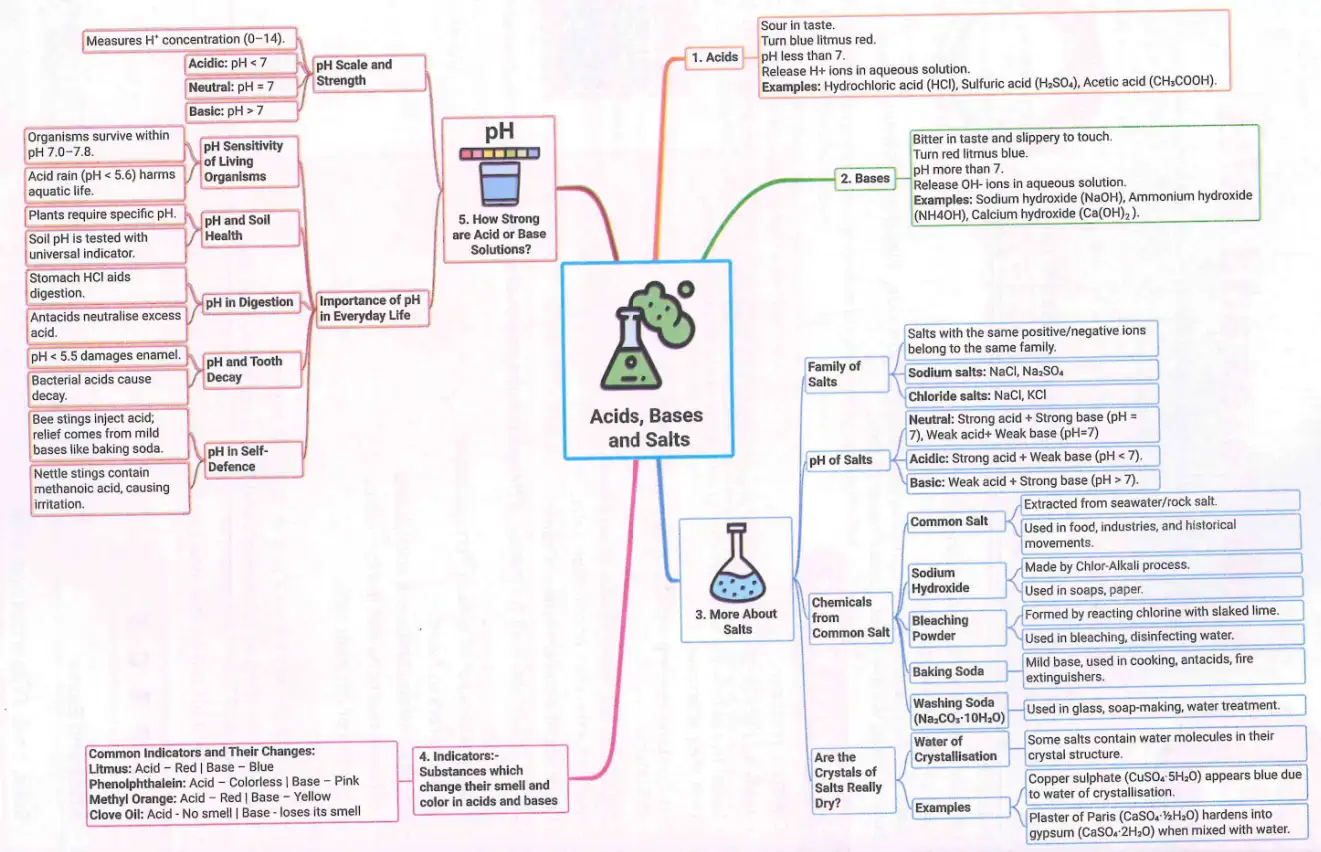
Acids are substances that release hydrogen ions (H⁺) in aqueous solutions. They have a sour taste and turn blue litmus paper red. Examples include sulphuric acid (H₂SO₄), acetic acid (CH₃COOH), and nitric acid (HNO₃). Acids can be dilute or concentrated depending on their concentration in water. Strong acids completely dissociate into ions, while weak acids partially dissociate.
Bases
Bases are substances that release hydroxide ions (OH⁻) in aqueous solutions. They have a bitter taste, feel soapy, and turn red litmus paper blue. Examples include sodium hydroxide (NaOH) and potassium hydroxide (KOH). Strong bases completely ionise in water, while weak bases partially ionise. Both acids and bases conduct electricity due to free ions.
Indicators
Indicators are substances that change colour or smell in acidic or basic solutions. Natural indicators include turmeric, litmus, and china rose. Synthetic indicators include methyl orange and phenolphthalein. Olfactory indicators like onion, clove oil, and vanilla extract change smell in acids and bases.
Chemical Properties
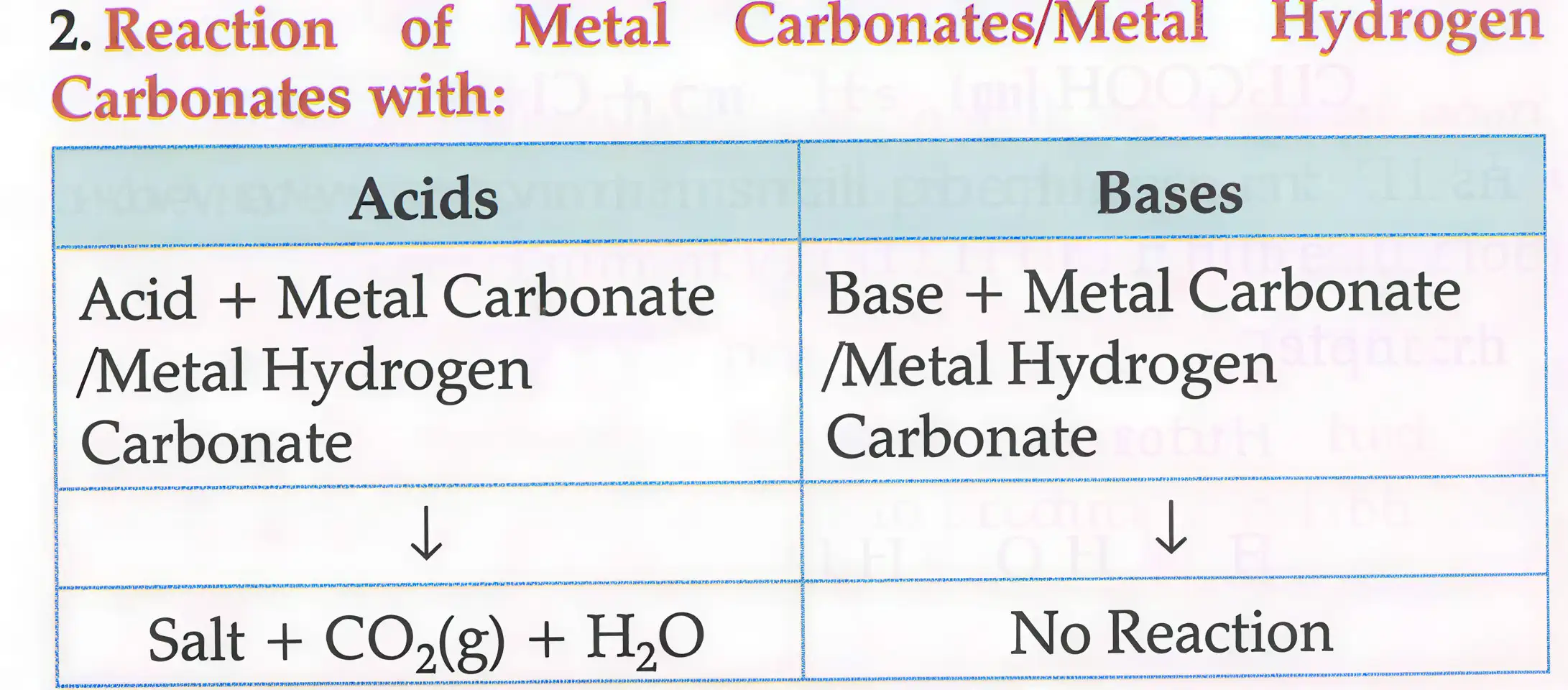
Acids react with metals to produce hydrogen gas and salts. Metal carbonates react with acids to produce salt, carbon dioxide, and water. Acids and bases neutralise each other to form salt and water. Metallic oxides react with acids to form salt and water, while non-metallic oxides react with bases similarly.
Dilution
Dilution of concentrated acids or bases is an exothermic process producing heat. It is important to add acid to water, not water to acid, to avoid violent reactions.
Strength of Acids and Bases
Strength depends on the degree of ionisation. Strong acids and bases completely ionise, while weak ones partially ionise.
pH Scale
pH measures hydrogen ion concentration on a scale from 0 to 14. Values below 7 are acidic, 7 is neutral, and above 7 are basic. pH is important for biological systems, soil health, and everyday life.
Salts
Salts are ionic compounds formed by neutralisation of acids and bases. They can be neutral, acidic, or basic depending on their pH. Common salts include sodium chloride, sodium hydroxide, bleaching powder, baking soda, washing soda, and plaster of Paris. Water of crystallisation refers to water molecules integrated into the crystal structure of salts.

Solved Examples
Example 1: Write the reaction of hydrochloric acid with sodium hydroxide and identify the products.
Solution:
Hydrochloric acid (HCl) reacts with sodium hydroxide (NaOH) as follows:
NaOH(aq) + HCl(aq) → NaCl(aq) + H₂O(l)
Products formed are sodium chloride (salt) and water.
Example 2: What happens when zinc reacts with hydrochloric acid?
Solution:
Zinc reacts with hydrochloric acid to produce zinc chloride and hydrogen gas:
Zn + 2HCl → ZnCl₂ + H₂↑
Hydrogen gas can be tested by bringing a burning candle near the gas bubbles; it produces a pop sound.
Example 3: Describe the reaction of sodium bicarbonate when heated.
Solution:
When sodium bicarbonate (NaHCO₃) is heated, it decomposes to form sodium carbonate, water, and carbon dioxide:
2NaHCO₃ → Na₂CO₃ + H₂O + CO₂↑
Carbon dioxide causes dough to rise in baking.
Practice Set
Conceptual Questions
- Level 1: What colour does blue litmus paper turn in an acidic solution?
- Level 2: Explain why acids conduct electricity in aqueous solutions.
Application-based Question
- Level 3: A metal carbonate reacts with hydrochloric acid to produce a gas that turns lime water milky. Identify the gas and write the chemical equation for the reaction.
Answer Key
Conceptual Questions
- Level 1: Blue litmus paper turns red in an acidic solution.
- Level 2: Acids conduct electricity because they dissociate into ions (H⁺ and anions) in aqueous solution, allowing electric current to flow.
Application-based Question
- Level 3: The gas is carbon dioxide (CO₂). The reaction is:
2HCl + Na₂CO₃ → 2NaCl + CO₂↑ + H₂O
Quick Reference Table
Acids: Release H⁺ ions, sour taste, turn blue litmus red.
Bases: Release OH⁻ ions, bitter taste, turn red litmus blue.
Indicators: Litmus, phenolphthalein, methyl orange, turmeric.
Neutralisation Reaction: Acid + Base → Salt + Water.
pH Scale: 0-6 acidic, 7 neutral, 8-14 basic.
Common Salts: NaCl (table salt), NaOH (caustic soda), CaOCl₂ (bleaching powder), NaHCO₃ (baking soda), Na₂CO₃·10H₂O (washing soda), CaSO₄·½H₂O (plaster of Paris).
Water of Crystallisation: Fixed water molecules in salt crystals, e.g., CuSO₄·5H₂O.
Common Mistakes and Misconceptions
- Confusing strong and weak acids or bases.
- Mixing up the reactions of acids with metals and metal carbonates.
- Assuming all salts are neutral; some are acidic or basic.
- Adding water to acid instead of acid to water during dilution.
Glossary
- Acid: Substance that produces H⁺ ions in water.
- Base: Substance that produces OH⁻ ions in water.
- Indicator: Substance that changes colour or smell in acids or bases.
- Neutralisation: Reaction between acid and base producing salt and water.
- pH: Scale measuring acidity or basicity of a solution.
- Salt: Ionic compound formed from acid-base reaction.
- Water of Crystallisation: Water molecules integrated into salt crystals.