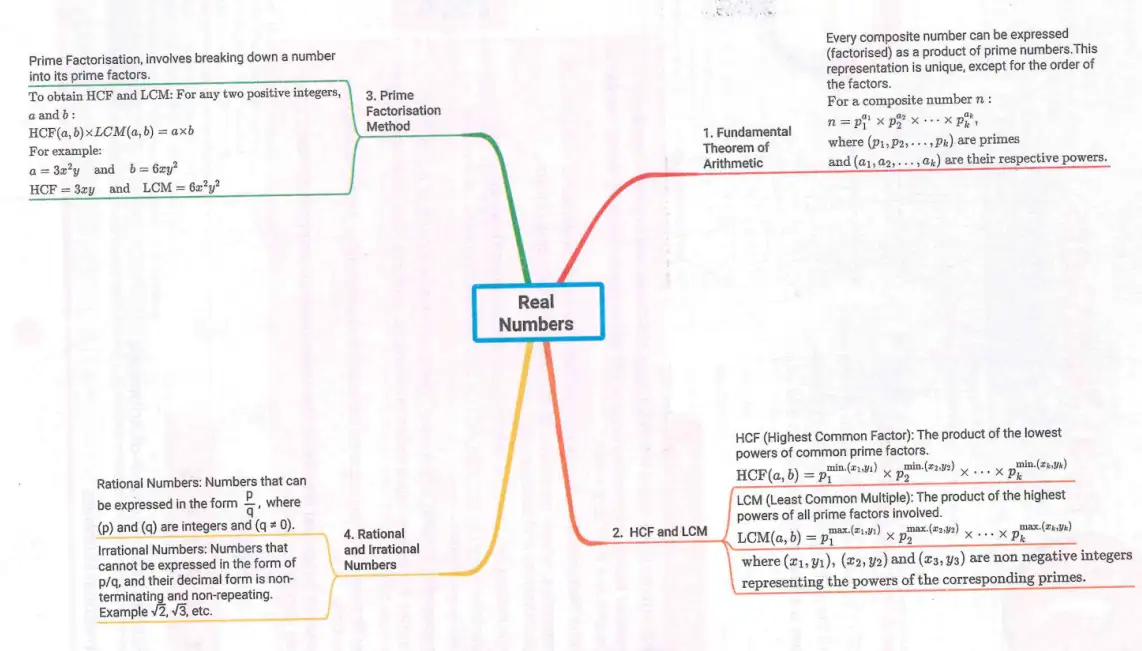
Fundamental Theorem of Arithmetic
The Fundamental Theorem of Arithmetic states that every composite number can be expressed as a product of prime numbers uniquely, except for the order of the factors. This is also known as the Unique Factorisation Theorem.
In other words, any integer greater than 1 is either a prime number or can be written as a unique product of prime numbers.
Formula Derivation and Explanation
Let \( n \) be a composite number. Then,
\[ n = p_1^{a_1} \times p_2^{a_2} \times \cdots \times p_k^{a_k} \]
where \( p_1, p_2, \ldots, p_k \) are prime numbers and \( a_1, a_2, \ldots, a_k \) are their respective powers.
Worked Illustration
Express 10,626 as a product of unique prime factors.
Solution:
Prime factorisation of 10,626 is:
\[ 10,626 = 2 \times 3 \times 7 \times 11 \times 23 \]
Prime Factorisation Method to find HCF and LCM
- Find all prime factors of the given numbers.
- HCF is the product of the smallest powers of all common prime factors.
- LCM is the product of the greatest powers of all prime factors involved.
Example
Find the HCF and LCM of 6 and 20 using prime factorisation.
Solution:
Prime factorisation of 6 = \( 2^1 \times 3^1 \)
Prime factorisation of 20 = \( 2^2 \times 5^1 \)
HCF(6, 20) = \( 2^1 = 2 \)
LCM(6, 20) = \( 2^2 \times 3^1 \times 5^1 = 4 \times 3 \times 5 = 60 \)
Practice Set
- Level 1 – Easy: Find the prime factorisation of 84.
- Level 2 – Moderate: Find the HCF and LCM of 36 and 48 using prime factorisation.
- Level 3 – Challenging: Find the HCF and LCM of 90, 150, and 210 using prime factorisation.
Answer Key
- Prime factorisation of 84 = \( 2^2 \times 3 \times 7 \)
- HCF(36, 48) = \( 12 \), LCM(36, 48) = \( 144 \)
- HCF(90, 150, 210) = \( 30 \), LCM(90, 150, 210) = \( 630 \)
Quick Reference
| Term | Definition |
|---|---|
| Composite Number | Integer greater than 1 with more than two factors. |
| Prime Number | Natural number greater than 1 with exactly two factors: 1 and itself. |
| HCF | Product of smallest powers of common prime factors. |
| LCM | Product of greatest powers of all prime factors. |
Glossary
- Prime Factorisation: Expressing a number as a product of prime numbers.
- HCF (Highest Common Factor): Largest factor common to two or more numbers.
- LCM (Least Common Multiple): Smallest multiple common to two or more numbers.
Irrational Numbers
An irrational number is a number that cannot be expressed as a fraction \( \frac{p}{q} \), where \( p \) and \( q \) are integers and \( q \neq 0 \). Examples include \( \sqrt{2} \), \( \sqrt{3} \), \( \pi \).
Properties
- If \( p \) is a prime number and divides \( a^2 \), then \( p \) divides \( a \).
- The sum or difference of a rational and an irrational number is irrational.
- The product or quotient of a non-zero rational and an irrational number is irrational.
Step-by-Step Proof: Irrationality of \( \sqrt{n} \)
Step 1: Assume \( \sqrt{n} \) is rational.
Then, \( \sqrt{n} = \frac{a}{b} \), where \( a, b \in \mathbb{Z} \), \( b \neq 0 \), and \( \gcd(a,b) = 1 \).
Step 2: Square both sides:
\[ n b^2 = a^2 \]
Step 3: Since \( a^2 \) is divisible by \( n \), \( a \) is divisible by \( n \). Let \( a = n p \), where \( p \in \mathbb{Z} \).
Step 4: Substitute back:
\[ (n p)^2 = n b^2 \Rightarrow n^2 p^2 = n b^2 \Rightarrow n p^2 = b^2 \]
Step 5: This implies \( b^2 \) is divisible by \( n \), so \( b \) is divisible by \( n \).
Step 6: Both \( a \) and \( b \) are divisible by \( n \), contradicting \( \gcd(a,b) = 1 \).
Step 7: Therefore, \( \sqrt{n} \) is irrational.
Example: Prove that \( \sqrt{2} \) is irrational.
Solution:
Assume \( \sqrt{2} = \frac{p}{q} \) in lowest terms.
Squaring both sides:
\[ 2 = \frac{p^2}{q^2} \Rightarrow 2 q^2 = p^2 \]
Since \( p^2 \) is even, \( p \) is even. Let \( p = 2r \).
Substitute back:
\[ 2 q^2 = (2r)^2 = 4 r^2 \Rightarrow q^2 = 2 r^2 \]
Thus, \( q^2 \) is even, so \( q \) is even.
Both \( p \) and \( q \) are even, contradicting the assumption that \( p/q \) is in lowest terms.
Hence, \( \sqrt{2} \) is irrational.
Practice Set
- Level 1 – Easy: Identify whether \( \sqrt{9} \) is rational or irrational.
- Level 2 – Moderate: Prove that \( \sqrt{3} \) is irrational.
- Level 3 – Challenging: Prove that \( \sqrt{5} \) is irrational using the step-by-step method.
Answer Key
- \( \sqrt{9} = 3 \), which is rational.
- Proof of irrationality of \( \sqrt{3} \) follows the same steps as \( \sqrt{2} \) with 3 replacing 2.
- Proof of irrationality of \( \sqrt{5} \) follows the same contradiction method assuming \( \sqrt{5} = \frac{a}{b} \).
Quick Reference
| Property | Description |
|---|---|
| Sum/Difference | Rational ± Irrational = Irrational |
| Product/Quotient | Non-zero Rational × Irrational = Irrational |
| Irrationality Proof | Assume rational, derive contradiction on co-primality. |
Glossary
- Irrational Number: Number not expressible as \( \frac{p}{q} \) with integers \( p, q \).
- Co-prime Numbers: Two numbers with no common prime factors.
- Prime Number: Number greater than 1 with exactly two factors.