CLASS 10 . MATHEMATICS . MATHEMATICS . QUADRATIC EQUATIONS
Chapter 4 : Quadratic Equations
Ch 4
MATHEMATICS
CLASS 10
Quadratic Equations
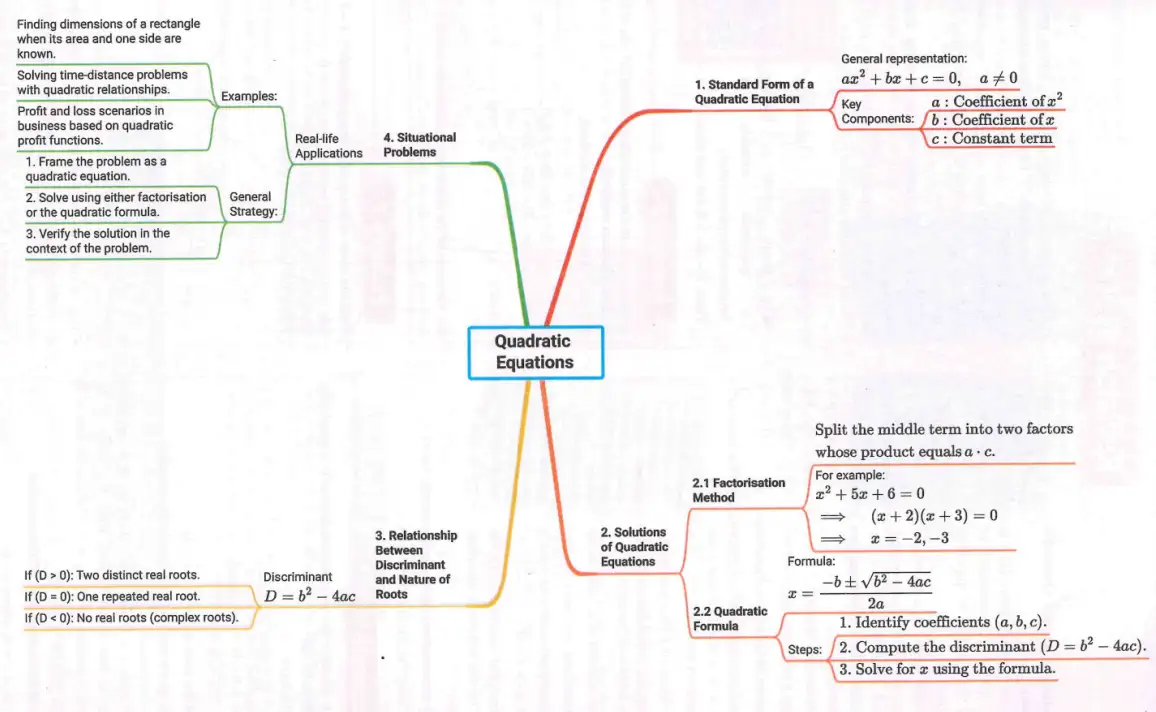
A quadratic equation is a polynomial equation of degree 2 in the variable \(x\), expressed in the standard form:
\[ ax^2 + bx + c = 0, \quad a \neq 0 \]
where \(a\), \(b\), and \(c\) are real numbers. The solutions or roots of this equation are the values of \(x\) that satisfy the equation.
Formula Derivation: Quadratic Formula
To find the roots of \(ax^2 + bx + c = 0\), we complete the square as follows:
Start with:
\[ ax^2 + bx + c = 0 \]
Divide both sides by \(a\) (since \(a \neq 0\)):
\[ x^2 + \frac{b}{a}x + \frac{c}{a} = 0 \]
Rearranged:
\[ x^2 + \frac{b}{a}x = -\frac{c}{a} \]
Add \(\left(\frac{b}{2a}\right)^2\) to both sides to complete the square:
\[ x^2 + \frac{b}{a}x + \left(\frac{b}{2a}\right)^2 = -\frac{c}{a} + \left(\frac{b}{2a}\right)^2 \]
Left side becomes a perfect square:
\[ \left(x + \frac{b}{2a}\right)^2 = \frac{b^2 - 4ac}{4a^2} \]
Taking square roots:
\[ x + \frac{b}{2a} = \pm \frac{\sqrt{b^2 - 4ac}}{2a} \]
Therefore,
\[ x = \frac{-b \pm \sqrt{b^2 - 4ac}}{2a} \]
Worked Illustrations and Solved Examples
Example 1: Check if \((x - 2)^2 + 1 = 2x - 3\) is a quadratic equation.
Solution:
Expand and simplify:
\[ (x - 2)^2 + 1 = 2x - 3 \]
\[ x^2 - 4x + 4 + 1 = 2x - 3 \]
\[ x^2 - 4x + 5 = 2x - 3 \]
Bring all terms to one side:
\[ x^2 - 4x + 5 - 2x + 3 = 0 \]
\[ x^2 - 6x + 8 = 0 \]
This is in the form \(ax^2 + bx + c = 0\) with \(a=1, b=-6, c=8\), so it is a quadratic equation.
Example 2: Find roots of \(2x^2 - 5x + 3 = 0\) by factorisation.
Solution:
Multiply \(a\) and \(c\): \(2 \times 3 = 6\).
Find two numbers whose product is 6 and sum is \(-5\): \(-2\) and \(-3\).
Rewrite middle term:
\[ 2x^2 - 2x - 3x + 3 = 0 \]
Group terms:
\[ 2x(x - 1) - 3(x - 1) = 0 \]
Factor:
\[ (2x - 3)(x - 1) = 0 \]
Set each factor to zero:
\[ 2x - 3 = 0 \Rightarrow x = \frac{3}{2} \]
\[ x - 1 = 0 \Rightarrow x = 1 \]
Roots are \(1\) and \(\frac{3}{2}\).
Example 3: Find roots of \(6x^2 - x - 2 = 0\) using quadratic formula.
Solution:
Identify coefficients: \(a=6, b=-1, c=-2\).
Calculate discriminant:
\[ D = b^2 - 4ac = (-1)^2 - 4(6)(-2) = 1 + 48 = 49 \]
Apply quadratic formula:
\[ x = \frac{-b \pm \sqrt{D}}{2a} = \frac{1 \pm 7}{12} \]
Roots:
\[ x = \frac{1 + 7}{12} = \frac{8}{12} = \frac{2}{3} \]
\[ x = \frac{1 - 7}{12} = \frac{-6}{12} = -\frac{1}{2} \]
Practice Set
- Level 1 – Easy
- Check if \(x^2 + 5x + 6 = 0\) is a quadratic equation.
- Find roots of \(x^2 - 7x + 10 = 0\) by factorisation.
- Find roots of \(x^2 + 4x + 4 = 0\) using quadratic formula.
- Level 2 – Moderate
- Find roots of \(3x^2 - 2x - 1 = 0\) using quadratic formula.
- Determine the nature of roots of \(2x^2 + 3x + 5 = 0\) using discriminant.
- Find roots of \(4x^2 - 12x + 9 = 0\) by factorisation.
- Level 3 – Challenging
- Find the roots of \(5x^2 + 6x + 1 = 0\) using quadratic formula and verify by factorisation.
- For the quadratic equation \(ax^2 + bx + c = 0\), prove that sum of roots is \(-\frac{b}{a}\) and product of roots is \(\frac{c}{a}\).
- Apply quadratic equations to solve: The area of a rectangle is 48 sq. units and its length is 3 units more than its width. Find the dimensions.
Answer Key
- Level 1
- Yes, it is quadratic with \(a=1, b=5, c=6\).
- Roots: \(x= -2, -3\).
- Roots: \(x= -2, -2\) (repeated root).
- Level 2
- Roots: \(x=1, -\frac{1}{3}\).
- Discriminant \(D = 3^2 - 4(2)(5) = 9 - 40 = -31 < 0\), no real roots.
- Roots: \(x= \frac{3}{2}, \frac{3}{2}\) (repeated root).
- Level 3
- Quadratic formula roots: \(x= -\frac{1}{5}, -1\). Factorisation: \((5x + 1)(x + 1) = 0\) roots match.
- Proof:
- Sum of roots \(\alpha + \beta = -\frac{b}{a}\) from quadratic formula.
- Product of roots \(\alpha \beta = \frac{c}{a}\).
- Let width = \(x\), length = \(x + 3\).
Area equation: \(x(x + 3) = 48\)
\(x^2 + 3x - 48 = 0\)
Using quadratic formula:
\[ x = \frac{-3 \pm \sqrt{9 + 192}}{2} = \frac{-3 \pm 15}{2} \]
Positive root: \(x = 6\), length = \(9\).
Quick Reference
| Concept | Formula/Result |
|---|---|
| Standard form | \(ax^2 + bx + c = 0, a \neq 0\) |
| Quadratic formula | \(x = \frac{-b \pm \sqrt{b^2 - 4ac}}{2a}\) |
| Discriminant | \(D = b^2 - 4ac\) |
| Nature of roots | \(D > 0\): two distinct real roots \(D = 0\): two equal real roots \(D < 0\): no real roots |
| Sum of roots | \(-\frac{b}{a}\) |
| Product of roots | \(\frac{c}{a}\) |
Glossary
- Quadratic Equation: Polynomial equation of degree 2.
- Roots/Solutions: Values of \(x\) satisfying the quadratic equation.
- Discriminant: Expression \(b^2 - 4ac\) determining nature of roots.
- Factorisation: Expressing quadratic as product of two linear factors.
- Quadratic Formula: Formula to find roots of quadratic equations.
- Sum of Roots: Sum of the solutions of the quadratic equation.
- Product of Roots: Product of the solutions of the quadratic equation.