Understanding Solutions: Composition, Types, and Properties
Fundamentals of Solutions and Their Components
Defining Solutions and Their Uniform Nature
A solution is a uniform mixture formed by combining two or more substances where the particles are extremely small, typically less than 1 nanometer in size. This microscopic scale ensures that the mixture appears as a single phase without any visible separation.
For instance, when sugar dissolves in water or salt is mixed with water, the resulting solution is consistent throughout. This homogeneity explains why a soft drink tastes the same from the first sip to the last.
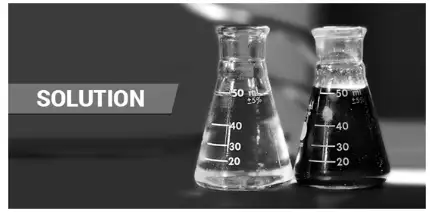
This image shows two glass beakers, one containing a clear liquid and the other a dark liquid. The label "SOLUTION" suggests these liquids are chemical solutions. Step-by-step explanation for high school students: 1. A solution is a mixture where one substance dissolves evenly in another. 2. The clear liquid could be a solvent, often water. 3. The dark liquid is likely the solvent with a dissolved substance, creating the solution. 4. Solutions are uniform, meaning the dissolved particles are evenly spread and not visible separately. 5. Scientists use beakers like these to mix and study solutions in the lab.
Example Problem
Consider a solution where 15 grams of salt is dissolved in 85 grams of water. Determine whether this mixture qualifies as a solution based on particle size and homogeneity.
Solution:
Since salt dissolves completely in water forming a uniform phase with particle sizes less than 1 nm, this mixture is indeed a solution. The salt particles are evenly distributed and not visible, confirming the homogeneous nature.
Components of Solutions: Solvent and Solute Explained
Understanding the Roles of Solvent and Solute
Every solution consists of two main parts: the solvent and the solute. The solvent is the substance present in the larger amount and acts as the medium in which the solute dissolves. The solute is the substance that gets dissolved.
Both solvent and solute can exist in any physical state—solid, liquid, or gas. For example, air is a gaseous solution where nitrogen acts as the solvent and oxygen as the solute. In sugar syrup, water is the solvent and sugar is the solute.
Example Problem
In a solution made by dissolving 20 grams of iodine in 100 grams of alcohol, identify the solvent and solute.
Solution:
Alcohol is present in the larger quantity, so it is the solvent.
Iodine, being dissolved, is the solute.
This confirms the roles of solvent and solute in the solution.
Classification and Characteristics of Different Solutions
Types of Solutions Based on Physical States
Solutions can be classified according to the physical states of their solute and solvent. Since both can be solid, liquid, or gas, there are nine possible combinations. The most common are liquid solutions, such as sugar dissolved in water, but solid and gaseous solutions also exist, like alloys and air respectively.
Additionally, solutions are categorized as aqueous if water is the solvent, and non-aqueous if another solvent is used.
Example Problem
Classify the following solution: carbon dioxide dissolved in water.
Solution:
Solute: carbon dioxide (gas)
Solvent: water (liquid)
Therefore, this is a gaseous solute in a liquid solvent, a type of liquid solution.
Key Properties That Define Solutions
Solutions exhibit several distinctive properties:
They are homogeneous mixtures with uniform composition.
Particle sizes are extremely small, less than 1 nanometer, making them invisible to the naked eye.
Solutions do not scatter light beams, so the path of light is not visible when passed through.
Solutes do not settle out or separate by filtration, indicating stability.
Example Problem
Explain why a solution of sugar in water does not scatter light and why the sugar does not settle at the bottom.
Solution:
The sugar particles are dissolved at a molecular level, with sizes less than 1 nm, so they do not scatter light.
Because the sugar is uniformly distributed and dissolved, it remains stable and does not settle out.
Measuring and Understanding Solution Concentration
Concept of Concentration and Its Calculation
The concentration of a solution quantifies the amount of solute present relative to the solvent or the entire solution. It indicates how diluted or concentrated a solution is.
Concentration can be expressed as:
\[ \text{Concentration} = \frac{\text{Mass of solute}}{\text{Mass of solution}} \]
or alternatively,
\[ \text{Concentration} = \frac{\text{Mass of solute}}{\text{Mass of solvent}} \]
Example Problem
A solution contains 25 grams of salt dissolved in 175 grams of water. Calculate the concentration of salt in the solution by mass.
Solution:
Total mass of solution = 25 g + 175 g = 200 g
Concentration by mass = \(\frac{25 \text{ g}}{200 \text{ g}} = 0.125\) or 12.5%
Summary Table: Quick Reference on Solutions
Aspect | Details |
|---|---|
Definition | Homogeneous mixture with particle size < 1 nm |
Solvent | Substance present in larger amount, dissolves solute |
Solute | Substance dissolved in solvent |
Types of Solutions | Solid, Liquid, Gas (based on states of solute and solvent) |
Properties | Homogeneous, stable, no light scattering, no sedimentation |
Concentration Formula | \(\displaystyle \frac{\text{Mass of solute}}{\text{Mass of solution or solvent}}\) |
Glossary of Key Terms
Term | Meaning |
|---|---|
Solution | A uniform mixture of two or more substances with particle size less than 1 nm |
Solvent | The component in a solution present in the largest amount that dissolves the solute |
Solute | The substance dissolved in the solvent |
Homogeneous Mixture | A mixture with uniform composition throughout |
Heterogeneous Mixture | A mixture with non-uniform composition |
Concentration | Amount of solute present per unit amount of solution or solvent |
Aqueous Solution | Solution where water is the solvent |
Non-Aqueous Solution | Solution with a solvent other than water |
Particle Size | Size of solute particles in a solution, typically less than 1 nanometer |
Stable Solution | A solution where solute particles do not settle or separate |
Frequently Asked Questions (FAQs)
What factors influence the properties of a solution?
The properties depend on the total number of dissolved particles, not their chemical nature. Colligative properties like boiling point elevation and osmotic pressure are examples.
What are the main categories of solutions?
Solutions are mainly classified as solid, liquid, or gaseous based on the states of solute and solvent.
Which component is present in the largest amount in a solution?
The solvent is the component present in the greatest quantity, while the solute is present in smaller amounts.
How are solutions classified based on the solvent?
They are classified as aqueous if water is the solvent, and non-aqueous if another solvent is used.
Why should concentrated solutions not be heated excessively?
Excessive heating can increase concentration further, making the solution more potent and harder to handle safely.