Understanding Relative Density and Its Applications
Fundamentals of Density and Its Measurement
Concept and Practical Demonstration of Density
Density quantifies how much mass is contained within a specific volume of a material. Each substance exhibits a unique density, which influences how it behaves when combined with others. To visualize this, consider an experiment using a tall transparent glass, honey, water tinted with food coloring, and coconut oil.
Begin by pouring one-quarter cup of honey into the glass. Next, carefully add one-quarter cup of colored water on top of the honey layer. Finally, gently pour one-quarter cup of coconut oil above the water. Observe how the liquids form distinct layers without mixing.
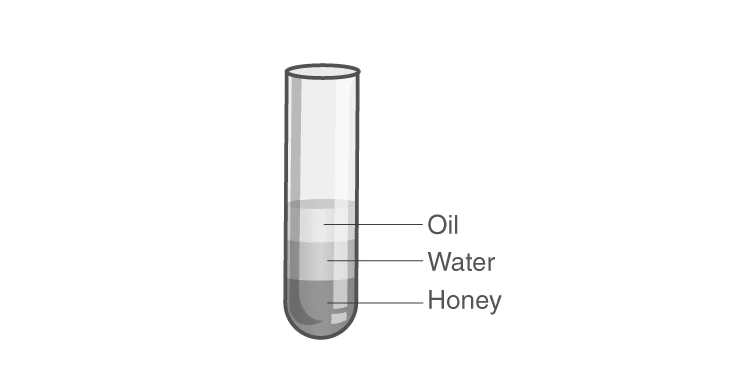
Layering of liquids based on their relative densities
This layering occurs because each liquid has a different density. Heavier liquids, like honey, settle at the bottom, while lighter ones, such as coconut oil, float on top. This experiment clearly illustrates how density affects the position of substances when combined.
Example Problem
A container holds three immiscible liquids: syrup with density \(1.35 \text{ g/cm}^3\), water with density \(1.00 \text{ g/cm}^3\), and vegetable oil with density \(0.92 \text{ g/cm}^3\). If equal volumes of each liquid are poured into a glass, in what order will they arrange themselves from bottom to top?
Solution:
The liquid with the highest density will settle at the bottom, and the one with the lowest density will float on top.
Given densities:
Syrup: \(1.35 \text{ g/cm}^3\)
Water: \(1.00 \text{ g/cm}^3\)
Vegetable oil: \(0.92 \text{ g/cm}^3\)
Therefore, the order from bottom to top is:
Syrup → Water → Vegetable oil
Exploring Relative Density and Its Significance
Definition and Interpretation of Relative Density
Relative density, also known as specific gravity, compares the density of a substance to that of a reference material, typically water at room temperature and pressure. Since water has a density of \(1 \text{ g/cm}^3\), the relative density of any substance is calculated as the ratio of its density to that of water.
For example, if honey has a density of approximately \(1.42 \text{ g/cm}^3\), its relative density is:
\[ \text{Relative Density} = \frac{1.42 \text{ g/cm}^3}{1.00 \text{ g/cm}^3} = 1.42 \]
Since relative density is a ratio of two densities, it is a dimensionless quantity and has no units. This property helps determine whether a substance will float or sink in water: substances with relative density less than 1 float, while those with relative density greater than 1 sink.
To deepen understanding, consider a set of liquids with varying relative densities. Your task is to calculate their relative densities with respect to rubbing alcohol instead of water, which requires adjusting the reference density accordingly.
Example Calculation
Given the densities of three liquids: glycerin \(1.26 \text{ g/cm}^3\), rubbing alcohol \(0.79 \text{ g/cm}^3\), and kerosene \(0.81 \text{ g/cm}^3\), find the relative density of glycerin and kerosene with respect to rubbing alcohol.
Solution:
Relative density is calculated as:
\[ \text{Relative Density} = \frac{\text{Density of substance}}{\text{Density of reference}} \]
For glycerin:
\[ \frac{1.26}{0.79} \approx 1.59 \]
For kerosene:
\[ \frac{0.81}{0.79} \approx 1.03 \]
Thus, glycerin is about 1.59 times denser than rubbing alcohol, and kerosene is slightly denser at 1.03 times.
Archimedes’ Principle and Its Practical Uses
Understanding the Buoyant Force on Submerged Objects
Archimedes’ principle states that any object, whether fully or partially submerged in a fluid, experiences an upward buoyant force equal to the weight of the fluid it displaces. This fundamental concept explains why objects float or sink and is widely applied in various fields.
This principle is instrumental in determining the purity of metals like gold, designing ships to ensure they float safely, and in devices such as lactometers that assess milk quality by measuring its density.
Example Application
A metal cube with a volume of \(0.05 \text{ m}^3\) is submerged in water. Calculate the buoyant force acting on the cube. (Density of water = \(1000 \text{ kg/m}^3\), acceleration due to gravity \(g = 9.8 \text{ m/s}^2\))
Solution:
The buoyant force \(F_b\) is equal to the weight of the displaced fluid:
\[ F_b = \rho_{\text{fluid}} \times V \times g \]
Substituting the values:
\[ F_b = 1000 \text{ kg/m}^3 \times 0.05 \text{ m}^3 \times 9.8 \text{ m/s}^2 = 490 \text{ N} \]
Therefore, the cube experiences an upward buoyant force of 490 newtons.
Quick Reference Summary
Term | Definition | Unit | Key Point |
|---|---|---|---|
Density | Mass per unit volume of a substance | \(\text{g/cm}^3\) or \(\text{kg/m}^3\) | Varies for each material |
Relative Density | Ratio of density of substance to density of water | Dimensionless | Indicates if substance floats or sinks |
Archimedes’ Principle | Buoyant force equals weight of displaced fluid | Newtons (N) | Explains flotation and buoyancy |
Specific Gravity | Another term for relative density | Dimensionless | Used interchangeably with relative density |
Buoyant Force | Upward force on submerged object | Newtons (N) | Depends on fluid displaced |
Glossary of Key Terms
Term | Meaning |
|---|---|
Density | Mass per unit volume of a substance |
Relative Density | Ratio of a substance's density to that of water |
Specific Gravity | Another name for relative density |
Buoyant Force | Upward force exerted by a fluid on a submerged object |
Archimedes’ Principle | Principle stating buoyant force equals weight of displaced fluid |
Mass | Amount of matter in an object |
Volume | Space occupied by an object |
Fluid | Substance that can flow, like liquids and gases |
Immiscible | Liquids that do not mix together |
Purity | Measure of how free a substance is from impurities |
Frequently Asked Questions
Why does relative density have no units?
Relative density is a ratio of two densities measured in the same units, so the units cancel out, making it a dimensionless quantity.
Is the relative density of a material always constant?
Relative density can vary slightly with temperature and pressure changes, but it is generally considered constant under standard conditions.
How does density differ from relative density?
Density is the mass per unit volume of a substance with units, while relative density is the ratio of a substance's density to that of water and has no units.
What is the standard unit used to express density?
Density is commonly expressed in grams per cubic centimeter (\(\text{g/cm}^3\)) or kilograms per cubic meter (\(\text{kg/m}^3\)).
At what temperature does water reach its maximum density?
Water attains its maximum density at approximately \(4^\circ \text{C}\).