Understanding Bohr’s Atomic Model and Its Implications
Fundamentals of Bohr’s Atomic Structure
Conceptualizing Electron Orbits and Energy Levels
In 1915, Niels Bohr refined the atomic model by introducing the idea that electrons orbit the nucleus in specific, fixed paths called shells or orbitals. Unlike earlier models where electrons could be anywhere around the nucleus, Bohr proposed that these orbits have distinct energy values and electrons cannot exist between them. This concept explained the stability of atoms and the discrete nature of atomic spectra.
Bohr’s model builds upon Rutherford’s nuclear atom, which identified a dense, positively charged nucleus surrounded by electrons. Bohr added that electrons revolve in circular orbits with quantized energies, preventing them from spiraling into the nucleus.
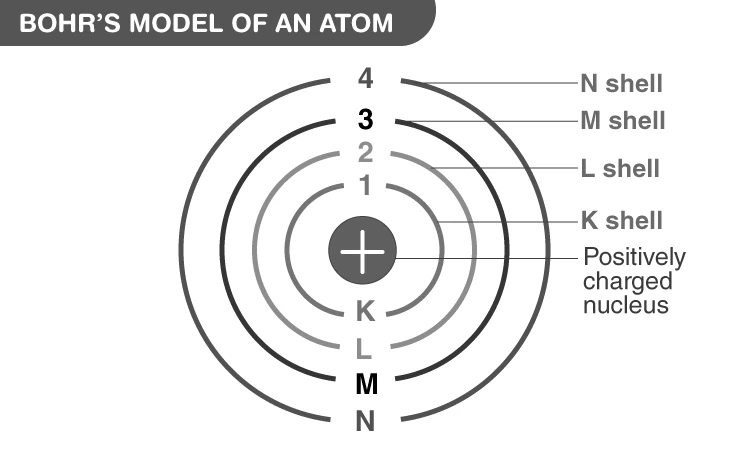
Illustration of Bohr’s Atomic Model
Example: Calculating Energy Difference Between Electron Orbits
Consider an electron transitioning from the third orbit (\(n=3\)) to the first orbit (\(n=1\)) in a hydrogen-like atom. The energy of an electron in the \(n^{th}\) orbit is given by:
\[ E_n = -\frac{13.6}{n^2} \text{ eV} \]
Calculate the energy released during this transition.
Solution:
Energy at \(n=3\): \(E_3 = -\frac{13.6}{3^2} = -\frac{13.6}{9} = -1.51 \text{ eV}\)
Energy at \(n=1\): \(E_1 = -\frac{13.6}{1^2} = -13.6 \text{ eV}\)
Energy released = \(E_1 - E_3 = -13.6 - (-1.51) = -13.6 + 1.51 = -12.09 \text{ eV}\)
The negative sign indicates energy is emitted as the electron moves to a lower energy level.
Key Principles Underlying Bohr’s Atomic Theory
Postulates Defining Electron Behavior and Energy Quantization
Bohr’s atomic model is based on several fundamental postulates:
Electrons revolve around the nucleus in fixed circular orbits without radiating energy.
Each orbit corresponds to a specific energy level, denoted by the principal quantum number \(n = 1, 2, 3, \ldots\).
The orbits are labeled as K, L, M, N shells corresponding to \(n=1, 2, 3, 4\) respectively, with the innermost orbit having the lowest energy.
Electrons can jump between these energy levels by absorbing or emitting energy equal to the difference between the initial and final orbits.
An electron in the lowest energy orbit is said to be in the ground state; higher orbits correspond to excited states.
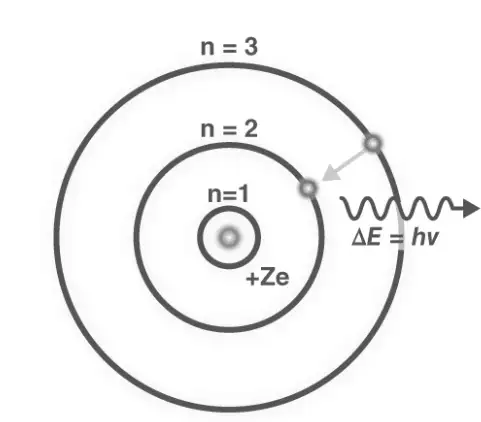
This image shows a simplified Bohr model of an atom with three energy levels (n=1, n=2, n=3). When an electron moves from a higher energy level (n=3) to a lower energy level (n=2), it releases energy as light (a photon), shown by the wave and the equation \(\Delta E = h\nu\). Step-by-step explanation for high school students: 1. Electrons orbit the nucleus in fixed paths called energy levels. 2. These energy levels are labeled n = 1 (closest to the nucleus), n = 2, n = 3, and so on. 3. When an electron drops from a higher level (like n=3) to a lower one (like n=2), it loses energy. 4. The lost energy is emitted as light in the form of a photon, which has energy \( \Delta E = h \nu \) (where \(h\) is Planck’s constant and \(\nu\) is the light’s frequency). 5. This explains how atoms emit specific colors of light.
Example: Energy Required to Excite an Electron
An electron in the first orbit (\(n=1\)) of a hydrogen atom absorbs energy and jumps to the fourth orbit (\(n=4\)). Calculate the energy absorbed.
Solution:
Energy at \(n=1\): \(E_1 = -13.6 \text{ eV}\)
Energy at \(n=4\): \(E_4 = -\frac{13.6}{4^2} = -\frac{13.6}{16} = -0.85 \text{ eV}\)
Energy absorbed = \(E_4 - E_1 = -0.85 - (-13.6) = 12.75 \text{ eV}\)
This energy corresponds to the photon absorbed to excite the electron.
Limitations and Scope of Bohr’s Atomic Framework
Challenges and Extensions Beyond the Original Model
While Bohr’s model successfully explained the hydrogen atom’s spectral lines, it has several shortcomings:
It cannot account for the splitting of spectral lines observed in magnetic fields (Zeeman Effect) or electric fields (Stark Effect).
The model contradicts the Heisenberg Uncertainty Principle, which states that the exact position and momentum of an electron cannot be simultaneously known.
Bohr’s theory fails to accurately describe atoms with more than one electron or complex atomic spectra.
Later refinements, such as the Sommerfeld model, introduced elliptical orbits to address some inconsistencies but still had limitations.
Example: Applicability of Bohr’s Model to Ions
Determine if Bohr’s model can be applied to the lithium ion \( \text{Li}^{2+} \), which has only one electron.
Answer:
Bohr’s model is valid for hydrogen-like species with a single electron.
\( \text{Li}^{2+} \) has only one electron orbiting the nucleus, similar to hydrogen.
Therefore, Bohr’s theory can be applied to \( \text{Li}^{2+} \) to predict energy levels and spectral lines.
Quick Reference: Bohr’s Atomic Model Summary
Aspect | Description |
|---|---|
Electron Orbits | Fixed circular paths with quantized energies |
Energy Levels | Represented by quantum number \(n = 1, 2, 3, \ldots\) |
Shell Labels | K, L, M, N corresponding to \(n=1, 2, 3, 4\) |
Ground State | Electron in the lowest energy orbit (\(n=1\)) |
Excited State | Electron in any orbit with \(n > 1\) |
Energy Transitions | Electrons absorb or emit energy when moving between orbits |
Limitations | Fails for multi-electron atoms, Zeeman and Stark effects, and violates uncertainty principle |
Applicable Systems | Hydrogen-like atoms and ions with a single electron (e.g., \( \text{Li}^{2+} \)) |
Glossary of Key Terms
Term | Definition |
|---|---|
Atom | Smallest unit of matter consisting of a nucleus and electrons |
Bohr Model | Atomic model with electrons in fixed circular orbits around nucleus |
Energy Level | Discrete energy associated with an electron’s orbit |
Quantum Number (n) | Integer representing the energy level or shell number |
Ground State | Lowest energy state of an electron in an atom |
Excited State | Higher energy state when electron moves to outer orbit |
Zeeman Effect | Splitting of spectral lines in a magnetic field |
Stark Effect | Splitting of spectral lines in an electric field |
Heisenberg Uncertainty Principle | Principle stating position and momentum cannot be simultaneously known |
Hydrogen-like Atom | Atom or ion with only one electron orbiting the nucleus |
Frequently Asked Questions
How do electrons behave in Bohr’s atomic model?
Electrons revolve around the nucleus in fixed circular orbits with specific energies and cannot exist between these orbits.
What discovery did Bohr make about electron arrangement?
Bohr identified that electrons occupy distinct energy levels and that an element’s chemical properties depend on the number of electrons in its outermost orbit.
Does Bohr’s model include neutrons in the nucleus?
Yes, the nucleus contains protons and neutrons, which hold most of the atom’s mass, while electrons orbit the positively charged nucleus.
How was Bohr’s model improved by Sommerfeld?
Sommerfeld extended Bohr’s model by proposing elliptical orbits for electrons instead of only circular ones, addressing some spectral anomalies.
Who originally discovered the electron?
J. J. Thomson discovered the electron in 1897 while investigating cathode rays.