Understanding Archimedes’ Principle and Its Applications
Fundamentals of Buoyant Force in Fluids
Conceptualizing the Buoyant Force
When an object is placed in a fluid, it experiences an upward force exerted by the fluid, known as the buoyant force. This force counteracts the object's weight, making it seem lighter when submerged. The magnitude of this force corresponds exactly to the weight of the fluid displaced by the object. This phenomenon is the essence of Archimedes’ principle, which explains why objects appear to lose weight in liquids.
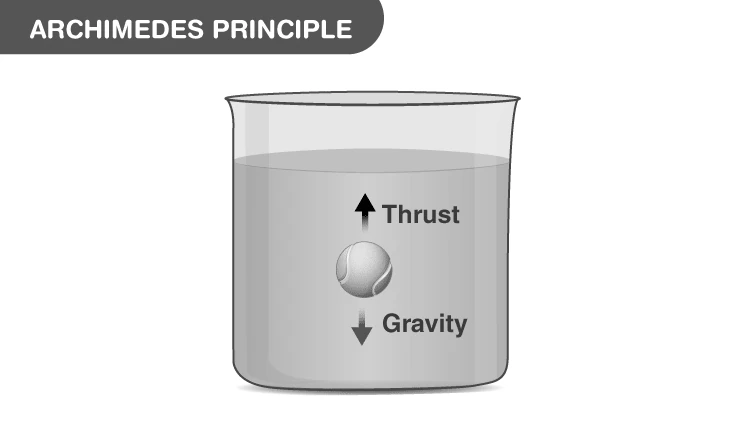
Diagram illustrating the buoyant force acting on a submerged object
The apparent weight of the object submerged in the fluid is calculated by subtracting the buoyant force from its actual weight in air:
Apparent weight = Weight in air − Buoyant force
This principle clarifies why objects feel lighter underwater and is fundamental to understanding fluid mechanics.
Example Problem
A brass sphere with a radius of 5 cm is fully immersed in water. Calculate the buoyant force acting on it. (Density of water = 1000 kg/m³, g = 9.8 m/s²)
Solution:
Given radius \( r = 0.05 \text{ m} \)
Volume of sphere,
\[ V = \frac{4}{3} \pi r^3 = \frac{4}{3} \pi (0.05)^3 = 5.24 \times 10^{-4} \text{ m}^3 \]
Using Archimedes’ principle, buoyant force \( F_b \) is:
\[ F_b = \rho \times g \times V = 1000 \times 9.8 \times 5.24 \times 10^{-4} = 5.14 \text{ N} \]
Therefore, the buoyant force on the brass sphere is 5.14 N.
Mathematical Expression and Derivation of Archimedes’ Principle
Formulating the Buoyant Force
The buoyant force exerted on an object submerged in a fluid is directly proportional to the weight of the fluid displaced. This relationship is expressed as:
\[ F_b = \rho \times g \times V \]
where \( F_b \) is the buoyant force, \( \rho \) is the fluid's density, \( g \) is the acceleration due to gravity, and \( V \) is the volume of fluid displaced by the object.
Deriving the Principle from Fluid Properties
Density is defined as mass per unit volume:
\[ \rho = \frac{m}{V} \]
Rearranging, the mass of the displaced fluid is:
\[ m = \rho \times V \]
The weight of this displaced fluid is then:
\[ W = m \times g = \rho \times V \times g \]
According to Archimedes’ principle, the buoyant force equals this weight, confirming the formula for \( F_b \).
Example Problem
A wooden block with volume 0.002 m³ is submerged in water. Calculate the buoyant force acting on it. (Density of water = 1000 kg/m³, g = 9.8 m/s²)
Solution:
Given volume \( V = 0.002 \text{ m}^3 \)
Buoyant force,
\[ F_b = \rho \times g \times V = 1000 \times 9.8 \times 0.002 = 19.6 \text{ N} \]
The buoyant force on the wooden block is 19.6 N.
Practical Demonstrations and Real-World Uses
Experimental Verification of Archimedes’ Principle
To observe Archimedes’ principle in action, fill a container to the brim with water. Measure the weight of a solid object using a spring balance. Then, submerge the object fully in the water without immersing the balance itself and note the new reading. The difference in weight readings corresponds to the buoyant force. Collecting and weighing the displaced water confirms that its weight equals the apparent loss in the object's weight.
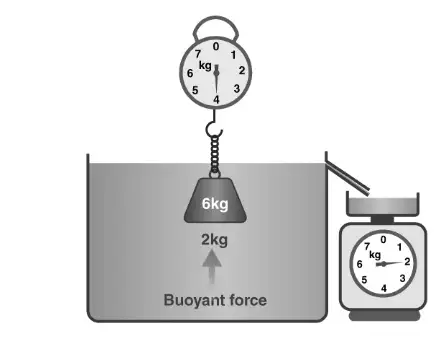
This image shows a 6 kg weight hanging from a spring scale while submerged in water, which reads 4 kg. Next to it, a regular scale shows the actual weight of the object as 6 kg. The image also illustrates the buoyant force of 2 kg acting upward on the object. Step-by-step explanation: 1. The weight of the object in air is 6 kg, shown by the regular scale. 2. When the object is submerged in water, it experiences an upward force called the buoyant force. 3. The spring scale measures the apparent weight, which is less than the actual weight because of this buoyant force. 4. The spring scale reads 4 kg because the buoyant force reduces the weight by 2 kg. 5. The buoyant force equals the weight of the displaced water, shown as 2 kg upward.
Applications in Technology and Daily Life
Archimedes’ principle is foundational in various technologies:
Submarines: Equipped with ballast tanks, submarines adjust their buoyancy by controlling water intake, allowing them to submerge or surface by balancing their weight against the buoyant force.
Hot-Air Balloons: These balloons rise or descend by changing the density of the air inside, affecting the buoyant force relative to the surrounding atmosphere.
Hydrometers: Instruments that measure the relative density of liquids by floating at different levels depending on the liquid's density.
Example Problem
A floating object is submerged 90% in water. If the density of water is 1000 kg/m³, estimate the density of the object.
Solution:
Let the volume of the object be \( V_b \) and the volume submerged be \( V = 0.9 V_b \).
Using Archimedes’ principle:
\[ V_b \times \rho_b \times g = V \times \rho \times g \]
Substituting \( V = 0.9 V_b \):
\[ V_b \times \rho_b = 0.9 V_b \times \rho \implies \rho_b = 0.9 \times \rho = 0.9 \times 1000 = 900 \text{ kg/m}^3 \]
The density of the object is 900 kg/m³.
Summary Table for Quick Review
Concept | Definition/Formula | Units |
|---|---|---|
Buoyant Force (\(F_b\)) | \( F_b = \rho \times g \times V \) | Newtons (N) |
Density (\(\rho\)) | Mass/Volume | kg/m³ |
Volume of Sphere | \( V = \frac{4}{3} \pi r^3 \) | m³ |
Apparent Weight | Weight in air − Buoyant force | Newtons (N) |
Relative Density | Density of object / Density of fluid | Dimensionless |
Key Terms and Definitions
Term | Meaning |
|---|---|
Archimedes’ Principle | The upward buoyant force on a submerged object equals the weight of the displaced fluid. |
Buoyant Force | The upward force exerted by a fluid opposing the weight of an immersed object. |
Apparent Weight | The reduced weight of an object when submerged in a fluid due to buoyancy. |
Density | Mass per unit volume of a substance. |
Displaced Fluid | The volume of fluid pushed aside by an immersed object. |
Relative Density | Ratio of the density of a substance to the density of a reference substance (usually water). |
Volume | Amount of space occupied by an object or fluid. |
Gravity (g) | Acceleration due to Earth's gravity, approximately 9.8 m/s². |
Ballast Tank | A compartment in submarines used to control buoyancy by filling with water or air. |
Hydrometer | An instrument for measuring the relative density of liquids based on buoyancy. |
Frequently Asked Questions
What is the core statement of Archimedes’ principle?
An object submerged in a fluid experiences an upward buoyant force equal to the weight of the fluid it displaces.
Who was the discoverer of this principle?
The principle was discovered by the ancient Greek mathematician Archimedes of Syracuse.
How does Archimedes’ principle explain why ships float?
A ship floats because it displaces a volume of water whose weight equals the ship’s weight, balancing the forces and preventing sinking.
In which devices is Archimedes’ principle applied?
It is used in designing submarines, hot-air balloons, and hydrometers, among other applications.
How can Archimedes’ principle help determine an object's density?
By measuring the buoyant force and volume displaced, one can calculate the object's density using the relationship between weight, volume, and fluid density.