Understanding Number Lines and Their Applications
Visualizing Numbers on a Straight Line
Concept and Purpose of a Number Line
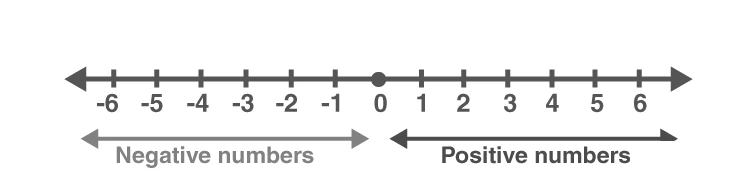
A number line is a straight horizontal line used to graphically display numbers in order. It serves as a fundamental tool to compare, order, and locate numbers, including all real numbers such as whole numbers, natural numbers, integers, fractions, and decimals. The line extends infinitely in both directions, with zero positioned at the center.
Positive numbers are placed to the right of zero, while negative numbers lie to the left. This arrangement helps in understanding the relative size of numbers; for instance, any number to the left is smaller than those to its right.
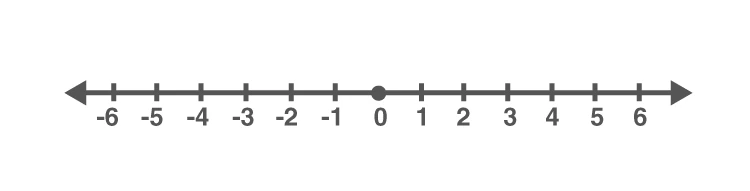
Solution: On the number line, -3 is located three units to the left of zero, and 2 is two units to the right. Since numbers increase as we move right, 2 is greater than -3.
Locating and Comparing Numbers on the Number Line
Positioning Various Types of Numbers
To effectively use a number line, one must understand how to place different numbers. Zero acts as the midpoint. Natural numbers and whole numbers are positioned to the right, increasing in value as you move further right. Negative numbers are placed to the left, decreasing in value as you move further left.
This visual representation simplifies comparing numbers: any number to the left is smaller than those to the right. Fractions and decimals can also be accurately placed between integers.
Solution: On the number line, \( \frac{3}{4} = 0.75 \) is to the right of 0.6, so \( \frac{3}{4} \) is greater than 0.6.
Performing Arithmetic Using Number Lines
Adding Positive Values
When adding two positive numbers, start at the first number on the number line and move to the right by the value of the second number. The result is always positive and located to the right of the starting point.
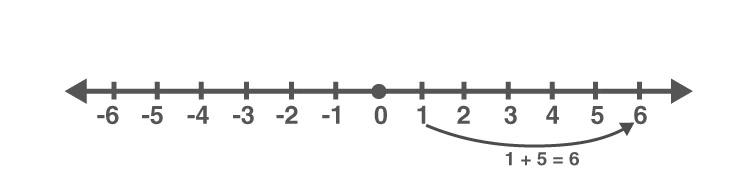
Solution: Begin at 3, then move 7 units to the right. The final position is at 10, so \( 3 + 7 = 10 \).
Adding Negative Values
When adding two negative numbers, start at the first negative number and move left by the value of the second number. The sum remains negative and lies further left on the number line.
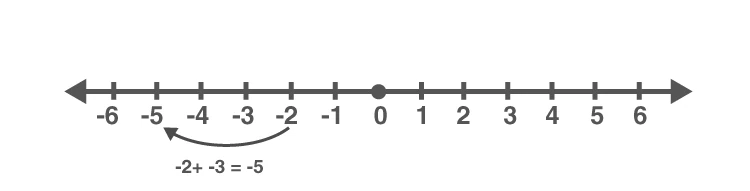
Solution: Start at -4, move 6 units left to reach -10. Thus, \( -4 + (-6) = -10 \).
Subtracting Positive Numbers
To subtract a positive number, begin at the first number and move left by the value of the second number. This movement decreases the value on the number line.
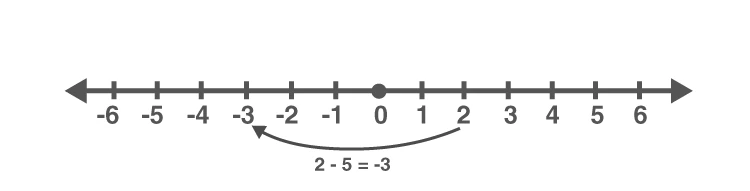
Solution: Start at 6, move 9 units left to reach -3. So, \( 6 - 9 = -3 \).
Subtracting Negative Numbers
Subtracting a negative number involves moving to the right on the number line by the magnitude of the second number, effectively increasing the value.
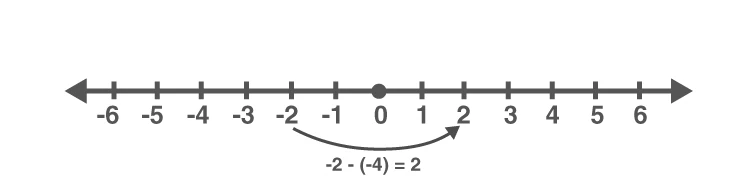
Solution: Start at -3, move 5 units right to reach 2. Therefore, \( -3 - (-5) = 2 \).
Summary of Number Line Concepts
| Concept | Key Points |
|---|---|
| Number Line Definition | A horizontal line representing numbers in order with zero at the center. |
| Positive Numbers | Located to the right of zero; values increase moving right. |
| Negative Numbers | Located to the left of zero; values decrease moving left. |
| Addition of Positives | Move right on the number line by the second number's value. |
| Addition of Negatives | Move left on the number line by the second number's value. |
| Subtraction of Positives | Move left on the number line by the second number's value. |
| Subtraction of Negatives | Move right on the number line by the second number's value. |
| Comparing Numbers | Numbers to the right are always greater than those to the left. |
| Representation | Integers, fractions, and decimals can all be placed on the number line. |
| Infinite Extension | The number line extends indefinitely in both directions. |
Glossary of Key Terms
| Term | Definition |
|---|---|
| Number Line | A straight line on which numbers are marked at equal intervals. |
| Zero | The central point on the number line separating positive and negative numbers. |
| Positive Numbers | Numbers greater than zero, located to the right on the number line. |
| Negative Numbers | Numbers less than zero, located to the left on the number line. |
| Whole Numbers | All natural numbers including zero. |
| Natural Numbers | Counting numbers starting from 1 upwards. |
| Integer | All whole numbers including their negative counterparts and zero. |
| Fraction | A number representing part of a whole, expressed as a ratio. |
| Decimal | A number expressed in the base-10 system, including fractional parts. |
| Arithmetic Operations | Basic mathematical operations such as addition and subtraction. |
Frequently Asked Questions
What is the purpose of a number line?
A number line helps visualize numbers in order, making it easier to compare, add, and subtract them.
How do positive and negative numbers differ on a number line?
Positive numbers are placed to the right of zero, increasing in value, while negative numbers are to the left, decreasing in value.
Why is zero placed in the center of the number line?
Zero acts as the neutral point separating positive and negative numbers, serving as a reference for positioning all other numbers.
Can fractions and decimals be represented on a number line?
Yes, fractions and decimals can be accurately placed between integers on the number line.
How does subtraction of a negative number work on the number line?
Subtracting a negative number means moving to the right on the number line by the magnitude of that number, effectively increasing the value.